



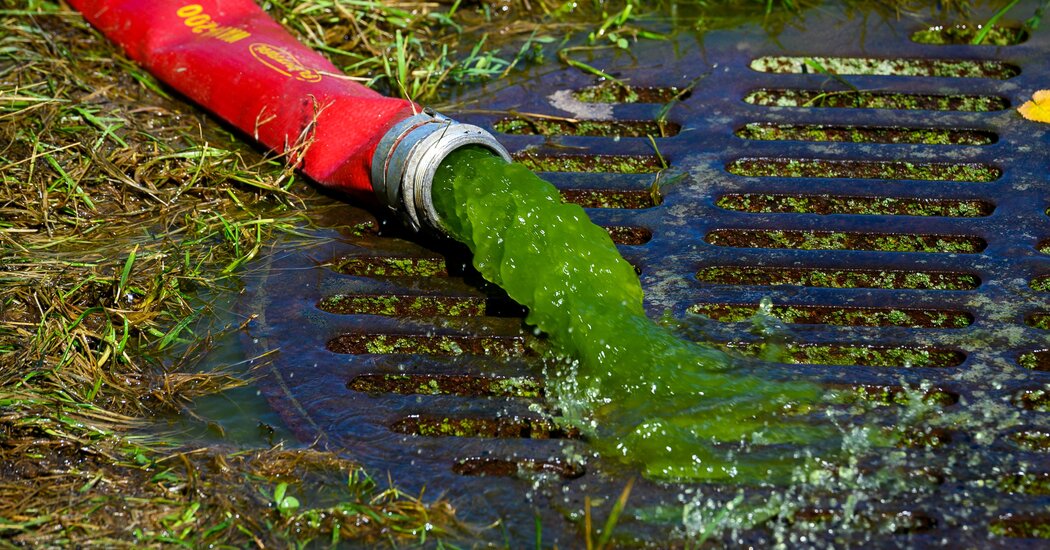
A respected historian once confided in me a theory that would prove chillingly prophetic: that the pressures and scale of the American presidency would not alter Donald Trump, but would rather distill his complex character to its absolute, unadulterated essence. Today, looking out over the landscape of our fractured federal capital, we can see exactly what that essence is. It is not the grand, enduring vision of the founding fathers, but rather an unrelenting, suffocating entity—much like the trillions of microscopic, slimy organisms currently choking the life out of the historic Reflecting Pool in front of the Lincoln Memorial. The president had loudly promised to grace this hallowed site with a brilliant, “American flag blue” sheen, a superficial veneer of patriotism applied directly to the concrete. Instead, nature responded with a stubborn, stinking rebellion of toxic green algae, leaving ugly, vibrant streaks that mar the $14 million restoration of this iconic water mirror. This ecological disaster serves as a perfect, living metaphor for our unreflective leader, whose impulsive, deeply solipsistic style of governing values immediate optic victories over sustainable reality. As a local schoolteacher gazing at the ruined pool with her bewildered middle school students aptly remarked, any basic biologist could have predicted that treating a living, breathing ecosystem with such arrogant disregard would result in this exact kind of putrid catastrophe. Here, on the very grounds where Marian Anderson sang her defiant anthems of equality and Martin Luther King Jr. shook the conscience of a nation with his “I Have a Dream” speech, we are left to contemplate a leader who cannot even manage the pool that reflects their legacy.
The official response to this public embarrassment highlights the surreal blend of aggressive propaganda and defensive spin that characterizes the modern executive branch. Under the scorching, humid summer sun, underpaid National Park Service workers in heavy rubber waders were left to battle the muck, sweating profusely as they used vacuums to suck up carpets of dead algae from the bottom of the pool. Rather than addressing the scientific failure of their hasty paint job with humility, the Department of the Interior weaponized the moment on social media. In a bizarre post that read like a parody of authoritarian state media, they claimed a total victory over the toxic blooms while taking an unsolicited, petty swipe at the previous administration to appease their boss. They boasted that their advanced “nanobubbler” technology had successfully eradicated the algae that had plagued every reopening since 1922, “most infamously Obama’s reopening.” In an astonishing leap of bellicose rhetoric, the post compared the vacuumed sludge resting at the bottom of the pool to the “destroyed Iranian Navy resting on the bottom of the Persian Gulf.” This hyper-aggressive posturing, however, was as hollow as it was premature. The desperate application of hydrogen peroxide to kill the stubborn algae backfired spectacularly; the harsh chemicals began to blister and peel away the very “American flag blue” paint that the president had so proudly ordered to be spread across the concrete floor. It is a striking microcosm of his entire geopolitical strategy: a cycle of brash, unilateral actions followed by catastrophic failures, covered up by aggressive gaslighting and vulgar comparisons that ultimately erode the physical and institutional foundations of the nation.
To paint an entirely one-dimensional portrait of this presidency, however, would be to ignore a genuine, albeit deeply flawed, impulse that originally resonated with a frustrated American electorate. For many decades, Washington D.C. had allowed some of its most magnificent and historically significant civic spaces to slowly rot under the weight of bureaucratic neglect and civic apathy. Decades ago, my own mother, then an ambitious young woman working for a metropolitan bond company, would make a daily pilgrimage to Meridian Hill Park in Columbia Heights on her long walk home from work, finding solace in its gorgeous Italian Renaissance design. Yet, in the intervening years, that beautiful park grew dry, cracked, and desperately shabby; its cascading fountain—the longest and most ambitious water feature of its kind in North America—stood silent and completely devoid of water for nearly seven long years. Channeling the raw, impatient energy of his legendary 1980s triumph in rebuilding the Wollman skating rink in Central Park, Trump looked at these dry fountains and crumbling monuments with the eye of an aggressive, old-school New York developer. He swept aside the endless committees, demanded the faucets be turned back on, cleared out the accumulated debris, and restored physical beauty to Meridian Hill Park and the grand fountains of Union Station. This visceral demonstration of executive will—the belief that a leader should be able to simply order a broken thing to be fixed and have it done—appeals to a very human, deeply rooted desire to see our country build grand, beautiful things once again.
But this occasional talent for cosmetic restoration is constantly overshadowed by a destructive, unbridled ego that treats public heritage as personal real estate. When left to his own devices without the checking power of democratic institutions or local expertise, the president’s architectural desires turn into a series of gaudy, historical desecrations. In his mind, the elegant, classical proportions of Washington—originally inspired by the sweeping, balanced avenues of Paris—are merely empty canvases waiting to be stamped with his personal brand of gold-plated, oversized luxury. He has proposed constructing an enormous, heavy ballroom on public land, dreamed of an egotistical “Arc de Trump” to dwarf existing monuments, and authorized a tacky, resort-style patio that effectively ruined the understated elegance of Jacqueline Kennedy’s historic Rose Garden. More alarmingly, his administration initiated a chaotic renovation of the John F. Kennedy Center for the Performing Arts, a project so poorly planned and legally dubious that a federal judge had to step in to halt the destruction. The physical manifestation of this failure was left on display for all to see: a giant, striped construction wrap draped over the building’s facade where workers had clumsily started to erase and replace names, leaving only the words “The John” on one side and “forming” on the other. He even set his sights on Hains Point, a beloved green space where generations of working-class local families have taught their children to ride bikes and play miniature golf, plotting to bulldoze it into an ultra-exclusive, private golf course for the wealthy.
This chaotic, bulldozer approach to urban planning is the defining signature of his entire administrative philosophy. He operates under the delusion that expertise is a scam, that planning is a sign of weakness, and that any project can be completed overnight if you simply yell at enough people and bypass the law. His habit of rushing into complex situations unilaterally, refusing to consult with urban planners, historians, Congress, or community leaders, has created structural disasters far beyond the municipal borders of Washington. We see this exact same self-destructive pattern in his broader governance: the erratic economic experiments launched under the guise of efficiency under the banner of Elon Musk and the newly minted Department of Government Efficiency (DOGE), and the ongoing diplomatic humiliations in the Middle East where adversaries openly mock our broken agreements. In every arena, he surrounds himself with a tight circle of sycophants who are too terrified of his wrath to offer necessary, sobering truths, allowing incompetence to flourish under the banner of supreme loyalty. When these rushed, poorly conceived plans inevitably fall apart, he transforms into a maniacal digital showman on Truth Social. He aggressively attacks his critics, gaslights the public with all-caps assertions that his failures are actually massive, unqualified successes, and insists that everything is “AMAZING.” He embodies the timeless warning of his late rival, the fierce New York hotelier Leona Helmsley, who once noted with chilling accuracy that she wouldn’t believe a single word coming out of his mouth even if his tongue was physically notarized.
Ultimately, the peeling blue paint and the suffocating, toxic green algae at the foot of the Lincoln Memorial stand as a sobering warning about the true cost of transactional, strongman politics. In a modern world bogged down by endless red tape and agonizingly slow governmental processes, there is a powerful, seductive allure to a leader who promises to simply smash through the system and get things done. But as the citizens of Washington—and the broader American public—are repeatedly forced to learn, this style of leadership is built on a foundation of sand, corruption, and profound aesthetic tackiness. True national greatness cannot be achieved by slapping a cheap layer of paint over a complex, living ecosystem, nor can a republic be maintained by someone who treats its most sacred public spaces as his personal, gold-plated playground. We are left on an exhausting, white-knuckle ride of chaotic governance, desperately clutching the handrails of our institutions while the veneer of our grandest democratic ideals continues to blister and peel away under the heat of his ego. The green slime in the Reflecting Pool is not merely an unsightly blemish; it is a mirrors-up reflection of our current political reality, showing us that when we sacrifice substance, science, and shared history for the cheap illusion of strength, we are left with nothing but toxic waters, ruined monuments, and an all-around, suffocating mess.