





The fragile illusion of peace that had briefly settled over the Middle East was violently shattered, leaving millions of people once again facing the terrifying reality of active conflict. After a delicate two-month cease-fire had finally offered a desperate, hard-won breathing room to families caught in the crossfire, the region was thrust back into chaos with a rapid, terrifying exchange of military strikes. This devastating escalation began when Israeli forces launched targeted operations on the outskirts of Beirut, focusing on positions held by the Iranian-backed militant group Hezbollah, which had been a key focal point of the regional tension. In a swift, massive, and highly escalatory response, Iran retaliated by launching a heavy barrage of ballistic missiles directly toward Israel, lighting up the night sky with a deadly trail of fire, smoke, and defensive iron dome interceptions. This dramatic retaliation instantly triggered a swift counterstrike from the Israeli military, effectively dismantling the delicate diplomatic efforts that had kept a lid on the conflict for the past sixty days. For the civilians living under these skies, the physical and psychological toll of this sudden escalation is devastatingly immediate. The quiet hopes of families in Beirut, Tel Aviv, and surrounding communities—who had just begun to imagine a return to some semblance of normal life—were replaced overnight by the familiar, dread-inducing wails of air-defense sirens and the terrifying thunder of explosions. Beyond the tactical military maneuvers and political messaging of the governments involved, this sudden breakdown of the cease-fire represents a profound human tragedy, demonstrating once again how quickly fragile diplomatic progress can be erased, leaving innocent people to pay the ultimate price of geopolitical hostility.
As the smoke cleared from the initial military exchanges, the shockwaves of the conflict quickly rippled across the globe, manifesting immediately in the international energy markets where oil prices experienced a sharp and sudden jump. For the average person living far from the front lines, the volatility of the crude oil market is not merely a dry, distant financial metric; it is a direct and painful threat to their daily household budget. When geopolitical tensions flare in the Middle East—a region that acts as the vital pumping heart of the world’s oil supply—traders immediately price in the risk of supply disruptions, damaged infrastructure, and closed shipping lanes. This preemptive panic causes crude prices to surge, a rise that quickly trickles down to local gas stations, heating bills, and the general cost of transporting food and consumer goods. At a time when households worldwide are already deeply fatigued by years of persistent inflation and an elevated cost of living, the prospect of prolonged high energy costs introduces a fresh wave of economic anxiety. The sudden spike in oil prices serves as a stark reminder of our global interdependence, showing how a localized military escalation can instantly transform into a financial burden for a family filling up their car in Europe or trying to heat their home in North America, highlighting the fragile nature of economic stability in an insecure world.
This geopolitical instability quickly ignited a wave of panic that swept through global financial markets, with Asian stock exchanges bearing the brunt of the immediate sell-off as nervous investors rushed to protect their assets. The sudden downturn was particularly pronounced among technology and artificial intelligence-related shares, which had previously been the main drivers of a massive, months-long bull run that pushed global stock markets to record heights. Human psychology plays a massive role in these market swings; when fear takes hold, the speculative optimism that fuels high-flying tech stocks can evaporate in an instant, replaced by a desperate, defensive sprint toward safe-haven assets like gold or government bonds. Investors who had spent the better part of the year riding the wave of the artificial intelligence boom suddenly faced a harsh reality check, forcing them to reevaluate the true value of these highly priced assets in a world threatened by systemic conflict. This dramatic shift in market sentiment illustrates how quickly investor confidence can shatter when confronted with real-world violence, proving that even the most advanced technological promises of the future cannot remain insulated from the ancient, recurring conflicts of the present.
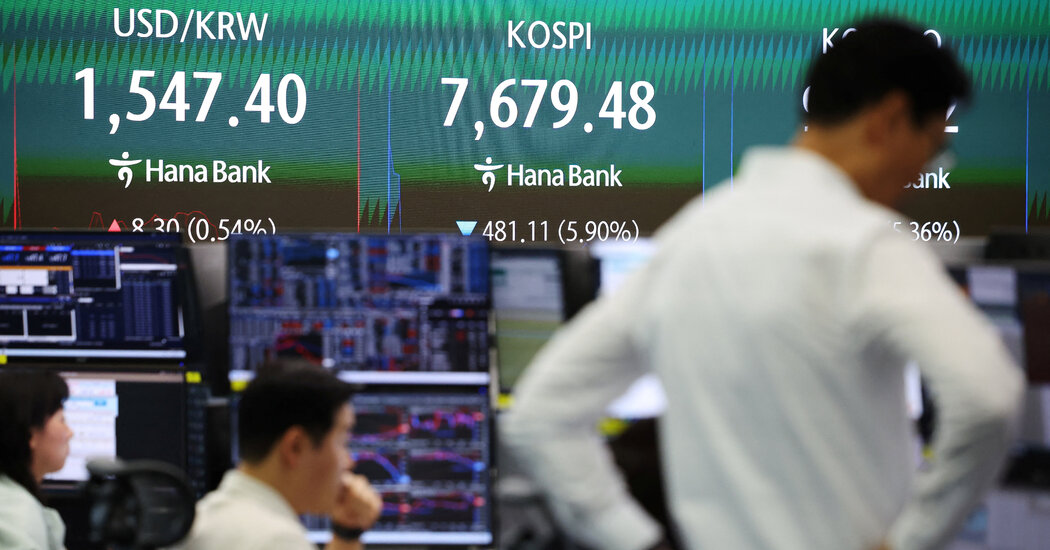
The epicenter of this financial earthquake was felt most acutely in South Korea, where the benchmark KOSPI index—which had proudly held the title of the world’s best-performing major stock market this year—plummeted by a staggering eight percent in a matter of hours. The decline was so rapid and severe that exchange operators were forced to activate emergency circuit breakers, temporarily halting all trading to prevent a complete and uncontrolled market freefall. This was not a minor correction; it was a systemic shock that sent panic through the ranks of institutional fund managers and ordinary retail investors alike. In South Korea, stock trading is not just the domain of wealthy elites; millions of regular citizens, popularly known as “ants” for their industrious and collaborative trading habits, actively manage their own portfolios in hopes of securing a comfortable future. Watching their life savings diminish in real-time as trading screens flashed emergency warning signs created an atmosphere of profound stress and helplessness across the country. The temporary halt in trading provided a brief, silent interlude in an otherwise chaotic day, leaving citizens to contemplate the unsettling truth of how deeply their personal financial security is tied to political decisions made thousands of miles away across the globe.
To understand why South Korea’s market was uniquely vulnerable to this geopolitical shock, one must examine its foundational role in the highly complex, global technology supply chain. South Korea is home to the world’s leading semiconductor manufacturers, the massive companies that produce the hyper-advanced memory chips essential for powering the global push into artificial intelligence, cloud computing, and consumer electronics. These highly sophisticated manufacturing processes rely on steady macroeconomic conditions, massive amounts of energy, and uninterrupted global trade routes to function. When the threat of a wider war in the Middle East drives up energy costs and dampens consumer confidence worldwide, the projected demand for high-end technology and expensive hardware quickly shrinks, prompting investors to dump tech shares first. This exposes a profound irony of our modern, hyper-connected era: our most advanced technological systems, designed to propel humanity into a highly automated future, are entirely built upon a physical world that remains deeply fragile and vulnerable to age-old geographical conflicts. The heavy losses suffered by tech giants in Seoul demonstrate that no amount of engineering brilliance or artificial intelligence innovation can fully protect an economy from the disruptive, human realities of war and geopolitical instability.
Ultimately, the compounding crises of rising oil prices, crashing stock markets, and a broken cease-fire serve as a powerful reminder of our shared, global vulnerability. We live in an incredibly interconnected world where the concepts of national borders and localized conflicts are, in many economic ways, an illusion. The economic safety of a family in Asia, the energy security of a household in Europe, and the physical safety of a community in the Middle East are all threads woven into the exact same delicate fabric. When one thread is violently pulled, the entire structure begins to unravel, proving that true prosperity cannot exist in a state of constant geopolitical fear. As diplomats and world leaders struggle to pick up the pieces of the shattered cease-fire and prevent the current hostilities from spiraling into an all-out war, the global community must come to terms with the reality that sustainable economic growth is fundamentally dependent on peace. In a world where a missile strike on one continent can wipe out the retirement savings of a worker on another, investing in diplomatic de-escalation, conflict resolution, and human empathy is not just a moral obligation, but a practical necessity for our collective global survival.