






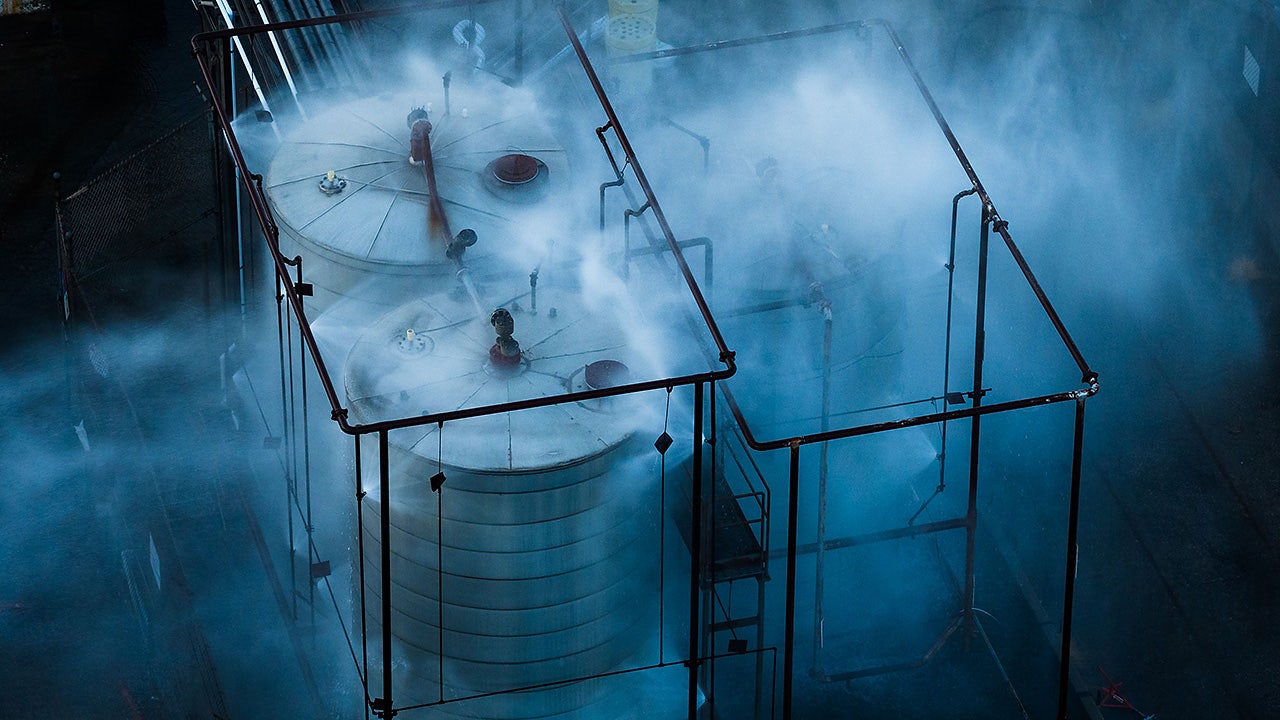
Nestled in the heart of Orange County, the vibrant community of Garden Grove, California, recently found itself plunged into an agonizing period of suspense, transformed overnight from a bustling suburban enclave into the epicenter of a high-stakes ecological and industrial crisis. The trouble began quietly within the industrial walls of GKN Aerospace, a prominent local manufacturing facility responsible for engineering high-tech components and structural elements vital to both commercial aviation and military defense. What is normally a hub of cutting-edge human ingenuity quickly became a source of community-wide dread as an emergency of volatile proportions unfolded around a massive, deteriorating storage tank. For days, the air in the surrounding neighborhood was thick not just with the invisible hazard of chemical vapors, but with the heavy, palpable anxiety of tens of thousands of local families who watched the unfolding disaster from evacuation centers, motels, and the temporary safety of relatives’ living rooms. At the core of this looming disaster was an unstable containment vessel holding thousands of gallons of a highly volatile substance, threatening a catastrophic failure that could shatter the peace of this Southern California community in an instant. This was not merely an industrial malfunction; it was a deeply human crisis that disrupted the daily rhythms of life, forcing neighbors to abandon their homes and leave behind their cherished belongings as they fled an invisible, ticking time bomb. The sheer scale of the emergency served as a stark, humbling reminder of the thin line that exists between modern industrial progress and the unpredictable forces of chemical chemistry when it escapes human control. As sirens echoed through the empty streets and emergency lights painted the night sky in flashes of red and blue, the collective gaze of the region turned toward a single, distressed metal tank, waiting to see if science and human bravery could avert a tragedy of historic proportions.
To understand the sheer magnitude of the threat that kept the entire region on a knife-edge, one must look at the highly volatile cargo locked inside the failing vessel: methyl methacrylate, commonly referred to by experts and emergency crew members as MMA. This chemical compound is a crucial ingredient in the production of acrylic plastics, resins, and specialized structural epoxies, making it a staple of aerospace manufacturing where materials must be incredibly strong yet lightweight. However, when MMA becomes unstable, its behavior turns fiercely unpredictable, characterized by its extreme flammability and its susceptibility to a terrifying thermodynamic phenomenon known to chemists as a “thermal runaway.” In simple terms, a thermal runaway is a self-sustaining vicious cycle where an increase in temperature triggers a chemical reaction that releases even more heat, which in turn accelerates the reaction, causing the pressure and temperature inside the tank to spiral exponentially out of control. If left unchecked, this runaway reaction turns a storage vessel into an improvised explosive device of monumental scale, capable of rupturing with a force that could easily flatten surrounding structures. Far worse than the initial blast wave was the terrifying prospect of a domino effect; should the primary tank explode, the resulting firestorm stood poised to breach neighboring chemical storage tanks within the facility, unleashing toxic, suffocating plumes of chemical smoke over densely populated residential zones. This nightmare scenario meant that emergency management was not just playing a game of containment, but rather trying to perform delicate, high-stakes surgery on a building-sized bomb before its temperature crossed the absolute point of no return. This delicate balance of chemistry and danger transformed the suburban landscape into a virtual battlefield against an invisible enemy, demanding the utmost precision from everyone involved in the crisis.
The human toll of this industrial nightmare was immediate, sweeping, and deeply disruptive, felt most acutely by the more than 40,000 residents who were abruptly uprooted from their homes and forced into a state of anxious exile. When local authorities issued sweeping evacuation mandates, lives were instantaneously put on pause; families scrambled to pack suitcases with absolute essentials, corral frightened pets, soothe confused children, and lock up houses they hoped would still be standing when they returned. The psychological weight of this mass displacement is difficult to overstate, as tens of thousands of ordinary citizens found themselves sleeping on gym cots in temporary shelters, checking their phones every few minutes for updates, and wrestling with the profound uncertainty of when, or if, their neighborhoods would be safe again. Recognizing the severe gravity of the situation and the immense resources required to handle a disaster of this scale, California Governor Gavin Newsom officially declared a state of emergency for Orange County, a political move that unlocked vital state funding, specialized equipment, and inter-agency coordination to bolster the local response. This declaration crystallized what residents already knew in their hearts: this was no routine factory mishap, but a historic crisis requiring an extraordinary, unified response to protect human life. Meanwhile, the vacant neighborhoods of Garden Grove stood as silent, eerie ghost towns, barricaded by police tape and patrolled by security details, while just a few blocks away, a small army of first responders prepared to walk directly into the path of potential devastation to save the community they had sworn to protect. This displaced populace found themselves bound by a shared vulnerability, united in their hopes for a safe resolution to a situation that had stolen their peace.
In the face of such overwhelming danger, the burden of resolution fell squarely upon the shoulders of a dedicated coalition of firefighters, hazardous materials specialists, and structural engineers who refused to let fear dictate their actions. Led by Orange County Fire Authority Interim Chief T.J. McGovern, these men and women demonstrated the very best of human courage, shifting their operational stance from a cautious, defensive posture aimed at containing a blast to a high-risk, offensive campaign designed to prevent it entirely. Entering a designated hazard zone where a catastrophic thermal runaway could occur at any second requires a rare, profound level of bravery, characterized by a willingness to place one’s own safety on the line for the collective well-being of strangers. Under the cover of darkness late on Saturday night, a highly specialized reconnaissance team suited up in heavy, pressurized protective gear and ventured deep into the heart of the GKN Aerospace facility, navigating a labyrinth of industrial piping, darkness, and intense ambient heat. These elite specialists were tasked with a crucial, near-impossible mission: to conduct a close-range physical and visual inspection of the unstable tank to gather real-time data that remote sensors simply could not provide. Every step they took into the hot zone was a calculated gamble, a delicate dance with a volatile giant where a single spark or structural shift could mean instant disaster, yet they pressed forward, driven by the knowledge that the fate of forty thousand of their neighbors hung precariously in the balance. Their silent march into danger exemplified the quiet heroism that routinely stands between modern civilization and industrial catastrophe.
It was during this tense, midnight reconnaissance mission that the brave hazmat team made an unexpected, pivotal discovery that would fundamentally alter the trajectory of the entire emergency response efforts. Using specialized thermal imaging cameras and direct visual inspections through the dense gloom, the crew identified what appeared to be a prominent structural crack running along the surface of the primary, pressurized tank. In almost any other engineering scenario, discovering a physical rupture in a chemical containment vessel would be a cause for absolute panic, signaling imminent structural collapse and a massive hazardous spill. However, in the bizarre physics of a pressurized thermal runaway event, this potential crack emerged as a miraculous, lifesaving silver lining, functioning as an makeshift, unplanned pressure-release valve. As Chief McGovern explained to an anxious public in a social media video update the following Sunday morning, the structural fissure was likely allowing built-up volatile gases to slowly escape the vessel, thereby relieving the intense inner pressure that had been pushing the tank toward an explosive rupture. While this discovery did not mean the danger had completely evaporated, it represented a monumental tactical breakthrough, shifting the math of the disaster and providing engineers with a viable pathway to stabilize the situation rather than merely bracing for a devastating blast. This critical piece of intelligence instantly reshaped the strategic playbook for the emergency command center, allowing experts to pivot from frantic disaster mitigation to a more calculated, controlled stabilization process that could eventually defuse the threat once and for all. It was a moment of profound relief for the teams on the ground, offering a sudden ray of light in what had been a long, dark, and seemingly intractable crisis.
Despite this highly encouraging development and the collective sigh of relief it generated among emergency personnel, officials were quick to remind the evacuated public that the battle was far from won and that caution must remain the order of the day. Chief McGovern, while praised for his steady leadership and transparent communication throughout the ordeal, emphasized that crews are still working tirelessly to confirm the precise nature of the crack and monitor the tank’s overall structural integrity before declaring the crisis officially over. The path back to normalcy for the displaced residents of Garden Grove remains a meticulous, step-by-step process that cannot be rushed, as specialized teams continue to conduct intensive, round-the-clock air quality monitoring and temperature readings around the facility to guarantee that no toxic residue remains in the atmosphere. The unwavering priority of the response teams remains the absolute safety of the community, a sentiment echoed by local leaders who understand that the emotional and physical well-being of the 40,000 evacuated citizens must not be prioritized over speed. As engineers, chemical experts, and hazardous materials teams analyze the fresh data Sunday afternoon, a quiet sense of hope has begun to replace the paralyzing dread that had gripped the region for days. The story of the Garden Grove chemical emergency is ultimately one of technical ingenuity, community resilience, and extraordinary human bravery in the face of chemical chaos, proving that when disaster threatens, the dedication of first responders and the solidarity of a community can safely guide them through the darkest of times back to the safety of home.