





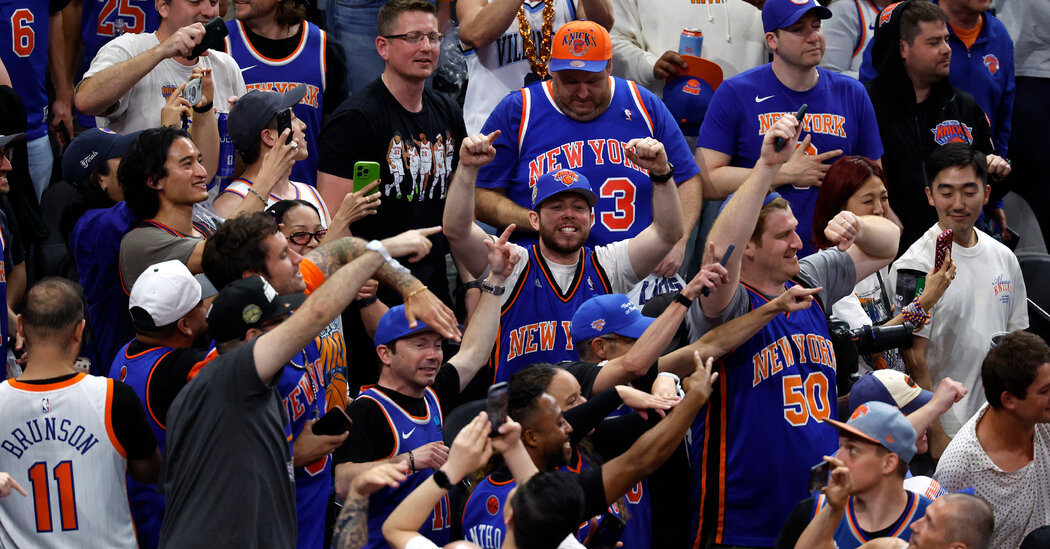
The familiar, electric hum of New York City—the rattle of the subway, the relentless rush hour, and the sharp wind coming off the Hudson—has suddenly taken on a distinct, collective rhythm as thousands of blue-and-orange-clad faithful prepare for an unprecedented mass migration. As the New York Knicks prepare to face the San Antonio Spurs for Game 5 of the N.B.A. Finals, they will not be making the long journey to Texas alone; instead, they are being trailed by an army of devoted fans who are transforming airports like JFK and LaGuardia into impromptu pep rallies. This is not merely a handful of affluent supporters making a weekend trip, but a massive, grassroots exodus of legendary proportions that has caught the sports world entirely off guard. Ticketing experts, who have analyzed generations of championship sports data, are watching this demographic shift in real-time with disbelief, noting that the sheer volume of New Yorkers traveling south could result in a phenomenon where the visiting team actually boasts a home-court advantage thousands of miles away. According to representatives from four of the nation’s largest ticket resale platforms, the presence of New York fans in San Antonio’s arena on Saturday night may very well dwarf the local Texan crowd. The scale of this movement has redefined what it means to be a loyal sports fan, turning a standard away game into a historical cultural takeover. Industry veterans, accustomed to standard playoff travel patterns, have struggled to find a precedent for this kind of fan behavior, with Matt Ferrel, a vice president of the resale platform TickPick, describing the developing situation as absolutely bonkers and unlike anything they have ever seen before.
The hard data behind this migration paints a stunning picture of fan devotion that completely defies traditional geographic boundaries and regional loyalties. With only about twenty-four hours remaining before the highly anticipated tipoff, TickPick reported a staggering statistic: fans originating from New York and New Jersey had purchased an incredible 48 percent of all Game 5 tickets sold through their platform, a figure calculated using the billing zip codes of the credit cards used for the purchases. This jaw-dropping metric was confirmed by Jonathan Gluskin, a spokesperson for the company, who noted that the trend showed no signs of slowing down in the final hours leading up to the game. But TickPick was not an outlier in these calculations; other major secondary ticketing giants like StubHub, SeatGeek, and Vivid Seats reported remarkably similar surges, with New York-area buyers driving between 36 and 40 percent of all transactions on their respective platforms. In contrast, the home-state supporters in Texas seemed to be relinquishing their own turf, with less than 20 percent of Game 5 tickets on major resale sites being bought with Texas-based credit cards. Additional sales data showed that fans from California and Florida, perhaps New York expatriates or neutral basketball enthusiasts eager to witness history, accounted for another 15 percent of TickPick’s sales, further diluting the local presence. The resulting demographic cocktail has led sportswriters and ticketing analysts to marvel at the impending atmosphere inside the Frost Bank Center, prompting Jack Sterne, a spokesperson for StubHub, to declare that it looks as though San Antonio might effectively become New York City’s sixth borough on Saturday night.
To truly appreciate the madness of this migration, one must understand the sheer physical geography of the journey and how it differs from typical sports travel. As Margaux Elias, a spokeswoman for SeatGeek, pointed out, when sports fans travel in enough numbers to dominate an opponent’s arena, it is almost always a matter of convenience—a short, manageable drive across state lines that allows supporters to invade a rival’s home court and return in time for work the next morning. It is common, for example, to see Chicago Bulls fans make the ninety-mile trek north up Interstate 94 to overrun the Milwaukee Bucks, or to watch Cleveland Cavaliers fans make a comfortable five-hour round trip to boo the Detroit Pistons in their own backyard. But the trip from Manhattan to San Antonio is an entirely different beast, spanning a grueling 1,800 miles from the iconic steps of Madison Square Garden to the dusty plains of south Texas. Making this journey by car would require an exhausting, coffee-fueled twenty-seven-hour drive straight through the heart of America, a logistical nightmare that is out of reach for anyone without multiple days of vacation to spare. Flying offers a faster alternative, but even the skies presented a frantic hurdle as Friday night approached, with commercial flights out of the metropolitan area booking up rapidly and leaving desperate fans to piece together complex layovers. For those lucky enough to secure a seat, a typical itinerary involved a pre-dawn wake-up call for a 6:00 a.m. Delta flight out of LaGuardia, followed by a tense layover in the bustling corridors of Atlanta’s Hartsfield-Jackson International Airport, all for the premium price of around $703 round-trip—a hefty sum that was nevertheless eagerly paid by fans desperate to reach Texas before the opening buzzer.
Yet, for the average New York sports enthusiast, spending nearly a thousand dollars on airfare and navigating the logistical headache of cross-country travel actually represents a brilliant stroke of fiscal responsibility. This paradox is rooted in the current hyper-inflated economy of New York sports, where securing a home ticket at Madison Square Garden has become an elusive luxury reserved only for the ultra-wealthy, corporate entities, and Hollywood celebrities. During this historic finals run, the cheapest, most vertically challenging nosebleed seats at the Garden have commanded astronomical prices, often starting at a staggering $8,000 apiece on the secondary market. By comparison, the cost of witnessing the very same players compete in San Antonio feels like an absolute steal; Julia Young, a spokeswoman for Vivid Seats, revealed that the average transaction price for a Game 5 ticket at the Frost Bank Center was hovering around $2,372 on Friday afternoon. When you calculate the math, a fan can purchase a prime seat in San Antonio, book a last-minute round-trip flight, secure a comfortable hotel room, indulge in some legendary Texas barbecue, and still fly back to New York with thousands of dollars left in their bank account compared to what they would have spent just to sit in the highest rafters of their own home arena. This economic disparity has effectively democratized the postseason experience for a segment of the fan base that had felt entirely priced out of their own city, transforming a remote Texas arena into a sanctuary where middle-class New Yorkers can finally afford to scream for their team.
The motivation driving this mass exodus is also deeply psychological, fueled by a mixture of intense optimism and existential dread regarding what might happen if the series stretches beyond Saturday. True basketball fans understand that a Game 5 is often the pivotal swing point of a championship series, a high-stakes battleground where legends are forged and trophies are brought within arm’s reach. But for the traveling New York faithful, there is an added layer of financial terror associated with the prospect of the Spurs pushing the series to a Game 6, which would send the action back to Manhattan. As Matt Ferrel of TickPick astutely noted, these traveling fans are acutely aware that if they do not seize this opportunity in San Antonio, they will face a truly terrifying economic reality back home at Madison Square Garden, where Game 6 ticket prices would undoubtedly skyrocket into the stratosphere, far beyond the already absurd $8,000 baseline. By investing their hard-earned money in a trip to Texas, these fans are hedge-funding their emotional and financial futures, guaranteeing themselves a live championship experience at a relative bargain before the market becomes completely elite and inaccessible. This desperate calculus has transformed thousands of ordinary New Yorkers into amateur travel agents and financial strategists overnight, as they calculate flight times, seat locations, and hotel availability in a frantic bid to witness what could be a once-in-a-generation sports milestone without bankrupting themselves in the process.
Ultimately, this unprecedented migration promises to create a surreal, emotionally charged cultural collision on Saturday night inside the Frost Bank Center, a venue normally defined by the gentle hum of South Texas hospitality and a sea of silver and black. Instead of the familiar home-court advantages that have comforted the Spurs all season, the arena will be subjected to the raw, unfiltered, and famously loud passion of New York City’s sporting soul. The polite clapping and localized cheers of the Texas crowd stand to be completely overwhelmed by the iconic, thunderous chants of “Let’s Go Knicks!” bellowed by thousands of people who slept in airports, boarded pre-dawn flights, and emptied their savings accounts just to be in the room. This extraordinary takeover serves as a beautiful, humanizing reminder of the irrational, beautiful lengths to which people will go in pursuit of shared joy, community, and the collective hope of victory. It proves that a sports team is not merely a corporate entity bound by municipal borders, but a living, breathing emotional anchor that can pull thousands of people across a continent on a whim. Whether the Knicks secure the championship on Saturday night or the Spurs manage to defend their home court against this invading army, the true story of Game 5 will be written in the stands, where the spirit of the Madison Square Garden faithful successfully bridged an 1,800-mile gap to prove that home is not a coordinate on a map, but wherever the passion of the crowd carries it.