



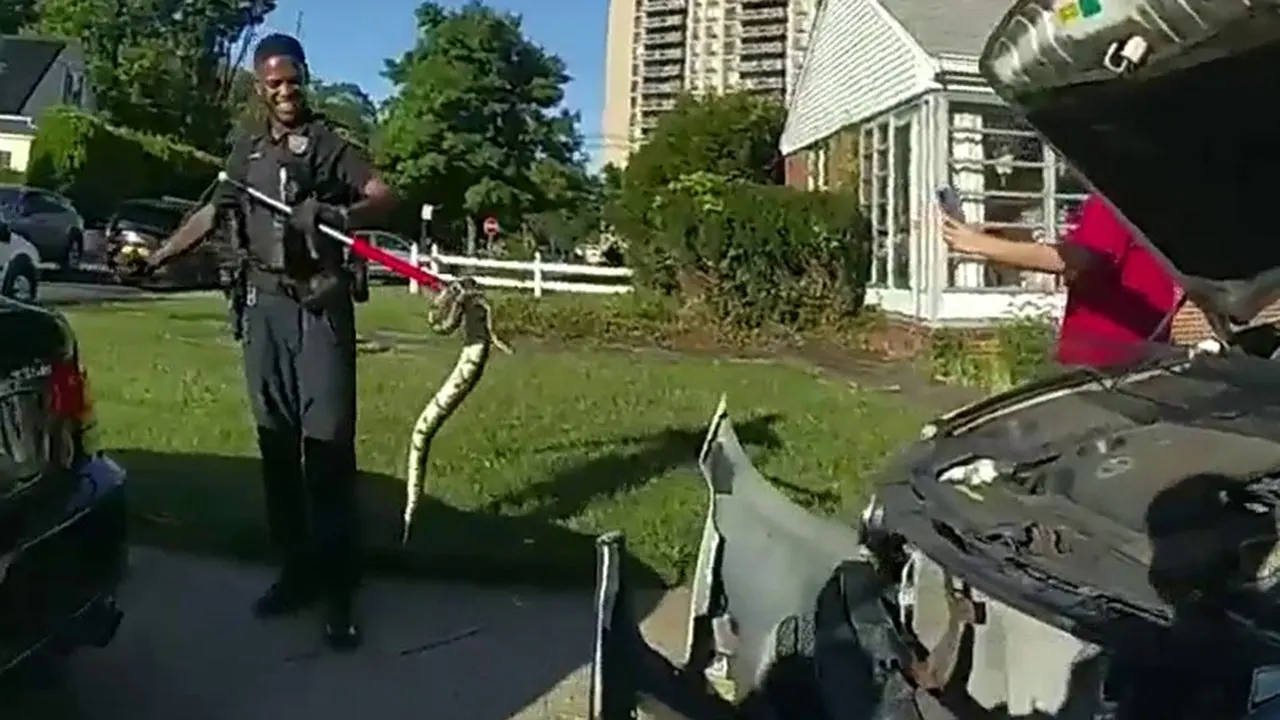
Some people come home after a simple errand with groceries, a dry-cleaning receipt, or maybe a sudden desire to take a nap. Aiyana Hudson came home with something far more unexpected: a live three-foot python wedged into the front grille of her car. It was Sept. 14, an otherwise ordinary day in Franklin Township, New Jersey. Hudson had just taken her vehicle in for a routine wheel alignment, the kind of mundane appointment that rarely makes it into conversation, let alone a headline. She probably expected to hear that her tires were worn unevenly, or that the steering felt a little loose, not that she’d be driving around with a hidden reptilian passenger. But when she found the snake coiled inside the front grille of her car, her routine day turned into a situation that required police, tools, and more than a little nerve. The discovery was startling enough on its own. The snake was lodged deep in the front end of the vehicle, its body pressed between the plastic and metal of the grille, looking almost like a strange piece of machinery that had no business being there. For Hudson, the moment must have been equal parts disbelief and fear. She didn’t know whether the snake was venomous, whether it was injured, or whether it might slither deeper into the car’s innards at any moment. What she did know was that she couldn’t ignore it and she couldn’t remove it herself. So she did what many of us would do: she called the police. It was a call that would lead officers into an impromptu rescue operation, one they never trained for but handled with quiet determination and a bit of humor.
When police officers arrived at the scene, they approached the car with understandable caution. Body camera footage captured the encounter, showing officers peering into the grille, trying to make sense of the odd situation unfolding before them. Officer Lisseth Villacis later recalled the initial plan was to get help from animal control, the obvious first call for anyone who finds an unexpected animal. But that plan quickly unraveled. Animal control let them know that they only handled domesticated animals, meaning cats, dogs, and perhaps the occasional stray pet, not snakes hiding in car grilles. Villacis remembered the moment with a kind of weary humor: “They’re like, they only deal with domesticated animals. And we’re like, oh shoot. OK. So, we’re kind of like the last resort.” That phrase, “last resort,” sums up the situation perfectly. Police officers are trained for all kinds of emergencies, from traffic stops to crimes in progress, but reptile extraction from a vehicle’s front bumper isn’t exactly part of the academy curriculum. Still, there was no time to wait for another agency or to hope the snake would simply leave on its own. The officers had to become improvised wildlife rescuers. They looked at the car, studied the grille, and started figuring out how to free the animal without hurting it and without putting anyone at risk. There was no test, no manual, no backup plan. Just a handful of officers, a trapped snake, and a decision to do whatever it took to solve the problem safely. They were, in every sense, on their own.
After surveying the situation, the officers decided that the only way to reach the snake was to take the car apart, at least enough to make room for the reptile to be removed. This was not a delicate procedure. It involved removing parts of the vehicle, including the front bumper, to reach the spot where the python had wedged itself. Body camera footage showed the officers working carefully, pulling and prying at the plastic components, trying not to harm the snake while also making sure it didn’t suddenly come loose and slither into a more inaccessible area. Twenty minutes passed, and the tension slowly gave way to relief. At last, the officers managed to untangle the snake and pull it free from the grille. It was a moment that probably felt both surreal and satisfying, the kind of small victory that stays with you long after the shift ends. The snake was identified by animal control officials as a three-foot ball python, a species that is not native to New Jersey and is commonly kept as a pet. Despite being crammed into a tight, hot space inside a car grille, the snake appeared to be unharmed. It was alive, alert, and apparently no worse for wear after its strange journey. The officers had managed to rescue the animal without injury, and Hudson could finally breathe easier knowing that the creature was out of her car. But the experience left a lasting impression. There was the obvious shock of finding a snake coiled in the front of a vehicle, but there was also the lingering mystery of how it got there in the first place, and how long it had been riding along as an uninvited traveler.
Hudson later said she was deeply relieved that the snake never made its way farther into the car’s interior while she was driving. The thought of a python suddenly appearing through an air conditioning vent or slipping out from behind the steering wheel is enough to make anyone shudder. She told reporters, “I was just really happy that it didn’t, like, pop its head through the AC vent when I was driving or come in through the steering wheel.” And then, with a laugh that betrayed both fear and disbelief, she added, “I want to let you know my car would have been lit on fire, and we’d be calling the fire department at that point.” It was the kind of remark that many people could understand, a half-joking admission of how utterly terrifying an unexpected snake in the car would be. Hudson’s reaction captured the strangeness of the whole incident. She had gone to a routine appointment, driven home, and discovered that her car had been carrying a hidden passenger the whole time. The snake had been right there, just inches away from her, separated only by a thin layer of plastic and metal. She had been behind the wheel, making normal driving decisions, while a python remained coiled in the front grille, silent and unseen. The thought of what could have happened, if the snake had decided to explore the car’s interior, was enough to unsettle anyone. Fortunately, nothing of the sort occurred. The snake stayed where it was, Hudson exited her vehicle safely, and the rescue ended without harm. But the mystery of how the python got into the grille remained unsolved, leaving both Hudson and the officers wondering about the strange twists of fate that brought them all together that day.
Once freed, the snake was taken to the Franklin Township Animal Shelter, where it could be cared for and evaluated. The fact that it was a ball python, a species often kept in homes as an exotic pet, suggested that it might have escaped from someone’s house or been intentionally released by an owner who no longer wanted it. No one knows for sure. It could have slithered into the car grille while the vehicle was parked, perhaps seeking warmth or a dark, hidden place to rest. It might have climbed in near a driveway, a parking lot, or even at the service station where Hudson had her wheel alignment done. There was no way to trace the snake’s path, and no one could say with certainty where it had come from. But its presence raised an important point about the responsibilities that come with owning exotic animals. A pet python is not like a cat or dog. It has specific needs, a particular temperament, and an ability to survive in unexpected places, especially in a state where such animals are not part of the natural ecosystem. When an exotic pet escapes or is abandoned, it can create dangerous situations, not only for the animal itself but also for people who encounter it. In this case, the snake was lucky. It was found in time, freed without injury, and taken to a place where it could be looked after properly. But not every story ends that way, and the risk of losing an exotic pet in a residential or suburban area is real.
Franklin Township Public Safety Director Lloyd Fredericks took the opportunity to remind residents about the law and the dangers of releasing exotic pets into the wild. He made it clear that letting such animals go is illegal, and it can pose a serious threat to native wildlife and household pets. A python, though not venomous, is still a predator. If released into an unfamiliar environment, it could survive for a while, but it would also struggle to find appropriate food and shelter, and it could become a danger to small animals that are part of the local ecosystem. Fredericks encouraged residents who have pet snakes they can no longer care for to surrender them to the township animal shelter instead of letting them loose. It was a practical and compassionate reminder that pets are not disposable. When people make the decision to bring an exotic animal into their homes, they accept a responsibility to care for it, even when circumstances change. The story of the python in the car grille ended on a relatively positive note: the snake was safe, the car was intact, and everyone walked away with a memorable story. But the incident also served as a wild, unexpected reminder of how closely human life and animal life can intersect. In a single ordinary moment, a woman on her way home from a routine appointment found herself face to face with the wild, and a group of police officers discovered that sometimes the most important job of the day is rescuing a very strange, very unexpected passenger.