



The Forgotten Apocalypse: Inside Myanmar’s Shadow Civil War and the Isolated Rebel Stronghold of Anyar
The Lonely Hilltop and the Silent Collapse of Southeast Asia
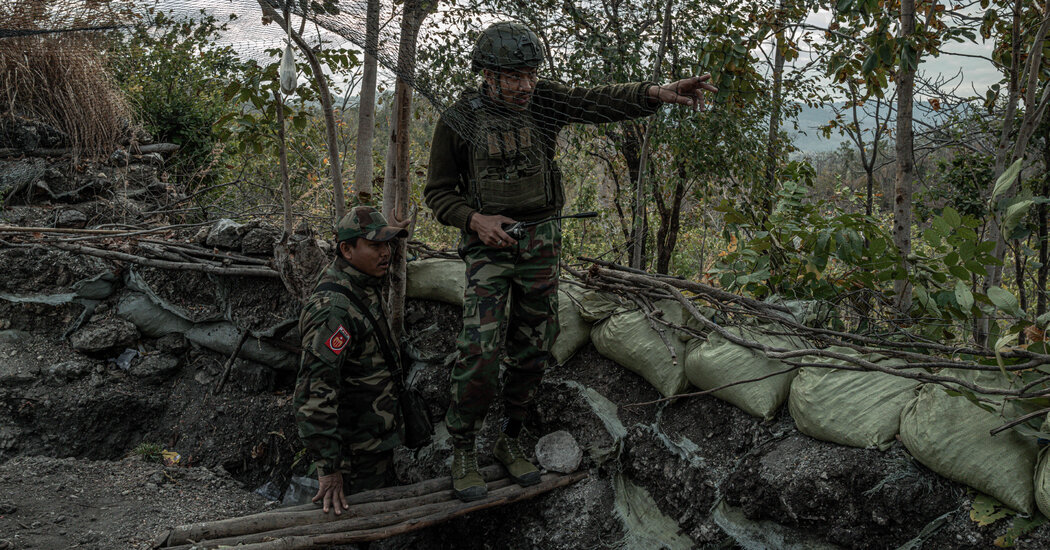
Perched upon a barren, wind-swept hilltop in the arid interior of central Myanmar, Dr. Lone Lone stands as a quiet testament to a desperate, invisible struggle. Squinting behind dust-covered spectacles as the parched earth of the Anyar region whips around him, this forty-one-year-old former physician turned rebel commander swallows a persistent wheeze, his body worn thin by five years of continuous guerrilla warfare. His men, a ragtag assembly of former students and professionals, stand at attention with an impeccable military bearing that belies the striking inadequacy of their weaponry. While the collective gaze of the international community remains firmly fixed on the high-profile geopolitical crises in Ukraine, the Gaza Strip, and Lebanon, Myanmar—a Southeast Asian nation of some fifty million people—has quietly slipped into a state of total, catastrophic collapse. The bloody aftermath of the 2021 military coup, which abruptly ended a brief decade of democratic transition and economic reform, has plunged the nation into a brutal, multi-front civil war. Armed resistance forces, operating under the loose banner of the People’s Defense Forces (PDF) and historical ethnic militias, now control more than half the country, yet they remain severely outgunned by a ruthless military junta. As the junta, led by General Min Aung Hlaing, unleashes unprecedented aerial terror upon its own citizens to maintain its grip on power, the civilian populace is left to bear the brunt of a devastating humanitarian crisis that the United Nations warns has already displaced over 3.7 million people and claimed at least 90,000 lives nationwide.
The Heart of the Heartland: Why Anyar Became a Brutal Battleground
To understand the unique tragedy of Myanmar’s current civil war, one must look to Anyar, a dry, landlocked central region that has historically served as the cultural and demographic heartland of the Bamar ethnic majority. For decades, Myanmar’s borderlands endured simmered insurgencies led by ethnic minority groups seeking autonomy—conflicts that, while highly destructive, maintained vital cross-border supply lines to neighboring countries for arms, intelligence, and humanitarian aid. Anyar, by contrast, is entirely marooned in the center of the country, leaving its population isolated and uniquely exposed to the unrestrained fury of the state’s military machine. Historically, this region was the traditional wellspring of support for the military, which is itself predominantly Bamar. However, the sheer brutality of the 2021 military coup shattered this historic alliance, turning former loyalists into the junta’s most unyielding adversaries—a perceived betrayal for which they are now paying an unfathomable price. Traversing this heavily contested and blockaded landscape to reach the front lines requires a grueling, three-day journey on backroads, motorcycle paths, and rivers, constantly evading military checkpoints, blackouts, and patrols. Here, the landscape resembles a post-apocalyptic wasteland where hundreds of villages have been reduced to charred ruins by scorched-earth military operations, and where civilian survivors like U San Nyaung weep over the remains of their bombed-out homes, feeling a profound, shared grief with the displaced peoples of Gaza and Ukraine, yet utterly forgotten by a world that has turned its back on Southeast Asia.
Stethoscopes and Physics Textbooks: The Unlikely Vanguard of the Resistance
The armed resistance forces fighting in the forests and dry fields of Anyar are not career soldiers, but rather an unlikely vanguard of civilians who surrendered their peaceful, modern lives to defend their communities. Dr. Lone Lone, who leads a battalion of 120 soldiers, never envisioned a life of military command; born in an Anyar town famous for its working elephants, he was a mild-mannered doctor preparing for a grand tour of Europe when the coup intervened. After witnessing peaceful, unarmed protesters—including young children—systematically executed by junta forces in the streets, he made the agonizing decision to trade his stethoscope for an assault rifle, escaping to the borderlands to receive basic combat training from veteran ethnic militias. His battalion is populated by young men who speak wistfully of the “B.C.” era—Before the Coup—including a second-year college physics student, a corporate marketing executive, and teenagers who took up arms before they had ever been on a date, got married, or harvested their family’s fields. Despite the brutal realities of their current existence, these fighters cling to the civilized habits of their past lives; a rebel driving a heavily armored pickup truck down a dusty, shell-shocked dirt road still instinctively uses his turn signals, a poignant reminder of the orderly society they are desperately fighting to reclaim. This deeply humanized resistance, however, faces an existential threat as the war of attrition grinds on, pitting their high democratic ideals against the grim reality of a heavily armed, state-sponsored war machine.
A Revolution Starved: The Deadly Disparity of Firepower and Global Apathy
The defining tragedy of the anti-military resistance in Myanmar is the stark, heartbreaking disparity in firepower and the absolute lack of international support compared to other global conflicts. While Western democracies have poured billions of dollars of high-tech military aid into Ukraine to counter foreign aggression, the rebels of Free Myanmar have been left to finance their revolution through meager donations, scrounging for weapons on a black market they can barely afford. The military junta, conversely, draws robust economic and diplomatic lifelines from powerful neighbors like China, Russia, and India, utilizing state-operated copper mines in central Myanmar to fund its campaign and purchase heavy weaponry. Local guerrilla commanders like Ko Thu Rein, a former copper mine worker, reveal the desperate nature of their struggle: his unit of 80 soldiers was allocated a mere five rifles by the government-in-exile, forcing the men to construct crude, improvised mortar launchers out of scrap metal with no manufactured shells to fire. This severe logistical starvation has forced heartbreaking setbacks, such as the loss of the strategic town of Tagaung and a chaotic retreat from northern Shan State where rebels were forced to abandon their treasured war elephants. As fighter jets tear through the skies above Anyar, rebel soldiers are left with a deep, encroaching depression, wondering why their blood-spilled fight for a federal democracy is deemed less worthy of global attention and material support than struggles occurring elsewhere on the map.
Everyday Apocalypse: Normalizing the Reign of Aerial Terror
In the isolated, war-ravaged villages of Anyar, the civilian population exists in a state of normalized, everyday apocalypse where the threat of sudden death from the sky has become as routine as the weather. At a local transport hub operated by the resistance, villagers calmly sit in a noodle shop run by Daw Wah Wah, slurping broth and listening to radios crackling with real-time troop movements, completely unfazed by the fact that the small, dirt-carved bomb shelter out back is entirely inadequate for their numbers. When asked about local airstrikes, the owner casually mentions an attack that killed six people just two miles away visual distance; she had briefly forgotten to mention it simply because “there is death everywhere.” The military’s aerial arsenal is terrifyingly creative, ranging from Russian-made Sukhoi fighter jets and Mi-35 attack helicopters to light gyrocopters and conscripted paragliders drifting silently through the night drop hand-held explosive payloads. Gas stations, medical clinics, and makeshift cafes equipped with Starlink satellite dishes—the only connection to the outside world—are routinely targeted and incinerated, leaving business owners like Ma Khin Moe Hnin to mourn family members amid charred ruins with a numb, heartbreaking acceptance. To ensure maximum carnage long after their ground troops depart, the junta’s retreating forces leave behind a legacy of anti-personnel landmines planted around Buddhist temples and private homes, transforming the cradle of Bamar culture into a permanently hostile zone of grief and terror.
The Breaking Point: Betrayal, Desertion, and the Heavy Search for Hope
As the civil war in Myanmar enters its fifth grueling year, the psychological toll on both the civilian population and the guerrilla fighters has reached a dangerous breaking point characterized by high desertion rates, strategic betrayals, and deep exhaustion. At a remote rebel camp near Mandalay, an artist turned guerrilla leader known as Brother Zero points to a deep, hand-dug pit in the earth—a makeshift prison used not for captured enemy soldiers, but to detain his own recruits who attempted to desert the front line out of sheer despair. The prolonged isolation, combined with a surge in precise military airstrikes facilitated by surrendering rebel commanders who traded operational coordinates for amnesty, has severely fractured the resistance’s once-unbreakable morale. Dr. Lone Lone’s own battalion has been cut in half since the beginning of the year; his beloved deputy commander has deserted, and a passionate young schoolteacher who once declared his readiness to die for the revolution has quietly vanished from the ranks. In the rare quiet moments of this relentless campaign, as his truck idle in the dark to wait out a potential drone strike, the weary doctor laughs to mask his profound sorrow before admitting his ultimate contingency plan. “If I cannot win the revolution, then I will become a monk,” he whispers, expressing a quiet yearning for monastic peace and spiritual meditation in a world that has become far too heavy, far too violent, and far too lonely to bear.