





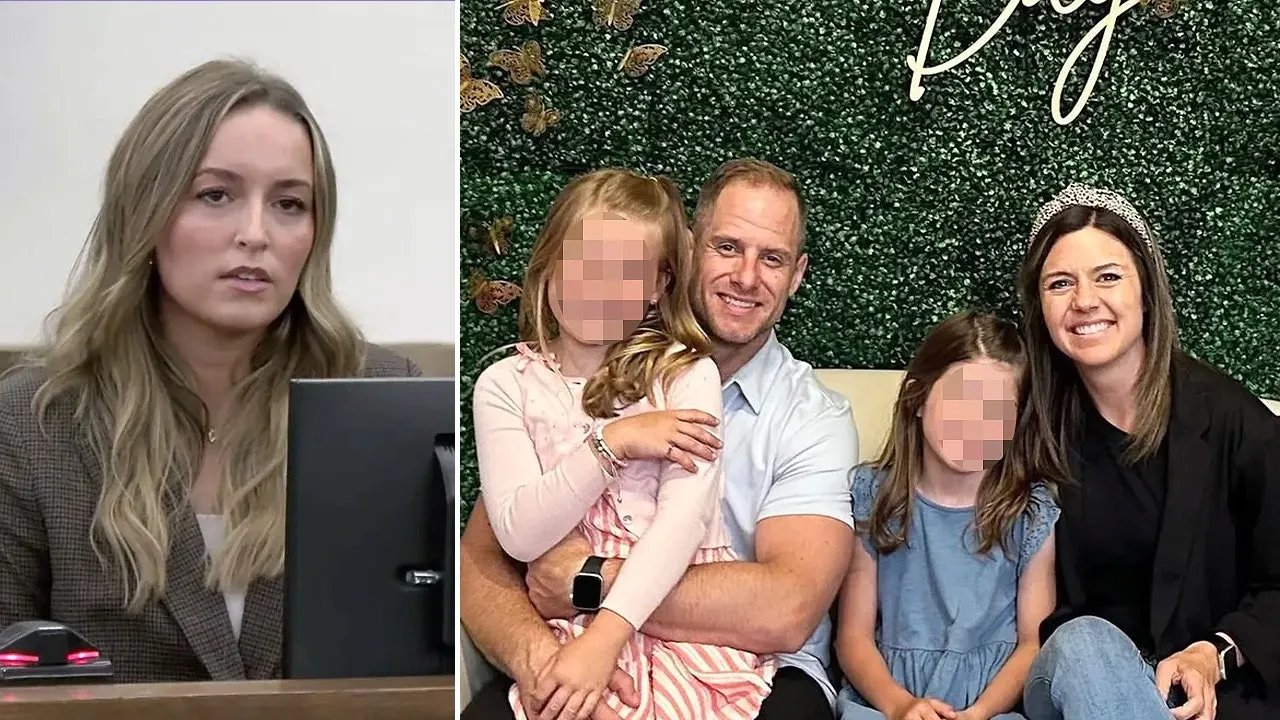
For weeks, the murder case against Caleb Flynn, a former “American Idol” contestant, has been built on a mountain of circumstantial evidence: a wife found dead in her bed with two bullets in the back of her head, a staged scene that looked like a burglary, and a husband who claimed innocence even as investigators peeled back the layers of his double life. But when Alleigha Botner, the woman with whom Flynn carried on a secret affair for nearly a year and a half, took the witness stand, the case shifted. Her testimony, spread over two emotional days, gave jurors something prosecutors often struggle to provide in cases like this: a human reason, a motive. According to Josh Ritter, a former prosecutor and Fox News contributor, Botner’s words offered the missing piece. “She provides a motive,” Ritter said. “She gives jurors a reason for why would this man murder his wife.” The victim, Ashley Flynn, was described as a kind woman and the mother of his children. Yes, Caleb may have wanted out of the marriage, and perhaps there was financial gain from life insurance, but jurors often struggle to understand why a seemingly ordinary man would cross that line. Botner’s testimony, raw and at times heartbreaking, helped answer that troubling question by showing that the idea of Ashley’s death was not a passing thought, but a recurring, desperate fantasy.
Botner took the stand and walked jurors through the secret world she and Caleb had built together, a relationship carried out through more than 107,000 text messages. She was emotional, often wiping away tears, especially when reading her own words back in open court. The affair was intense, all-consuming, and at times, darkly fixated on the woman standing in the way of their happiness. The messages were not just romantic; some were explicitly about Ashley’s death. In one message from May, Flynn allegedly wrote, “If I could literally kill her and not go to hell, I would do it in a heartbeat.” Days later, he allegedly continued, “I hate her, loathe her. I want her dead.” These were not the kind of vague frustrations that many people vent in the middle of a bad marriage. Ritter stressed that this went far beyond wishing a spouse would simply disappear. “This is saying you want that person dead, that, in your view, that is your solution to the problem that you have,” he explained. It was the substance of these exchanges, not just the existence of the affair, that gave prosecutors their most powerful tool. The messages showed a man who had stopped seeing his wife as a person and had started seeing her as an obstacle, an enemy, someone whose very existence prevented him from being happy.
The intensity of the messages only grew as time passed, and Botner’s testimony painted a picture of a relationship spiraling toward something unthinkable. In August, Flynn allegedly told Botner that he had stayed up until 4 a.m. “literally thinking of ways to kill her and not go to jail.” At another point, he allegedly begged her to act on his behalf, writing, “Please hire someone to take [her] out. I need you in my life, I need you.” Botner’s own response revealed how deeply she had been pulled into his dark world: “So tempting. I can’t live without you. And I’ve had this thought so often lately. How do we figure this out?” She later read another message aloud, one she said she wished she had never written, in which she told Flynn, “I want to kill her, Caleb.” His alleged reply was chilling in its simplicity: “That makes two of us.” These were not strangers engaging in dark fantasy; they were two people who had convinced themselves that Ashley’s death was the only way forward. Botner’s testimony also revealed the pressure that may have pushed Flynn over the edge. By January, she had given him an ultimatum: leave Ashley or lose her. When he failed to follow through, she cut off communication entirely on January 11. For weeks, she was silent. Then, on February 14, just two days before Ashley was killed, the two reconnected, and the conversation quickly turned to the future they had been dreaming about.
The most damning testimony may have come when Botner described the final hours before Ashley’s murder. On the night of February 15, she and Flynn were talking again, and he told her about his plans for the following day. He said he intended to tell family members about the divorce and mentioned obtaining a burner phone. Then, shortly after midnight, the messages took a sinister turn. Flynn allegedly wrote, “It’s happening.” He followed with, “February 16th – day I’ll never forget.” Botner responded, “You’re about to be free.” Flynn’s last message to her before Ashley was found dead was simple: “I choose you.” For Ritter, this timing was crucial. “The day before the murder takes place, he tells his mistress that tomorrow is going to be a big day, that he chooses her,” he explained. “He’s made a decision and that tomorrow, meaning February 16th, the date his wife was murdered, will be a day that he will never forget.” According to prosecutors, Flynn then went home and carried out the killing, shooting his wife in the back of the head while she slept, before staging the scene to look like an intruder had broken in. He allegedly took his own gun, used his own vehicle, and left the rest of the house undisturbed. The image is haunting, and Botner’s testimony made it all the more devastating, because it suggested that Ashley’s fate had been sealed long before that night, in a stream of messages between two people who had convinced themselves that her death was their liberation.
But as powerful as Botner’s testimony was, the defense has a fight ahead, and her own words may provide some room for doubt. Flynn’s attorneys spent hours on cross-examination, pushing back against the narrative that these messages were a literal plan. They pointed to the sheer volume of the conversation, more than 100,000 messages exchanged during an intense affair, and argued that prosecutors were cherry-picking the most damaging statements while ignoring the context. In the heat of an affair, people say ugly things, exaggerate their emotions, and vent in ways they do not truly mean. The defense also highlighted Botner’s own volatile language, forcing her to acknowledge that she had written things like, “I’m so done with you. You have murdered my heart,” and “I hope you’re glad you took my virginity and also my heart and stomped all over it. Enjoy your marriage. I’m done.” These were not the words of a woman who was simply a victim of a manipulator; they were the words of someone caught up in a messy, toxic relationship. More importantly, Ritter noted, despite all the talk of wanting Ashley dead, Flynn never explicitly told Botner that he was going to follow through. “There was never an explicit mention of, ‘I’m going to do it, I’m gonna follow through on it,’” he said. The defense can argue that when Flynn said something was “happening” on February 16, he meant he was finally going to leave his wife, not kill her. It is a thin thread, but it is enough to create reasonable doubt in the mind of at least one juror.
The defense also has other holes in the prosecution’s case to point to. There is no murder weapon, no eyewitness, and no gunshot residue found on Flynn. In an ideal world, prosecutors would love to put the gun in front of the jury, but they cannot. Botner did testify that Flynn had once shown her a gun he kept in the center console of his truck, but she could not remember what it looked like, and the weapon has never been found. The defense has also suggested that police may have rushed to judgment once they uncovered the affair, abandoning other leads and deciding that a cheating husband must be a murderer. As Ritter put it, the defense will argue that “once they knew that he was planning on leaving his wife, they thought, ‘Well, that’s enough for us. We’re not going to pursue other leads.’” It is not necessarily a winning argument, but it gives the jury something to think about. And yet, even with all those holes, the emotional weight of Botner’s testimony cannot be ignored. It is one thing to hear that a man had a motive; it is another to read his own words, written in the dark hours of the night, describing in chilling detail his desire to see his wife dead. For all the reasonable explanations the defense may offer, the messages remain a window into Caleb Flynn’s state of mind, a place filled with hatred, desperation, and a willingness to imagine a world without Ashley in it. In the end, this case may come down to a simple question: was Caleb Flynn a man who said terrible things but never meant them, or was he a man who finally decided to make his darkest words a reality? Botner may have given the jury the answer, or she may have given them only a glimpse of a story they will never fully know. Either way, her testimony has ensured that the jury will not forget Ashley Flynn, the woman whose life ended so violently, and whose death has now become the center of a trial that will decide whether her husband is a grieving widower or a calculating killer.