





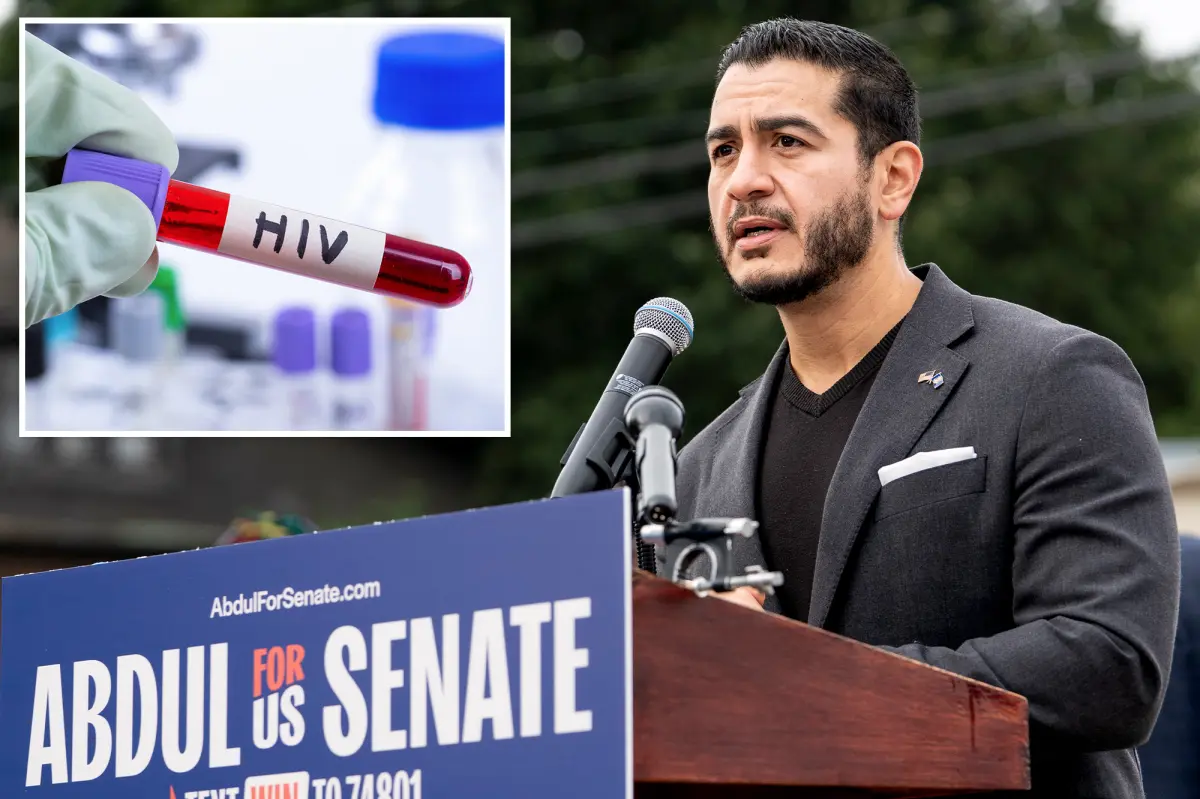
Abdul El-Sayed is not the kind of candidate who hides from his past, even when the past comes with political risk. In the heat of Michigan’s 2018 Democratic gubernatorial primary, El-Sayed, then a relatively unknown physician and public health leader, made a bold promise that still echoes through his current Senate campaign: he would work to repeal a Michigan law that sent HIV-positive people to prison for up to four years if they had sex without first telling their partner. The law, which had been on the books since 1988, treated a virus like a crime. To El-Sayed, who had spent years as a doctor and epidemiologist, including serving as Wayne County’s health director, that approach was not just medically wrong; it was deeply dehumanizing. “You should not be criminalized for a disease. That is absolutely wrong. It’s hateful. It’s discriminatory, and we can, as a state, do better. You can count on me for that,” he said at the time. Eight years later, as he runs against Republican former Rep. Mike Rogers for the seat of retiring Democratic Sen. Gary Peters, El-Sayed is standing by every word. The race is one of the most competitive in the country, and Democrats need to hold Michigan to have any realistic chance of retaking the Senate majority. Yet El-Sayed has not moderated his message to fit the politics of a purple state. Instead, he has made his public health values central to his candidacy, arguing that the United States needs fewer laws that stigmatize illness and more policies that actually help people manage it. For him, the HIV law was never just about sex or disclosure; it was about how society treats the most vulnerable among us. It would have been easy to dodge the question, to say the law was old and everyone made mistakes in the 1980s, but El-Sayed did the opposite, and he has continued to do so with a stubbornness that defines his political style.
The law that El-Sayed criticized was a relic of a very different time. Passed in 1988, at the height of AIDS panic, it reflected fear and ignorance more than medical reality. Under the statute, a person who knew they were HIV-positive and engaged in sexual penetration without notifying their partner could be charged with a felony and face up to four years behind bars. There was no requirement that the disease actually be transmitted, and no exemption for people whose viral load was so low that they posed no real risk of transmission. In practice, the law targeted people living with HIV simply for being HIV-positive and for acting on normal human intimacy. For El-Sayed, this was a textbook case of discrimination disguised as public safety. His 2018 campaign website explicitly called for repealing “HIV/AIDS criminalization laws” and also for ending the exclusion of transgender Michiganders from state Medicaid coverage—showing that he viewed the fight against HIV stigma and the fight for LGBTQ rights as inseparable. When asked whether he would support a less severe alternative, creating two levels of misdemeanors instead of a felony, El-Sayed refused to settle for half-measures. “One of the big things that we have to recognize about HIV is that no disease can be illegal,” he said. “The continuing forward of these laws on the books stigmatize people with the disease.” He was not entirely alone in the Democratic field. Gretchen Whitmer, who went on to win the governorship, also said the law “absolutely should be revisited,” arguing that criminalizing sickness was wrong. After Whitmer took office, the law was reformed in early 2019, passing a GOP-controlled legislature with broad bipartisan support. The revised statute limited felony charges to cases involving vaginal or anal intercourse with an actual intent to transmit HIV, or where HIV was actually transmitted. It reduced non-transmission offenses to misdemeanors and protected people whose HIV was medically suppressed from prosecution under the reckless-disregard provision. The reform was a victory for advocates and a vindication of the arguments El-Sayed had made on the campaign trail.
Now, as El-Sayed stands on the threshold of what would be an extraordinary political breakthrough, the HIV fight has taken on renewed urgency. He is running in a midterm election that will help determine whether Democrats can hold the Senate, and Michigan is ground zero. The battlefield is a seat left open by Gary Peters, a two-term Democrat, and the margin could not be tighter. El-Sayed won a contentious August primary, narrowly edging out more moderate Democratic Rep. Haley Stevens. That primary exposed, in miniature, the ongoing ideological war inside the Democratic Party between its progressive wing and its establishment pragmatists. El-Sayed represents the former, unabashedly. If he wins in November, he would become the first Muslim American ever elected to the United States Senate—a milestone that resonates far beyond Michigan. He is a son of Egyptian immigrants, a Rhodes Scholar, and a trained physician who spent his career thinking about population health, not just individual patients. As Detroit’s top public health official in Wayne County, he saw up close how systemic inequities—poverty, housing, access to care—shape who gets sick and who gets left behind. That lived experience informs his approach to so many issues. It also explains why he refuses to treat the old HIV law as an unfortunate but distant memory. In his telling, the law was not merely outdated; it was a warning about what happens when politics overrides science and fear overrides compassion. The people who were harmed by it were not abstract categories. They were Michiganders living with a chronic disease, trying to live full lives. The same public health logic now drives his support for universal healthcare, his criticism of drug policies that punish rather than heal, and his conviction that the federal government should be funding HIV prevention and treatment, not paring it back. In this race, El-Sayed is asking voters to imagine what a senator with a stethoscope—and a serious understanding of epidemiology—might do for a country still wrestling with pandemics, addiction, and health disparities.
El-Sayed’s campaign is eager to make clear that his position on HIV decriminalization was not a passing whim. Spokesperson Roxie Richner told Fox News Digital that El-Sayed supports the bipartisan reform that replaced the old law, and she connected it directly to his broader public health philosophy. “As a public health professional, Abdul has fought to support programs that stem the spread of diseases, including HIV,” Richner said. But she also struck a distinctly urgent note, accusing the Trump administration—and the health policy vision being pushed by Robert F. Kennedy Jr.—of making the epidemic worse. “The Trump administration has completely exacerbated this crisis by defunding the organizations and programs that do frontline care to prevent transmission and exposure in the first place,” she added. “In the US Senate, Abdul will fight back against Donald Trump and RFK Jr’s attempts to dismantle our public health infrastructure and ensure all Americans have access to the care they need.” This is a carefully framed message: El-Sayed is not just a critic of a discredited Michigan law; he is a defender of the public health system itself at a moment when it is under assault. It also appeals to the base he needs to win over—Black voters, LGBTQ voters, and younger progressives who care deeply about HIV justice. By tying the old criminalization statute to current Republican policies, El-Sayed’s campaign is making a larger argument about who gets treated with dignity in America. The old law stigmatized a disease; the new Trump-era cuts to HIV programs, in his view, essentially do the same thing by other means. This is the story of a candidate who sees continuity between a 1988 Michigan felony and a 2026 federal budget cut. For El-Sayed, the fight against HIV has always been about more than one statute. It is a battle against stigma, and stigma keeps reappearing in new forms.
El-Sayed also stands by his broader record of fighting discrimination against people with HIV. Last week, as he secured an endorsement from the Human Rights Campaign, one of the nation’s leading LGBTQ advocacy groups, he emphasized the same values that animated his 2018 position. “I’ll fight to ensure every Michigander can live without discrimination and never have to wonder whether their rights will still be there tomorrow,” El-Sayed said. The endorsement was not merely symbolic. The Human Rights Campaign has spent years pushing states to repeal HIV criminalization laws, and its decision to back El-Sayed in this race signals that his longstanding stance has been noticed and appreciated. For voters who remember the fear-mongering of the 1980s and 1990s, the significance is hard to overstate. There was a time when people with HIV were treated as threats, as predators, as someone else’s problem. El-Sayed grew up in that era, went to medical school during it, and has spent his professional life trying to undo its damage. His insistence on saying “no disease can be illegal” is not a talking point. It is a conviction that emerged from years of seeing patients, reading data, and understanding that shame is one of the deadliest vectors in any epidemic. If someone feels they might be arrested for revealing their status, or punished for a moment of intimacy, they are less likely to get tested, less likely to seek treatment, and less likely to be honest with doctors. That is not just a legal problem; it is a public health emergency. El-Sayed’s campaign has leaned into this message, presenting him as a candidate who will bring a physician’s evidence-based mindset to Washington, where too many decisions are made on vibes and moral panic. The Human Rights Campaign endorsement, therefore, is both a reward for his consistency and a promise about the kind of senator he would be.
None of this exists in a vacuum. El-Sayed’s candidacy has become a lightning rod for the larger debates roiling the Democratic Party and the country. He is running on “Medicare for All,” an ambition that establishment Democrats have long treated as politically risky, and he has called for abolishing Immigration and Customs Enforcement, which places him on the far-left edge of the party. He has also been an outspoken critic of Israel during its war against Hamas, going so far as to describe Israel’s actions in Gaza as “genocide” against Palestinians. Those positions have energized young progressives and Arab American and Muslim voters, while alarming moderates and, of course, drawing fierce opposition from Republicans. In a purple state like Michigan, where the Arab American community is large and politically active, his stance on Gaza is not an abstraction; it has deep local resonance. But it also carries risk, especially in a general election where every vote matters. El-Sayed seems to accept that risk. He has built his political identity around honesty and moral clarity, on the theory that voters are tired of candidates who triangulate and hedge. The HIV law episode fits that pattern perfectly. He saw a bad law, called it out, took heat for it, and never apologized. Eight years later, as he stands on the verge of making history, that consistency is both a vulnerability and a strength. It makes him a target for attacks, but it also makes him believable. In a political era defined by calculation and focus-group-tested pablum, there is something refreshing about a candidate who will tell you exactly what he believes, even if the issue makes people uncomfortable. Whether that will be enough to defeat Mike Rogers and help Democrats hold the Senate is another question. But if Michigan voters choose El-Sayed, they will be sending to Washington a singular figure: a doctor, an epidemiologist, a Muslim American, an unapologetic progressive, and a man who has spent years insisting that no disease should ever be a crime.