





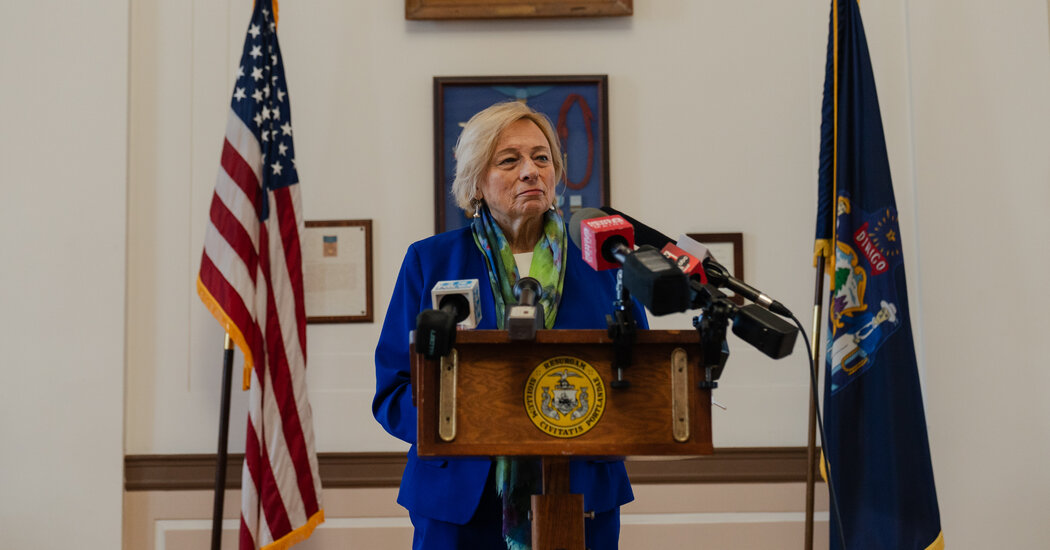
The cold, salt-streaked air of Maine has always nurtured a unique breed of independent-minded politics, but the latest developments in the state’s Democratic Senate primary have introduced a level of personal drama and strategic recalculation rarely seen even in this famously independent battleground. At seventy-eight years old, Governor Janet Mills is a figure of undeniable resilience, having guided her state through turbulent political waters over two terms with a pragmatic, steady-handed approach that earned her deep local respect and the coveted endorsement of Senate Minority Leader Chuck Schumer. When Mills stepped back from the active campaign trail in late April, many national observers assumed her departure was absolute, a graceful concession to the surging, youthful energy of her opponent, the progressive outsider Graham Platner. Yet, in a candid and calculated interview with Steve Collins of The Portland Press Herald, Maine’s premier newspaper, Mills shattered that assumption with a quiet, powerful reminder to the electorate: she is still very much an option. With the poise of a seasoned prosecutor and the tactical awareness of a veteran politician, Mills clarified that she had merely suspended her active campaigning rather than fully withdrawing, ensuring her name remains printed on the upcoming primary ballot. This calculated move was not just a bureaucratic technicality; it was a lifeline thrown to moderate and anxious Democrats who find themselves suddenly adrift, watching their presumptive nominee struggle under the weight of mounting personal controversies. By re-entering the public discourse at this critical juncture, Mills has humanized the agonizing choice facing Maine voters, presenting herself not as an ambitious seeker of power, but as a reliable, known quantity ready to step back into the breach if the party’s rising star should burn out before reaching the general election. This political maneuver reflects her profound understanding of the voting public’s psychological need for stability in uncertain times.
To understand how the Democrats arrived at this volatile crossroads, one must look to the compelling, albeit complicated, figure of Graham Platner. At forty-one years old, Platner represents a stark contrast to the traditional political class; he is an oyster farmer, a man whose hands are calloused by the cold waters of the Atlantic, and whose political identity is deeply intertwined with the working-class struggles of coastal Maine. His campaign began as a grassroots phenomenon, galvanizing a passionate coalition of progressives, young voters, and environmental activists who saw him as an authentic voice capable of bringing real, systemic change to Washington. This raw, populist momentum was powerful enough to nudge Governor Mills, despite her formidable establishment support and decades of public service, out of the race in April, signaling what many believed to be a major generational and ideological shift within the state’s Democratic Party. Platner’s appeal lay in his complete rejection of polished, focus-grouped political rhetoric, presenting himself instead as an ordinary citizen fighting for local communities against entrenched corporate interests. However, the very authenticity that fueled his rapid, historic ascent has now become a double-edged sword, as the transition from the quiet solitude of working on an oyster boat to the harsh, unforgiving spotlight of national politics has laid bare his personal flaws and past indiscretions. The human element of Platner’s journey is one of meteoric promise colliding with the severe, unrelenting reality of modern political vetting, leaving his fervent supporters to wrestle with whether their champion’s ideological purity can outweigh his escalating personal liabilities. It is a classic narrative of a well-meaning outsider who discovers that the political arena demands a level of personal scrutiny for which his quiet coastal life had left him entirely unprepared.
The storm currently threatening to derail Platner’s political aspirations is not his first brush with controversy, but it is undoubtedly the most intimate, embarrassing, and damaging yet. His campaign had previously managed to weather intense public scrutiny over a tattoo resembling a Nazi symbol—which he quickly explained was an unfortunate misunderstanding and subsequently had completely covered up—as well as a series of highly inflammatory, historically insensitive Reddit posts from his younger years. But the latest revelations, first reported by The Wall Street Journal and The New York Times, have struck directly at the heart of his personal integrity, revealing that Platner sent sexually explicit messages to as many as six different women since his marriage in 2023. This disclosure has sent shockwaves through the local political landscape, transforming what was once a campaign about economic policy and climate change into a deeply personal debate about character, fidelity, and trust. Platner’s reaction to these reports has been defensively combative rather than apologetic; he lashed out at the national media, branding the investigative reporting as “journalistic malpractice” designed to distract working-class voters from the urgent issues of economic inequality and corporate greed. Within this political firestorm lies a quiet, painful human drama: a young marriage thrust into the national spotlight, with Platner’s wife, Amy Gertner, choosing to stand publicly by her husband in the face of widespread public embarrassment. This domestic loyalty has become a central defense for the Platner campaign, though it does little to ease the deep anxieties of party leaders who fear that a candidate with such a complicated, volatile personal history is uniquely vulnerable in a high-stakes general election.
The anxiety rippling through the Democratic Party is deeply rooted in the mathematics of the United States Senate and the formidable opponent waiting for them in November. Senator Susan Collins is a political institution in Maine, a five-term Republican moderate who has repeatedly demonstrated an uncanny ability to win re-election even when top-of-the-ticket Democratic presidential candidates, like Kamala Harris in 2024, carry the state by comfortable margins. Maine remains a unique political anomaly—the only state won by Harris that currently features a competitive Senate seat held by a Republican—making it the crown jewel of the Democratic strategy to reclaim the Senate majority. To achieve this, Democrats must defend every seat they currently hold nationwide and successfully flip at least four Republican-held seats, a mathematical challenge that leaves absolutely no room for strategic errors or self-inflicted wounds. The distraction caused by Platner’s personal conduct is highly frustrating to party strategists, who recognize that defeating a resilient incumbent like Collins requires a disciplined, focused campaign that can appeal to Maine’s independent-minded, middle-of-the-road voters. In a state where split-ticket voting is a cherished tradition, the Democratic nominee must project stability, maturity, and moral clarity; qualities that Governor Mills possesses in abundance, but which Platner’s unfolding scandals have thrown into serious question, forcing the electorate to reconsider their priorities. This pressure has turned the primary from a simple choice between moderate and progressive ideologies into a high-stakes calculation about which candidate possesses the personal durability to survive a bruising statewide campaign against a legendary campaigner who has dominated Maine politics for decades.
In the midst of this internal crisis, some of the nation’s most prominent progressive voices have stepped forward to defend Platner, arguing that the focus of the election should remain firmly on policy rather than personal failures. Senator Bernie Sanders of Vermont, an early and influential booster of Platner’s campaign, publicly downplayed the significance of the texting scandal, urging voters and journalists alike to concentrate on the systemic economic issues plaguing working families rather than the intimate details of Platner’s marriage. Sanders’ defense highlights a fundamental ideological divide within the modern progressive movement: the belief that a candidate’s commitment to healthcare reform, environmental preservation, and labor rights is ultimately more important than their personal adherence to traditional moral standards. This perspective asks voters to compartmentalize their moral judgment, viewing Platner’s marital transgressions as a private matter between him and his supportive wife, rather than a disqualifying political liability. Yet, this argument ignores the psychological reality of the typical American voter, for whom personal integrity is often seen as a reflection of how a leader will behave when entrusted with public office. This tension between policy and personality has created a profound dilemma for Maine Democrats, who must decide whether to forgive their flawed champion in pursuit of a progressive revolution, or pivot back to a more conventional, safe path represented by the waiting presence of Governor Mills on the ballot. It raises fundamental questions about whether a movement built on systemic justice can be effectively led by an individual struggling with personal accountability.
As the primary election approaches next week, the ultimate decision rests in the hands of Maine’s Democratic voters, who find themselves navigating a complex landscape of political ambition and human vulnerability. Beside Governor Mills, who remains a formidable ghost candidate on the ballot, voter choices also include David Costello, a dedicated former state government official with deep administrative experience in both Maine and Maryland, who offers another quiet, drama-free alternative to the chaotic headlines surrounding Platner. This primary has become a referendum on what voters truly value in their leaders during times of national polarization: the exciting but high-risk promise of a political outsider who carries significant personal baggage, or the steady, predictable governance of a seasoned public servant like Mills. The human heart of this race lies in this collective search for a leader who can balance the fiery passion required to challenge the status quo with the emotional maturity and personal discipline needed to withstand the grueling demands of public office. Ultimately, the voters of Maine must look beyond the tabloid headlines and politically calculated statements to decide what kind of representative they want carrying their hopes to Washington, knowing that their choice will resonate far beyond their scenic coastline and could shape the balance of power in the nation’s capital for years to come. In the quiet of the voting booth, they will weigh the promise of a flawed idealist against the comfort of a proven leader, shaping the future of their state and the nation.