





For countless working families across Michigan, the daily routine of raising children is a fragile balancing act, suspended between the demands of employment and the grueling search for safe, reliable, and affordable childcare. In a climate where parents must routinely join months-long waiting lists and stretch their household budgets to the breaking point just to secure a safe environment for their toddlers, public childcare programs are not merely bureaucratic policy lines; they are vital lifelines. It is against this backdrop of widespread parental exhaustion and systemic scarcity that a deeply troubling investigation has emerged in Clinton Township, capturing the attention of state lawmakers and sparking widespread public outrage. At the center of the controversy is a local facility known as 1st Premier Learning Academy & Daycare, which officially operated under the corporate umbrella of Premier MI Network Clinton Twp. Over a multi-year period stretching from fiscal year 2023 through 2026, this single facility was quietly allocated a staggering $1,121,641 in taxpayer-funded reimbursements through the state’s Child Development & Care (CDC) program—a public initiative specifically funded to help low-income families offset the soaring costs of early childhood education. Yet, despite the vast sum of public wealth flowing into its accounts, a sudden, intensive probe launched by the Michigan House Oversight Subcommittee on State & Local Public Assistance Programs has uncovered a jarring reality: the bustling learning academy described in state financial ledgers appears to be nothing more than a ghost. Rather than a vibrant space echoing with the sounds of playing children and caring teachers, investigators discovered a locked, silent, and deserted building that shows absolutely no physical evidence of ever actually operating as a functional childcare center during the years it collected over a million dollars in public support.
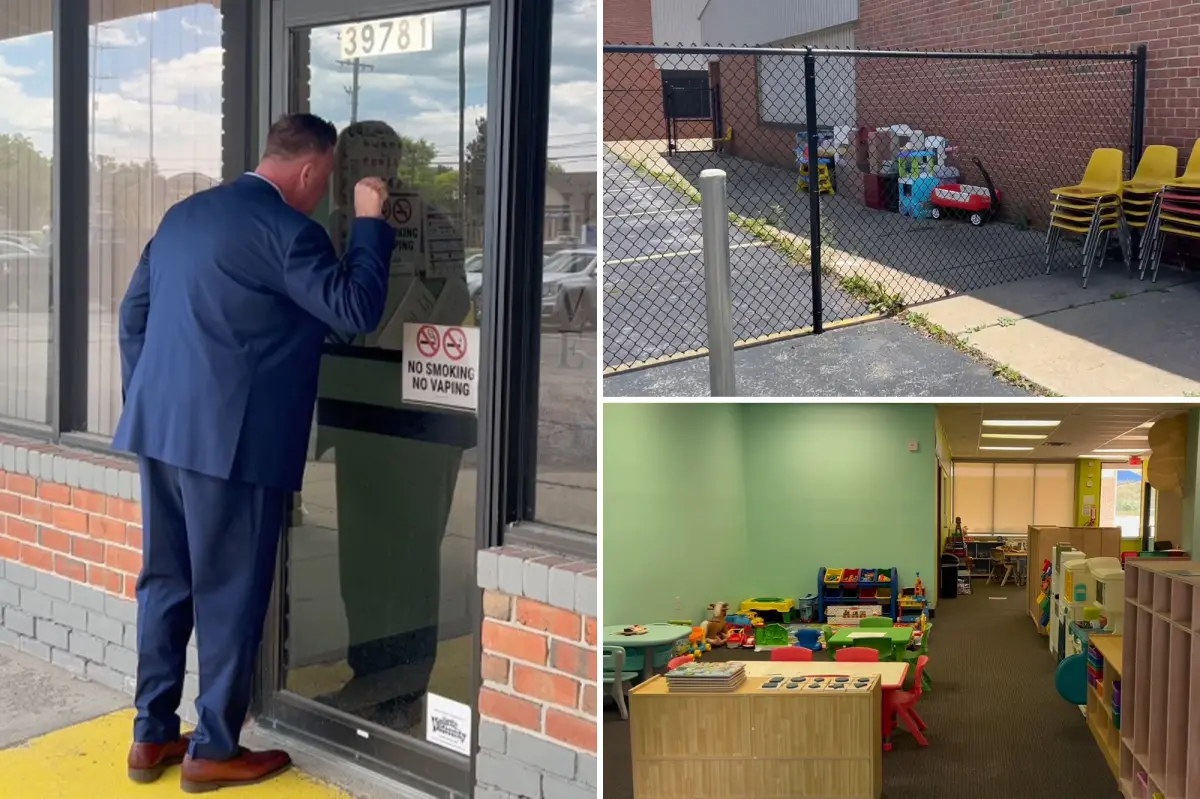
The physical reality of the site at 39781 Garfield Road stands in stark, eerie contrast to the warm, nurturing environment that taxpayers believed they were funding. When committee staff members first initiated their investigation and conducted unannounced site visits during regular business hours, they did not find a bustling classroom of eager toddlers or busy caregivers preparing lunch. Instead, they were greeted by heavy, locked doors, drawn blinds, and a profound, unsettling silence. Although the facility’s official operating hours indicated it should have been in full swing, the interior was utterly devoid of human life; while lights were left burning inside to give the superficial illusion of activity, not a single child or staff member could be seen through the glass windows. Even more alarming was the revelation concerning the building’s regulatory history. The address listed for 1st Premier Learning Academy & Daycare actually bore the external signage of “Kidz in Motion Early Learning Institute”—a completely different childcare provider whose state-issued operating license had already been officially marked as closed. When investigators pulled regulatory files to verify who was currently authorized to watch children at the location, they made another stunning discovery: they were completely unable to locate any active, valid state childcare license registered under the name of 1st Premier Learning Academy & Daycare. Phone calls made to the facility’s publicized contact numbers during normal operating hours yielded no direct human connection, routing immediately to an automated, sterile off-site answering service that offered no real answers about the true nature of the business.
To understand the full depth of this mystery, one must look at the physical decay and neighborhood isolation that characterized the property, which was vividly documented during a personal follow-up inspection conducted on June 15 by Subcommittee Chairman Representative Jason Woolford. Standing outside the locked entrance, Woolford knocked repeatedly, but his calls went entirely unanswered. Walking around the exterior, he discovered an unlocked rear door, but when he stepped inside and called out into the quiet building, his voice merely echoed back through empty rooms. The outdoor play area, which should have been a sanctuary of physical activity, laughter, and high-energy games, was perhaps the most depressing testament to the facility’s abandonment. Rather than a modern, safe playground, Woolford documented a desolate, fenced-in asphalt parking lot where wild, unkempt weeds and tall grass were aggressively pushing their way up through the cracks in the pavement. A single, weathered plastic playhouse lay pushed discardingly against the side of the brick building, and a stack of faded children’s plastic chairs sat abandoned in the elements, their seats filled to the brim with stagnant rainwater from past storms. This image of neglect was supported by those who worked in the immediate vicinity; employees at a neighboring café and workers in adjacent storefronts, some of whom had operated their own businesses in the complex for decades, confessed to investigators that they had never once seen a single child enter or leave the facility, noting that the only activity they ever occasionally observed was sporadic, quiet construction work.
This disturbing discrepancy raises massive systemic and financial questions regarding corporate oversight and the mechanisms of state-level accountability. According to the House Oversight Committee’s report, the paper trail of 1st Premier Learning Academy & Daycare leads directly to a Chicago-based corporate entity known as Premier Early Childhood Education Partners LLC. This parent company is not a small, fly-by-night operation; it owns and manages a portfolio of several legitimate, active, and fully functioning childcare centers across the state of Michigan. Yet, somehow, their Clinton Township branch managed to harvest approximately $1.12 million in state CDC childcare reimbursements over a three-year period without raising any red flags within the state’s regulatory system, despite the apparent absence of children, staff, or even an active license. The revelation has exposed a massive, systemic vulnerability in how public assistance programs are audited and managed, leading many to wonder how a corporate network could consistently request and receive millions in public funds without being subjected to basic, routine physical verification of their operations. As the Oversight Committee continues to dig into the company’s financial records and administrative practices, the public is left demanding to know if this was a case of massive bureaucratic neglect, a sophisticated corporate shell game, or a localized administrative failure that slipped quietly through the enormous cracks of a overburdened state welfare infrastructure.
The societal and human impact of this potential fraud extends far beyond the dry logistics of state audits and corporate spreadsheets; it strikes at the very heart of community trust and the dignity of public assistance. Every dollar of the $1.12 million that was funneled into this non-existent Clinton Township classroom represents a stolen opportunity for families who are genuinely struggling to survive in a highly competitive economy. In Michigan, low-income parents frequently have to make agonizing choices between paying for rent, buying groceries, or staying home from work because they cannot afford the astronomical cost of local childcare. When public funds meant to alleviate this heavy burden are instead absorbed by empty, locked facilities, it deprives actual, hardworking child providers of the resources they need to pay their staff fair wages, keep their classrooms clean, and offer high-quality early childhood education. To the parents who sacrifice daily to support their children, the sight of a weed-choked asphalt playground and an empty, locked building funded by their tax dollars is a deeply painful reminder of how easily the systems designed to protect the vulnerable can be manipulated and exploited by corporate entities operating far away from the communities they claim to serve.
As the Michigan House Oversight Subcommittee continues its aggressive investigation, the spotlight remains firmly fixed on the empty building on Garfield Road, served as a silent monument to a failure of oversight that lawmakers are determined to correct. While representatives from the Chicago-based parent company, Premier Early Childhood Education Partners LLC, have been contacted for comment, they have yet to offer a clear public explanation for why their Clinton Township location received massive sums of public money while failing to provide any discernible care to the community’s children. Although no formal criminal charges have been filed at this stage of the investigation, the committee’s findings have already sent shockwaves through the state government, prompting urgent demands for sweeping reforms in how childcare licenses are monitored and how public reimbursements are verified. Representative Woolford and his legislative colleagues have made it clear that this investigation is only the beginning of a broader campaign to restore transparency, enforce accountability, and ensure that every single penny of taxpayer money is directly used to support real families, real children, and real educators who are working tirelessly to build a better future for the state of Michigan.