


The modern experience of commercial air travel is defined by a silent, unspoken social contract: hundreds of strangers, packed shoulder-to-shoulder in a pressurized metal tube soaring miles above the earth, agree to suspend their individual anxieties and respect the shared peace of the cabin. On the afternoon of January 24, 2024, as a flight prepared to make its routine journey from the damp skies of Seattle to the sun-drenched valley of Las Vegas, the passengers on board settled into this familiar, comforting rhythm, adjusting their seats, closing their eyes, and looking forward to their arrival. Among them sat Julio Alvarez Lopez, a fifty-something Mexican national who had lived under the stability and promise of lawful permanent residency in the United States since securing his legal status in 2018. To the casual observer, Lopez might have appeared to be just another ordinary traveler, recognizable only by his gray-white hair tied in a distinctive topknot and an unpretentious, casual sweatshirt. However, beneath this unremarkable exterior, a severe, silent, and terrifying psychological fracture was rapidly unfolding within his mind. Long before he even set foot on the bustling jet bridge at the departure gate, Lopez had succumbed to a dark, consuming paranoia, one that compelled him to deliberately fabricate a crude but highly lethal weapon by tightly binding three ordinary plastic writing pens together with elastic hairbands. Once settled into his seat on the aircraft, his deep internal distress manifested as a series of bizarre, repetitive physical compulsions that gradually drew the anxious, curious gazes of his fellow passengers. Witnesses later recalled that Lopez was intensely fidgety and visibly disturbed; he repeatedly pulled a pair of gloves onto his hands only to rip them off moments later, reached feverishly into his backpack to check on his hidden belongings, and went to extreme lengths to avoid making any form of direct eye contact with anyone who passed by his row. This silent, frantic display of psychological disintegration was the quiet before a catastrophic storm, an unnoticed warning sign that a desperate, isolated, and deeply disturbed passenger was preparing to shatter the safety of the flight in the most violent way imaginable.
The fragile illusion of safety that protects passengers during flight evaporated entirely approximately thirty minutes before the plane was scheduled to touch down at Harry Reid International Airport in Las Vegas. As the pilots initiated their descent and the seatbelt signs illuminated, signalling the beginning of the end of a mundane trip, Lopez stood up and made his way to the aircraft’s restroom, a movement that initially seemed routine but served as the final, agonizing prelude to an unprovoked nightmare. Upon returning to the main cabin, Lopez did not slide back into his seat; instead, he launched a sudden, ferocious, and incredibly brutal assault on a fellow passenger, identified in federal criminal complaints only by the initials C.R., who was seated directly across the aisle. With no warning, no prior conversation, and absolutely no personal connection to his target, Lopez began punching and stabbing at the defenseless man with his hand-crafted pen weapon, striking with a primal intensity that sent immediate shockwaves of terror through the surrounding rows. The confined space of the aircraft cabin, laid out so compactly that escape is physically impossible, became an arena of raw survivor instinct as C.R.’s wife screamed in absolute horror, desperately trying to pull the violent assailant away from her husband while simultaneously shielding their vulnerable seven-year-old son from the rain of blows. During the chaotic, desperate struggle, the mother was herself struck by Lopez’s wild, repetitive swings as she used her own body as a human shield to protect her child from the bloody violence unfolding inches from his face. Passengers nearby described a scene of absolute pandemonium, noting that within seconds, blood splattered across the seats, the tray tables, on the walls, and down the floor of the narrow aisle, transforming a standard commercial flight into a chaotic, blood-drenched chamber of horror suspended miles above the Nevada desert.
In the immediate aftermath of the initial, bloody ambush, as the echoes of panicky screams reverberated through the cabin, the threat shifted from localized violence to a potential catastrophe for the entire aircraft. Covered in blood and clutching his makeshift weapon, Lopez disengaged from his writhing victim and began to pace aggressively toward the front of the airplane, marching up the narrow aisle toward the cockpit door in a state of high, erratic agitation. Witnesses watched in paralyzed terror as he repeatedly yelled out a singular, chilling demand over the roar of the engines: “I’ll only talk to the FBI!” The terrifying prospect of an unstable, violent individual attempting to breach the flight deck or seize control of the aircraft galvanized the cabin into action, demonstrating the profound, immediate courage that ordinary people can summon when faced with mortal peril in a locked metal tube. Fortunately, an off-duty law enforcement officer was traveling aboard the flight, and he immediately stepped into the aisle, confronting Lopez with authoritative commands to halt his advance and sit down. Seizing this critical moment, flight attendants rushed forward carrying plastic flex cuffs, while several brave passengers threw themselves into the fray, risking their own lives to tackle Lopez, pin him to the floor, and secure his wrists behind his back. Together, this makeshift, spontaneous coalition of flight crew and ordinary travelers managed to physically subdue the struggling assailant, keeping him pinned down to the floor for the agonizing, high-tension final stretch of the flight. For the remaining passengers, those thirty minutes felt like an eternity, watching a bound, bleeding man mutter under his breath while the pilots expedited their descent, navigating the immense psychological stress of a compromised cabin to bring the aircraft safely down to the runway.
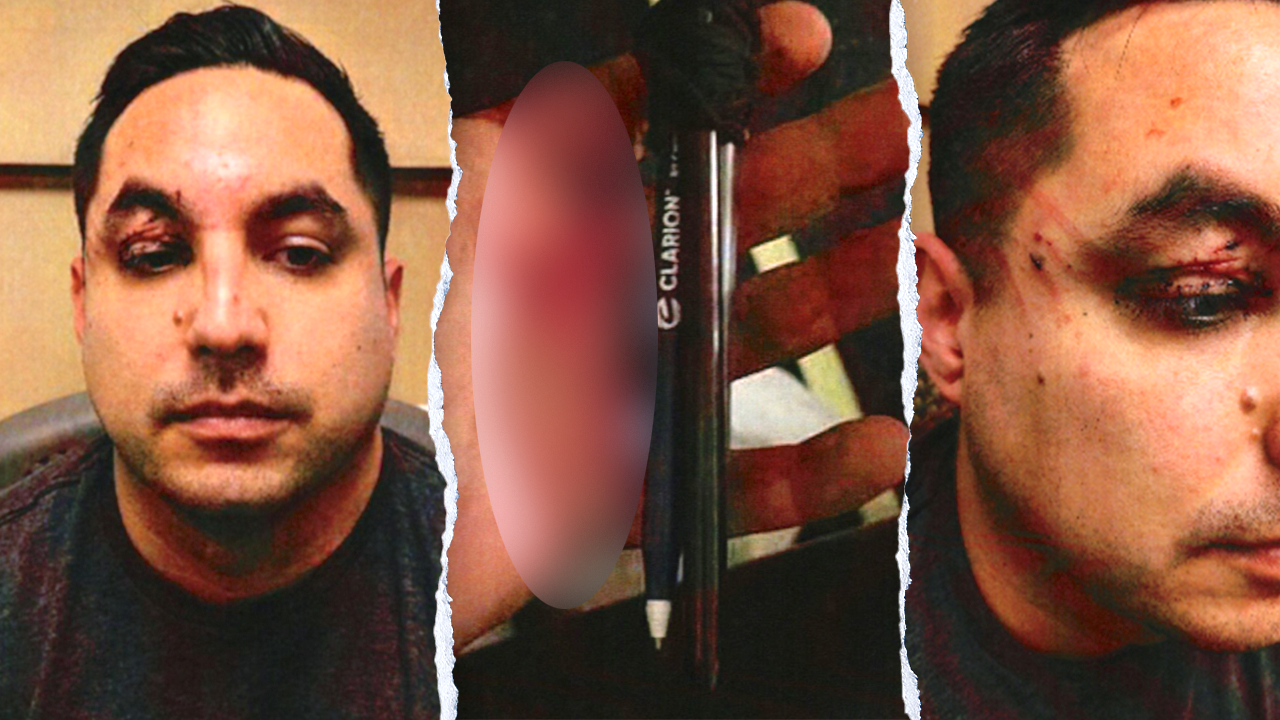
When the tires finally screeched onto the tarmac at Harry Reid International Airport, the plane taxied straight to a secure terminal where emergency vehicles and tactical units were already waiting with flashing sirens. Officers with the Las Vegas Metropolitan Police Department immediately boarded the vessel, taking custody of a bound and bloodied Lopez, while medical personnel rushed on to attend to the physically and emotionally devastated family who had borne the brunt of the assault. For C.R., the physical toll of the unprovoked attack was severe, requiring immediate hospitalization for deep lacerations, trauma to his face, and complex injuries around his eye that required extensive, delicate stitching to repair. Meanwhile, inside a secure federal interrogation room, FBI agents sat down with Lopez, who voluntarily waived his Miranda rights, to unpack the deeply disturbing and bizarre motives behind an attack that seemed to defy all rational explanation. What emerged from the interview was not a calculated plot of international terrorism or political radicalism, but rather the tragic, shattered psyche of a man thoroughly consumed by violent, persecutory delusions. Lopez explained to the investigators that he had never in his life seen C.R. before boarding the flight in Seattle, but had become utterly convinced during the journey that the stranger was an operative of “the Cartel” who had been dispatched to follow and ultimately execute him. He claimed that he had spent the last several months running for his life from a shadowy, omnipresent mafia syndicate, and that his desperate flight to the United States was part of an attempt to seek political asylum from these imagined tormentors, turning a routine passenger flight into what he believed was a high-stakes, life-or-death battle for his own survival.
Yet, despite the manifest presence of severe, untreated mental illness, the details of Lopez’s planning revealed a chilling level of calculated, mechanical intent that elevated his actions from a tragic psychological breakdown to a severe federal crime. He confessed to FBI investigators with shocking, cold-blooded clarity that he had not merely intended to wound C.R. or scare him away; rather, he had boarded the aircraft with the explicit, predetermined goal of ending the man’s life. He detailed the biomechanical specifics of his plan, admitting that he had bundled the three plastic pens together with the precise intention of driving them directly through C.R.’s eye socket, aiming to penetrate the bone and reach the brain to ensure a fatal blow. This horrific admission of premeditated intent cast a dark shadow over the entire incident, showing that even within the grip of deep delusion, Lopez possessed the presence of mind to design a lethal weapon, evaluate his target, wait for a moment of maximum vulnerability during the plane’s descent, and execute a strike designed for maximum lethality. The fact that he was able to easily bypass airport security with the components of his weapon—items as seemingly mundane and innocuous as writing pens and hairbands—exposed a haunting vulnerability in modern aviation security, proving that a determined individual can transform everyday personal artifacts into deadly instruments of violence. Consequently, the U.S. Attorney’s Office for the District of Nevada fast-tracked the prosecution, leading to Lopez’s formal guilty plea to a federal count of assault with a dangerous weapon, a charge that carried the weight of his terrifyingly deliberate actions.
As Julio Alvarez Lopez awaits his official sentencing, scheduled for September 22 in a Nevada federal courtroom, the ripples of his mid-air assault continue to serve as a stark reminder of the fragile nature of public safety and the devastating human cost of untreated mental health crises. For the victim, C.R., and his family, the physical wounds will gradually heal under medical care, but the profound psychological scars of having their safety shattered at thirty thousand feet—in a confined space where there is no escape, no immediate police presence, and no avenue for retreat—will undoubtedly linger for a lifetime. In particular, the young seven-year-old boy who watched his father bleed and his mother use her own body as a shield against a crazed attacker will carry the mental weight of this trauma long into his adulthood. This tragic case sits at a complicated, deeply uncomfortable intersection of public mental health advocacy, transportation security protocols, and international asylum systems, forcing a broader societal reflection on how we, as a community, identify and assist individuals suffering from extreme persecutory delusions before their internal terror spills over into horrific acts of public violence. Government agencies and airline regulators will likely review this incident to determine how to better prevent passenger security breaches, but tech and policy can only do so much to secure the human element. The justice system will soon deliver its final verdict, locking away a man who genuinely believed he was fighting a desperate battle for survival against a phantom cartel, but no jail sentence can truly restore the peace of mind stolen from the passengers on that flight. Ultimately, this harrowing event underscores a sober, inescapable truth about our modern, highly networked world: that behind the routine, automated travel systems designed to carry us safely to our destinations, we remain deeply, fundamentally vulnerable to the unpredictable and chaotic depths of the human psyche.