





The atmosphere inside Madison Square Garden on the monumental evening of Saturday, June 13, 2026, was thick with the accumulated weight of fifty-three years of desperate hope, psychological trauma, and unyielding expectation, all of which evaporated into the stratosphere in a single, gloriously chaotic microsecond as the final buzzer echoed through the historic arena. The New York Knicks, a franchise whose identity had for over half a century been defined by a bittersweet nostalgia for its golden era in the early 1970s, had finally climbed back to the absolute apex of the basketball world, putting an exclamation point on Game 5 of the NBA Finals with a gritty, hard-fought triumph over a formidable and relentless San Antonio Spurs squad. As the golden and blue confetti began its slow, sparkling descent from the rafters, dusting the glossy hardwood in a shimmering blanket of hard-earned victory, the players collapsed into tearful, exhausted embraces, their faces a raw tapestry of relief and pure, unadulterated ecstasy. Celebrated photographers from Getty Images captured the defining image of this new epoch: sweat-drenched, battle-tested modern gladiators, eyes wide with the realization of their newly minted immortality, hoisting the gleaming Larry O’Brien Championship Trophy toward the heavens as if offering a sacred tribute to the legends who paved their way. In their trembling hands, the physical trophy was far more than an assembly of silver and gold; it represented the redemption of a franchise that had survived decades of punchlines, administrative turbulence, agonizing near-misses, and the persistent, crushing anxiety of a city that demands nothing short of perfection. Each camera flash that illuminated the court told a story of sacrifice—veterans who had traveled the league in search of a home, young stars who blossomed under the intense, unforgiving glare of the Manhattan spotlight, and a coaching staff that engineered a masterpiece of modern basketball.
While the glossy hardwood of Madison Square Garden served as the stage for the formal presentation of the championship cup, the true, beating heart of this monumental victory immediately manifested itself on the concrete canvas of the surrounding city streets, transforming midtown Manhattan into a roaring, pulsating sea of blue and orange within moments of the final horn. Captured in a series of breathtaking, documentary-style photographs by Brenden Willsch for Imagn Images, the scene directly outside the legendary arena on Seventh Avenue was nothing short of a massive, spontaneous spiritual revival, as tens of thousands of ecstatic fans spilled out of nearby local taverns, subterranean subway entrances, and high-rise apartments to claim the public spaces of their beloved city. Perfect strangers, normally separated by the disparate socioeconomic realities of life in a colossal metropolis of over eight million people, found themselves locked in emotional, tearful embraces, united by a profound, generational catharsis that defied simple explanation or logic. The night air quickly grew thick and fragrant with the acrid, exciting scent of blue and orange smoke flares, transforming the iconic New York streetscape into a dreamlike, hazy wonderland through which the marquee of the world’s most famous arena glowed like a triumphant beacon. Taxicabs, city buses, and private vehicles became completely immobilized in a joyous, gridlocked celebration, their drivers happily abandoning their steering wheels to climb onto hoods and roofs, joining in the deafening, rhythmic chorus of chants that bounced off the towering, glass-and-steel skyscrapers. It was an overwhelming sensory experience of pure human connection, demonstrating how a sports team’s success can deeply knit itself into the collective soul of an urban population, transforming ordinary commuters into ecstatic participants in a historical event they would recount for the rest of their lives.
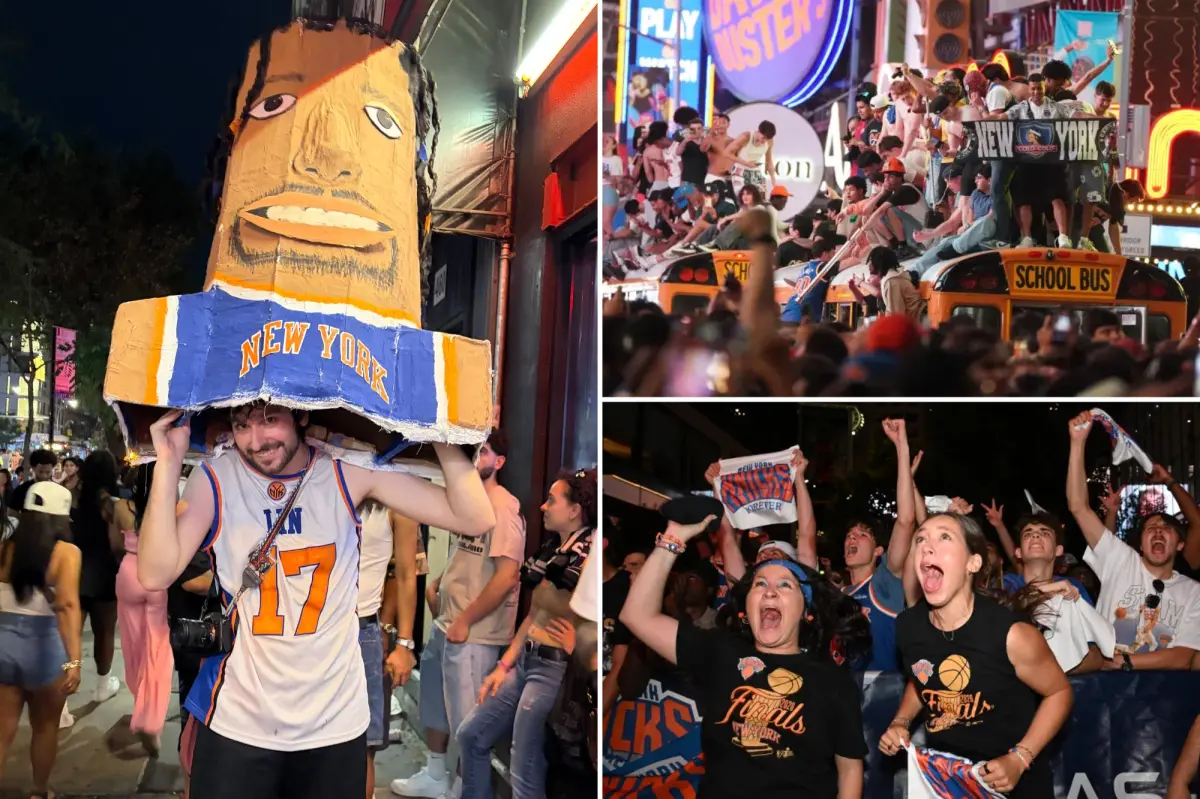
As the initial wave of celebration expanded outward from the epicenter at the Garden, the emotional center of gravity for the city’s historic night naturally gravitated toward the neon-bathed crossroads of the world—Times Square—where the festivities took on a highly cinematic, surreal quality that perfectly encapsulated the chaotic, beautiful essence of modern corporate and urban life. Among the most iconic and visually arresting documents of this unforgettable night was a photograph captured by Christopher Sadowski for the New York Post, depicting a group of daring and exuberant fans who had scaled the roof of a classic yellow school bus parked amidst the gridlock near the intersection of Broadway and 42nd Street, utilizing the vehicle as an impromptu stadium stage to orchestrate the chants of the massive crowds below. Bathed in the brilliant, multi-colored glow of towering digital billboards advertising Broadway blockbusters and global consumer brands, these young fans stood silhouetted against the dark sky like conquerors of old, waving flags and championship shirts with a frantic, infectious stamina that galvanized the thousands of onlookers packed shoulder-to-shoulder on the pavement. The scene represented a masterclass in spontaneous urban reclamation, showing how easily a highly curated and commercialized space could be instantly transformed back into a democratic playground for the local community in a moment of genuine, shared triumph. People from every conceivable walk of life—commuters on their way home, international tourists who suddenly found themselves witnessing living history, and lifelong outer-borough residents who had rushed to Manhattan to feel the pulse of the crowd—stood side-by-side in a state of collective awe, capturing the madness on their smartphones while simultaneously surrendering to the overwhelming, tribal rhythm of a city united in joy.
To fully appreciate the profound depth of human emotion that flooded the streets of New York on this historic evening, one must look far beyond the colorful visual spectacle and delve deeply into the immense generational weight and cultural narrative that this specific championship carried for the city’s long-suffering population. For exactly fifty-three years, ever since the legendary duo of Walt “Clyde” Frazier and Willis Reed guided the franchise to its last NBA title in the spring of 1973, supporting the New York Knicks had been a masterclass in resilient, painful loyalty—a hereditary inheritance of unrequited love passed down from parents to children through decades of heartbreaking playoff exits, mismanagement, and unfulfilled promises of salvation. On this magical Saturday night, grandparents who had watched the 1973 championship on bulky, curved cathode-ray tube television sets stood weeping alongside grandchildren who had only ever known the team’s historical greatness through grainy archive footage on social media, united at last in a shared, living experience of victory. This championship was a poetic tribute to the grittier, blue-collar identity of a city that prides itself on its toughness and collective work ethic; the 2026 Knicks had won not through superficial glamour or fortune, but through the grueling, defensive-minded, and self-sacrificing style of basketball that New York fans respect above all else. By systematically dismantling a highly disciplined and heavily favored San Antonio Spurs team, this squad did not merely win a professional sports trophy; they validated the decades of stubborn, irrational faith exhibited by a fanbase that refused to walk away during the darkest eras, proving once and for all that when glory is finally achieved after an eternity of waiting, the taste of victory is sweet enough to justify every single tear shed along the way.
In our modern, hyper-connected digital age, a civic milestone of this colossal magnitude demands swift official recognition, which materialized in the early hours of Sunday morning when New York City Mayor Zohran Mamdani utilized social media to officially proclaim the city’s triumphant intentions to honor their new champions with a legendary ticker-tape parade down Broadway. The Mayor’s highly anticipated announcement, which spread across platform X (formerly Twitter) with the speed and intensity of a summer brushfire, adopted a tone of unbridled joy and lighthearted civic pride, mirroring the ecstatic mood of the millions of constituents currently celebrating in the streets below City Hall. Rather than merely presenting a cold, administrative list of times and transit closures, Mamdani’s post spoke directly to the heart of the New York experience, acknowledging the relentless passion of the fans, praising the team’s blue-collar work ethic, and promising a celebration through the majestic Canyon of Heroes that would exceed any public gathering in the city’s modern record. This digital decree functioned as a grand, official validation of the ongoing street parties, elevating the organic, chaotic expressions of happiness into a structured, highly anticipated historical ritual that would soon see oceans of shredded paper and confetti raining down from the financial district’s skyscrapers. The viral tweet perfectly bridged the gap between the celebrated civic traditions of New York’s storied past—where astronauts, world leaders, and sporting legends were showered with paper—and the rapid, real-time communication networks of 2026, creating a singular moment where political leadership and public ecstasy merged into a unified promise of a celebration that would be remembered for generations to other fans across the world.
As the first gentle rays of dawn on Sunday, June 14, 2026, began to illuminate a quieted but deeply transformed metropolis, the true scale of what had transpired began to settle into the collective consciousness of New York, shifting the immediate, explosive ecstasy of the night into a profound, enduring sense of civic peace and anticipation for the historic parade ahead. The litter-strewn corridors of Seventh Avenue, the suddenly tranquil plazas of Times Square, and the echoing, empty subway platforms all seemed to harbor a completely renewed energy, as though the city had finally been purged of a half-century-old sports curse that had loomed over its daily life. The upcoming ticker-tape parade would represent far more than a simple celebration of a victorious athletic team; it would stand as a monument to New York’s enduring resilience, its capacity for boundless collective joy, and the unbreakable, sacred bond that exists between the city’s inhabitants and the beloved cultural institutions that define their identity. The immortalized images of players hoisting the championship trophy high, of fans dancing gleefully atop school buses, of crowds singing in unison outside Madison Square Garden, and of the Mayor’s virtual proclamation would now be preserved forever in the grand annals of sports history, serving as a lasting testament to the night when Gotham truly belonged to the Knicks. Long after the last pieces of shredded paper are cleaned from the streets of Broadway and the players return to their homes for the summer, the memory of Saturday, June 13, 2026, will endure as the moment a fifty-three-year daydream transformed into a beautiful, living reality, cementing this team’s legacy not just as standard champions, but as timeless legends of New York.