






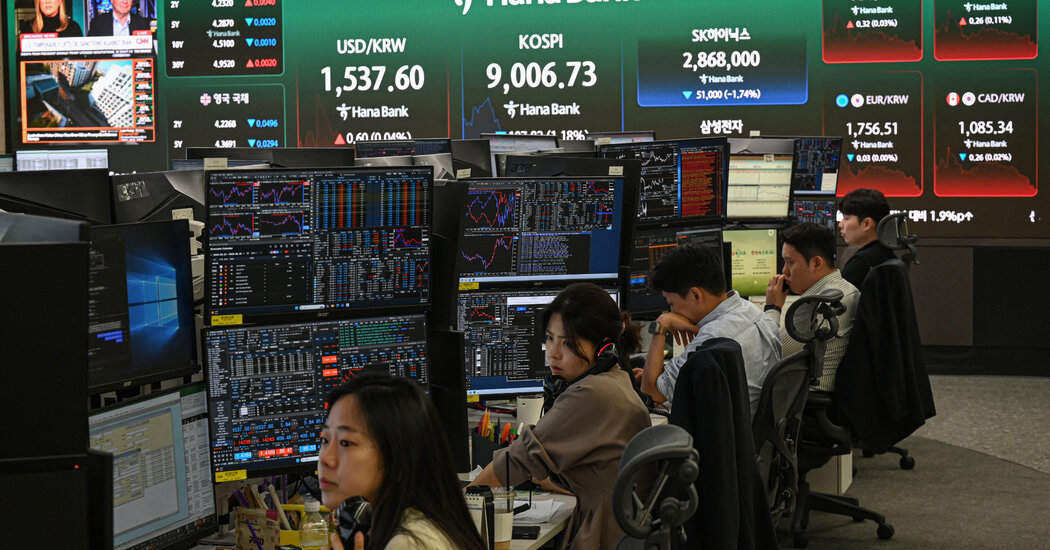
Across the globe on Tuesday, ordinary citizens and seasoned financial professionals alike woke up to the unwelcome, stark glare of red numbers blinking on their screens, realizing that the digital safety nets they had taken for granted were beginning to fray. For many months, the promise of the artificial intelligence revolution had felt less like an aggressive, high-risk speculative venture and more like an absolute economic inevitability, driving major stock indices to dizzying new heights and filling everyday savers with a deep, comforting sense of security. The high-profile technology firms at the very frontlines of software innovation and advanced semiconductor manufacturing had been heralded as the invincible architects of our collective future, their skyrocketing valuations exerting a massive, gravity-defying pull on the benchmark indices that safeguard our retirement accounts, pension funds, and personal nest eggs. Yet, this high-flying reality came crashing down when a sudden, aggressive wave of selling, which had begun in the United States on Monday, transformed into a full-scale rout that reverberated through the financial capitals of the world, hitting Asian markets with devastating force. By the time the trading day fully unfolded, the collective euphoria of this modern technological gold rush was replaced by a cold, sobering realization: the very companies that had single-handedly carried global markets to record-breaking pinnacles were now the primary engines of their decline. This dramatic shift exposed the fragile, deeply human psychology that underpins our global economic architecture, showing how quickly shared confidence can turn to collective anxiety when the momentum of progress suddenly stumbles under its own weight.
Nowhere was this vulnerability more visible than in the American market, where some of the world’s most influential and culturally entrenched technology brands struggled to find their footing in the anxious premarket hours of Tuesday morning. Household giants like Alphabet and Amazon, companies deeply woven into the fabric of our daily lives, communication networks, and global consumption habits, continued their downward trajectory, compounding the bruising losses they had incurred just twenty-four hours earlier. Meanwhile, a particularly dramatic scene played out in the valuation of SpaceX, Elon Musk’s ambitious rocket and artificial intelligence enterprise, which has recently captured the public imagination in ways few other companies ever have. Not long after a triumphant initial public offering that saw eager retail investors pile into the stock to secure a piece of the future, SpaceX found itself caught in a brutal downdraft, shedding more than twenty percent of its market value in a mere three trading sessions. Although the stock managed to defend a position above its original IPO price, the swiftness of the decline served as a harsh, heart-wrenching lesson for ordinary people who had bought into the dream of interplanetary expansion and boundless machine learning. This rapid retreat highlighted the volatile intersection of celebrity leadership, speculative technology, and market reality, leaving many everyday investors to wonder if the lofty dreams of tomorrow had been priced far too high for the fragile economic realities of today.
The shockwaves from the American sell-off traveled eastward across the Pacific with incredible speed, striking South Korea with unprecedented and localized force. South Korea had occupied a proud position as the world’s best-performing stock market since the dawn of 2025, a success story powered by national pride, a robust manufacturing base, and a relentless cultural drive toward technological dominance. However, on Tuesday, the country’s benchmark Kospi index suffered a historic ten percent plunge, sending shockwaves through the local community and prompting the exchange operator to trigger an emergency twenty-minute trading halt to prevent absolute panic. This remarkable market surge over the past year had been fueled almost entirely by the explosive growth of Samsung Electronics and SK Hynix, two national champions whose advanced memory semiconductors are absolutely essential to power global artificial intelligence systems. Enticed by the promise of rapid wealth creation, millions of everyday South Korean citizens—often referring to themselves as “ants” in the domestic trading community—had channeled their hard-earned life savings into these two firms, turning the stock market into a high-stakes arena of hope and unpredictable swings. As shares of both Samsung and SK Hynix cratered by more than twelve percent on Tuesday, these retail investors were left watching in disbelief as their digital portfolios, built on months of optimistic savings, evaporated in the span of a single afternoon.
Amidst the chaos in Seoul, professional market observers attempted to make sense of a landscape that seemed to be actively shifting beneath their feet, trying to find words to comfort a deeply rattled public. Addressing a gathering of anxious investors at a CLSA brokerage conference in the South Korean capital, the firm’s chief equity strategist, Alexander Redman, observed that the way we experience financial crises is undergoing a profound psychological mutation. In previous decades, a one-day market drop of this magnitude would have triggered widespread, paralyzing panic and emergency government interventions; today, however, such violent swings are increasingly treated as a routine, almost mundane feature of a hyper-active trading ecosystem. “It’s unnerving that you’re seeing this kind of volatility,” Redman admitted candidly to reporters, describing the current market environment with the evocative term “very, very frothy.” He acknowledged that in this highly charged, algorithm-dominated landscape, it is nearly impossible for even the most seasoned analysts to determine whether this deep drop is a minor setback from which South Korean tech shares will quickly recover, or if it represents the “beginning of the end” of the great AI-driven bull market. This uncertainty strikes at the heart of the modern investor’s dilemma: trying to discern the difference between a healthy market breath and a catastrophic systemic heart attack in an environment of constant noise.
The anxiety that paralyzed Seoul quickly spread to neighboring economic powerhouses, turning trading screens across Asia a uniform shade of red. In Tokyo, Japan’s Nikkei benchmark saw an alarming decline of 3.6 percent, while key stock markets in Taiwan and Hong Kong both slid by more than one percent, as regional investors rushed to protect their capital from further degradation. The financial malaise did not stop at the borders of the Pacific; as the sun rose over Europe, the continent’s major indexes were instantly pulled down into the slipstream of the global rout. The Stoxx 600, which tracks the health of Europe’s largest corporations, fell by one percent, heavily weighed down by its own prized semiconductor and manufacturing champions. Highly respected enterprises such as Switzerland’s STMicroelectronics, Germany’s Infineon, and the Dutch lithography giant ASML all posted deep, painful losses. This widespread, synchronized decline illustrated the profound, inescapable interconnectedness of our global supply chains; a drop in demand or a shift in sentiment in California or Seoul instantly impacts a worker in Munich or a retirement fund in Amsterdam. It was a vivid reminder that in the modern global economy, we no longer lock ourselves behind geographic borders, and when the hardware that powers our digital future begins to falter, everyone, everywhere, feels the impact.
As the global trading day crawled back toward its origin in the United States, the focus shifted to the impending opening bell on Wall Street, where futures for the S&P 500 were flashing warning signs with a 1.5 percent drop, and the tech-heavy Nasdaq futures were trading a steep 2.5 percent lower. These grim numbers whispered of a difficult day ahead for American workers and pension holders, promising to import the global financial pain right back to where it had originated. This systemic shudder forces us to ask a larger, more deeply human question about our relationship with technology and progress: have we allowed our collective imagination to run too far ahead of what our physical factories and corporate earnings can actually deliver, creating a speculative bubble on the backs of microchips and artificial intelligence? Behind every cold statistic, every percentage point decline, and every corporate earnings report lies a vast sea of human stories—of families rethinking their financial security, retirees watching their nest eggs shrink, and young professionals questioning the stability of the tech industry. As the clock ticked down to the start of the New York trading session, the world waited with baited breath, reminding us that for all our complex algorithms and high-speed data networks, the stock market remains a deeply human theater powered by the oldest emotions of all: fear, hope, and the search for security in an unstable world.