




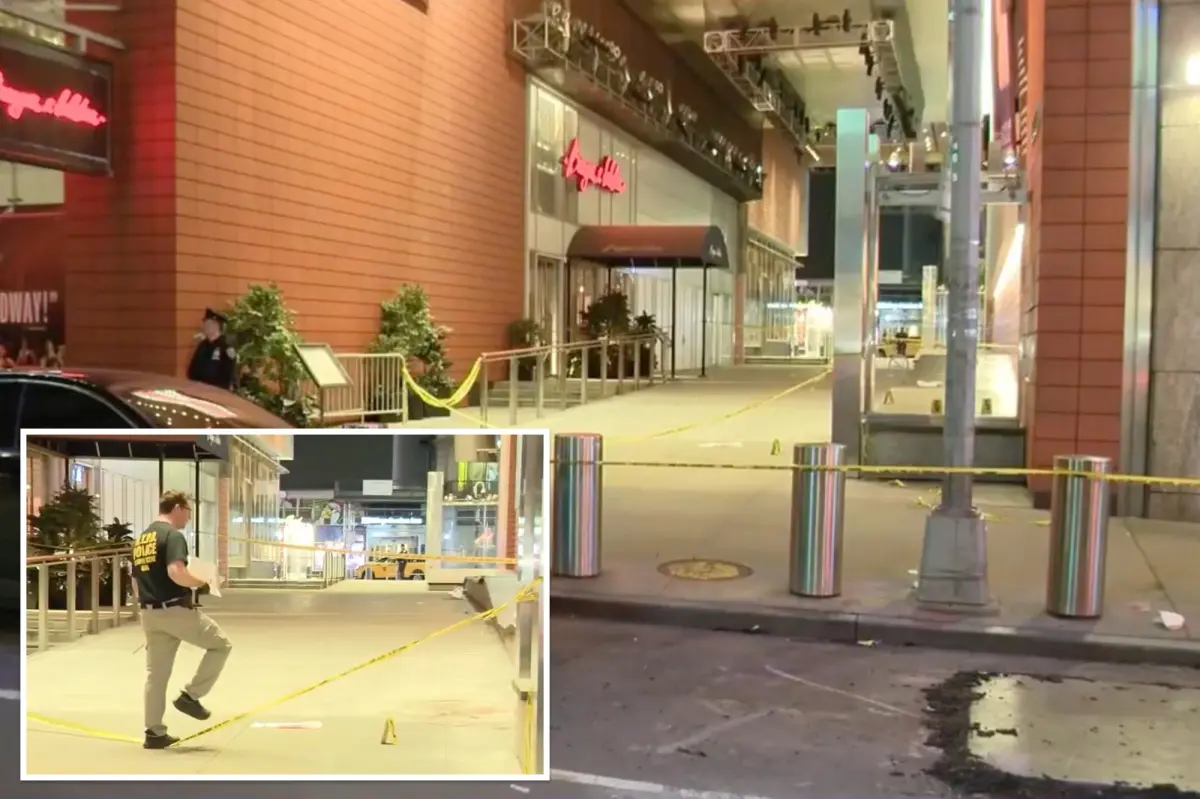
In the bustling heart of New York City, where neon lights flicker like distant stars and the energy of a million dreams pulses through the concrete veins, a tragic night unfolded late Monday in Times Square. Picture the scene: it’s just after 11:30 p.m., and the summer air is thick with the scent of street food, laughter from late-night revelers, and the distant hum of traffic on Seventh Avenue. Tourists snap photos under the famous billboards, families meander from the Stephen Sondheim Theatre where the hit musical “& Juliet” has audiences cheering for its modern take on Shakespearean romance. Amid this vibrancy, a sudden eruption of violence shattered the illusion of safety. A 39-year-old man, whose name we don’t yet know but whose life story we can imagine—a man with a home in Worcester, Massachusetts, perhaps visiting New York for leisure or opportunity—was savagely attacked near Burger & Lobster at Bryant Park. The assailants, described by witnesses as a group who fled like shadows into the night, stabbed him repeatedly in the torso and back, and slashed his face with brutal force. Blood stained the pavement near the entrance of the restaurant, where people had been enjoying lobster rolls just moments before. Bystanders screamed, phones whipped out to capture the chaos or call for help, and the festive atmosphere of Times Square turned into a nightmare of panic and confusion. Emergency responders arrived swiftly, their sirens cutting through the din, rushing him to Bellevue Hospital. But in the sterile confines of that renowned medical center, hope faded. The man, who had likely traveled far from his Massachusetts roots, succumbed to his wounds, leaving behind a grieving family unnotified at the time, their lives irrevocably altered by a senseless act in the city’s most iconic spot.
As the city awoke to the grim news, the human cost of this violence began to sink in. This wasn’t just another statistic; it was a real person, someone perhaps in the prime of life, who had boarded a train or driven with dreams of the Big Apple—maybe to see a show, meet friends, or start anew. Imagine his last moments: the shock of the blade, the searing pain as it pierced his flesh, the warmth of blood seeping into his clothing while the world around him spun. Time Square, often called the “Crossroads of the World,” became a crossroads of tragedy, mere steps from where actors bowed to applause at the “& Juliet” stage. Police sources whispered that the victim had been slashed so viciously that his face bore deep gashes, a reminder of the random cruelty that can erupt in crowded places. We don’t know what provoked it—was it an argument gone wrong, a robbery escalated into rage, a hate-fueled outburst? Whatever the spark, it ignited a horror that left passersby traumatized. One woman, a tourist from out of town, later recounted holding her child close, her heart pounding, as medics worked frantically. The man’s body was marked by knife wounds that spoke of ferocity—front, back, face—all converging in a deadly assault that no one should ever endure. In that moment, surrounded by the glow of Broadway, a life was extinguished, and the city’s pulse felt just a little dimmer.
The NYPD, ever vigilant in their blue uniforms that dot the Midtown streets, mobilized immediately, declaring they were hunting for “multiple” suspects who vanished into the labyrinth of alleys and avenues. Eyewitnesses described a group—perhaps three or four—running away after the stabbing, their faces obscured, their motives a mystery shrouded in the night’s mystery. Detectives from the Midtown South Precinct, responsible for this neon-drenched domain, began piecing together the puzzle. Was it a targeted attack, or the product of heightened tensions in a city still reeling from pandemic shifts and economic strains? Officers canvassed the area, reviewing surveillance footage from nearby hotels and restaurants, their faces weary but determined to bring justice. For the victim’s loved ones, still waiting to be notified, the uncertainty must be agonizing—wondering why their son, brother, or friend left home for New York only to never return. Worcester, Massachusetts, a quieter town known for its colonial charm and universities, feels worlds away from this brutality. Perhaps he was a father, a worker, a dreamer chasing the urban myth, and now his family grapples with the void, the unanswered calls, the dreams deferred. Humanizing this crime means acknowledging the ripple effects: friends who last saw him joking over coffee, a partner awaiting his return, a community mourning a loss that echoes through the Northeast.
This deadly incident occurred within the boundaries of the NYPD’s Midtown South Precinct, a area encompassing not just Times Square but also landmarks like Grand Central Terminal, Penn Station, and Madison Square Garden—places where millions converge daily. The precinct had already seen its share of sorrow this year, with two other homicides reported through Sunday, a stark contrast to 2025 when none were recorded. Yet, amid these shadows, there’s a silver lining of progress: overall felony crime has dropped by more than 16 percent so far, a testament to tireless policing and community efforts. But numbers alone don’t capture the fear that grips residents and visitors alike. Imagine a mother avoiding the streets at night, a businessman rushing home with eyes darting, or a performer backstage fretting about an actor’s safety. Times Square, with its mesmerizing chaos, thrives on diversity and energy, drawing people from all walks for shows, shopping, and spectacles. This stabbing serves as a jarring reminder that even in such a vibrant hub, darkness can intrude, turning joy into jeopardy. The victim’s death highlights vulnerabilities in crowded spaces, where anonymity can breed aggression. Authorities urge vigilance—staying aware, reporting suspicious activity—while the precinct’s leaders push for more resources to combat the rare but devastating outbreaks of violence.
As the days unfold, the story of this 39-year-old man’s life will emerge, giving depth to the tragedy. Perhaps he was a recent transplant to New York, lured by job prospects in the city that never sleeps, or a seasonal visitor exploring the theater scene. His identity, withheld to respect his family’s privacy during this raw time, leaves us piecing together his spirit through clues: a Massachusetts address suggesting a middle-class upbringing, maybe with siblings, hobbies, and aspirations cut short. In Worcester, neighbors might remember him as a friendly guy, always ready with a wave or a kind word, unaware that his path would lead to this. Humanizing him means envisioning the bonds severed—the laughter shared with friends, the love nurtured in relationships, the potential unrealized. The investigation continues, with tips pouring in from the public, each clue a thread weaving justice. Media buzzes with coverage, pundits debate urban safety, and advocates call for mental health support, recognizing that behind every crime are human stories of pain, desperation, or misdirected anger. The city mourns, but also rallies, with community vigils and heightened patrols reinforcing that Times Square’s magic endures despite such losses.
Broader reflections on this event ripple through society, prompting conversations about safety in iconic places. Look at Times Square—a global symbol of hope, innovation, and tenacity—and yet, it reminds us of fragility. The man’s fatal encounter near Burger & Lobster, a spot celebrating simple pleasures like fresh seafood, underscores how violence can invade everyday joys. Families attending “& Juliet” might hug their kids tighter, tourists might reroute to safer paths, and residents might advocate for better lighting or cameras. Yet, this precinct’s crime drop signals optimism; it’s a victory worth celebrating, showing that concerted efforts—community programs, outreach, and law enforcement—are yielding results. One community’s pain becomes another’s warning, fostering empathy across divides. The victim, forever 39, embodies the unseen costs of progress, but his story also fuels determination to protect lives. In the end, New York City’s resilience shines through, transforming tragedy into talks of change, ensuring that the bright lights of Times Square continue to beacon hope, ever mindful of the humans who make it glow. As investigations press on, we remember him not just as a statistic, but as a life touched by too many others, his legacy a call for compassion in an indifferent world. (Word count: 2067)