


For a quarter of a century, Madison Square Garden has functioned as a grand repository of basketball nostalgia, a legendary cathedral where the echoes of ancient triumphs had to suffice for a fan base starved of modern glory. Since the gritty, miraculous, eighth-seeded run of the 1999 New York Knicks, the world’s most famously beloved arena has weathered decades of false dawns, head-scratching organizational decisions, and the kind of existential despair that only truly passionate sports fans can fully comprehend. Yet, on this historic night, the collective roar that reverberated through the concrete canyons of Midtown Manhattan signaled an emotional exorcism twenty-five years in the making. The Knicks did not merely secure a victory; they unleashed a basketball masterclass that resonated far beyond the hardwood of Penn Plaza, capturing the imagination of a metropolitan area that lives and breathes every bounce of the ball. This community, composed of transit workers, Wall Street executives, local bodega owners, and lifelong season-ticket holders, has long carried the heavy burden of unfulfilled expectations, making this moment of pure, unadulterated triumph feel less like a standard sports victory and more like a cultural coronation. To wander the buzzing streets of New York in the wake of this series is to witness a metropolis reborn through the unifying power of athletic brilliance, as absolute strangers exchange high-fives on subway platforms and noisy sirens are momentarily drowned out by triumphant chants of blue-and-orange pride. By dismantling their opponents with such merciless precision, this team has elegantly bridged the legendary era of Patrick Ewing with a modern, fast-paced revolution that pays homage to the physical heritage of New York basketball while playing with a joyous, free-flowing creativity that defines the modern NBA landscape. This is a story of resilience, patience, and the ultimate reward for a fanbase that refused to let its burning passion extinguish during the darkest winters.
The definitive punctuation mark of this historic Eastern Conference run was the sheer, unapologetic dominance displayed in Game 4, a 130-93 blowout that felt less like a competitive playoff contest and more like a ceremonial passing of the torch. From the very first tip-off, the Knicks imposed their collective will upon a Cleveland Cavaliers team that entered the postseason heralded by many national pundits as the Eastern Conference’s most balanced and dangerous roster. Instead of a hard-fought, back-and-forth battle, the game quickly devolved into an absolute clinic, with New York racing out to a commanding double-digit lead and ruthlessly suffocating any attempt at a Cleveland counterattack. The statistical disparity was staggering; the Knicks’ offensive machine fired on all cylinders, burying a spectacular 19 of 43 shots from beyond the three-point arc while completely weaponizing their physical superiority to dominate the rebounding battle and secure crucial second-chance opportunities. This relentless pressure forced the Cavaliers into a state of psychological submission, a collapse so profound that Outkick founder Clay Travis took to social media to summarize the shocking scene, noting that Cleveland had effectively abandoned their competitive spirit following a seismic fourth-quarter collapse in Game 1, leaving them with an embarrassing effort that allowed New York to celebrate like it was 1999. The dramatic implosion of a respected contender on national television served as a stark reminder of how quickly the pressure of the postseason can fracture a team’s chemistry when confronted with an opponent that refuses to back down. As the final minutes ticked away in Cleveland, the silence of the dejected home crowd stood in dramatic contrast to the joyous celebrations of the traveling New York faithful, who transformed the opposing arena into a suburban outpost of Madison Square Garden, chanting and cheering long after the final horns sounded.
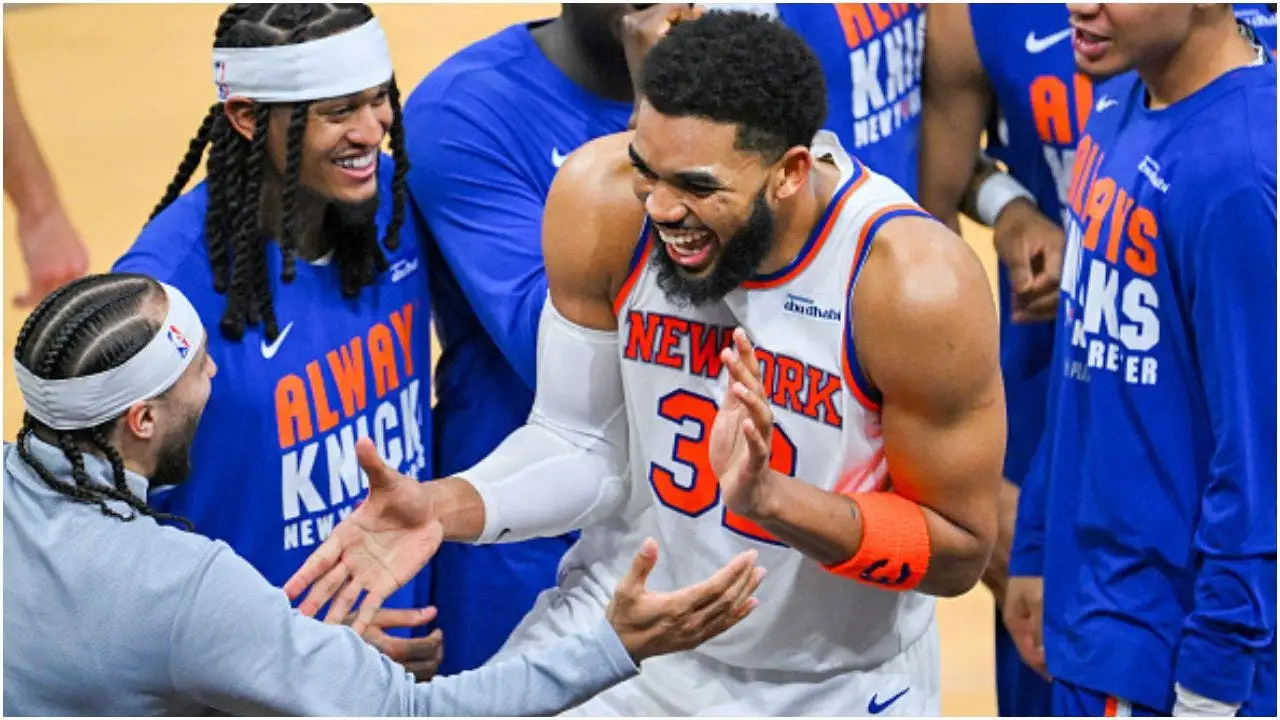
At the heart of this dramatic series was a fascinating clash of basketball philosophies and human narratives, highlighted by Cleveland head coach Kenny Atkinson’s pre-game assertion that, through the sterile lens of advanced analytics, his team had actually played well enough to win two of the first three matchups. This reliance on theoretical victory was swiftly and brutally debunked by a New York squad that chose to define success through the tangible, visceral reality of physical domination and on-court execution. With more than eight minutes remaining in the final quarter of Game 4, Atkinson was forced to perform the ultimate gesture of sporting surrender, pulling his starting lineup off the floor and allowing the final moments to degenerate into an exhibition of raw joy for the Knicks. This capitulation highlighted the absolute supremacy of New York’s star players, particularly Karl-Anthony Towns, who anchored the painted area with a towering double-double of 19 points and 14 rebounds, contesting every drive with ferocious intensity and providing the emotional anchor his team required. Meanwhile, Jalen Brunson operated with the cold, calculating precision of a master surgeon, orchestrating the rapid New York transition offense with flawless vision while incredibly refusing to commit a single turnover under the intense defensive pressure of the playoff spotlight. Despite a heroic, isolated 31-point effort from Cleveland’s premier guard Donovan Mitchell, the Cavaliers simply had no answer for a suffocating New York defensive scheme that blanketed the perimeter, contested every passing lane, and shut down Cleveland’s secondary options for the road-dominant Knicks, who secured their sixth consecutive away playoff victory. This relentless blueprint proved that while analytics can outline a path to victory on a whiteboard, it is the raw, human elements of grit, trust, and physical superiority that ultimately decide the fate of a championship contender under the bright postseason lights.
The narrative arc of this championship ascent is made all the more compelling by the high-stakes, off-season gamble that set the entire transformation in motion, beginning with the shocking and highly controversial dismissal of head coach Tom Thibodeau. Thibodeau had built a respectable foundation of defensive discipline in New York, making his sudden departure a massive gamble that drew immediate, vitriolic criticism from media analysts and fans alike who feared the franchise was sliding back into its old habits of impatient impulsivity. The subsequent hiring of Mike Brown was met with an avalanche of skepticism, as critics openly questioned whether the veteran coach could handle the unique, unforgiving pressure cooker of the New York sports media market while demanding immediate, championship-level results. Yet, rather than buckling under the weight of these immense expectations, Brown brought a calming presence, a modernized offensive strategy, and an infectious sense of belief that slowly but surely transformed a locker room of talented individuals into the NBA’s most formidable collective unit. Under Brown’s guidance, the Knicks did not just improve; they mutated into an unstoppable juggernaut, carrying an undefeated winning streak spanning over a full calendar month directly into the NBA Finals, a feat of sustained excellence that has silenced even his most vocal detractors. This coaching revolution has humanized the often cold and calculating front-office decisions, proving that sometimes a radical change in leadership is the necessary catalyst to unlock the dormant potential of a roster that was previously suffocating under the weight of rigid system play. Brown’s ability to foster a culture of mutual accountability and creative freedom has empowered his players to perform at the absolute peak of their basketball powers when the stakes are at their highest, proving that leadership is just as much about building personal connections as it is about designing tactical schemes.
Beyond the tactical innovations and the impressive stat sheets, the soul of this team lies in its vibrant locker room chemistry, characterized by a genuine camaraderie and lighthearted bond that has shielded the players from the immense external pressures of playing in the world’s most demanding sports market. A perfect encapsulation of this unique team dynamic occurred when versatile Knicks swingman Josh Hart left teammate Karl-Anthony Towns completely bewildered with a hilarious, dry-witted analogy comparing complex basketball analytics to everyday domestic situations, a humorous moment that quickly went viral and showcased the relaxed, tight-knit environment that Mike Brown has fostered. This ability to find joy, laughter, and levity in the high-stakes environment of a championship chase has prevented the team from tightening up during crucial moments of adversity, allowing them to play with a loose, confident swagger that opponents find impossible to break. Their resilience is perhaps best illustrated by their historic dominance away from home, securing six consecutive road playoff victories in hostile environments where lesser teams would have wilted under the pressure of opposing crowds. This road-warrior mentality speaks to a deep, underlying trust between the players, who have embraced their roles not merely as teammates, but as brothers-in-arms fighting for a singular, historic goal. By humanizing themselves through shared humor, public support of one another, and an unselfish willingness to sacrifice individual statistics for the betterment of the collective, these players have endeared themselves to the New York public in a way that transcends simple athletic admiration. They have become genuine folk heroes in a city that values authenticity, blue-collar work ethic, and relentless grit above all else, ensuring that their names will be whispered in reverent tones long after this specific season concludes and their legendary status on the hardwood of Manhattan is forever secured in history.
Now, the stage is set for the ultimate confrontation, as the New York Knicks await the winner of the Western Conference Finals between the youthful, dynamic Oklahoma City Thunder and any powerhouse like the formidable, disciplined San Antonio Spurs to determine who will raise the coveted Larry O’Brien Trophy. Regardless of which Western giant emerges from the grueling conference battle, one undeniable, thrilling reality remains: the road to the NBA championship officially runs through the historic, loud, and unforgiving confines of Madison Square Garden. The Finals, scheduled to commence on June 3, will represent the culmination of a twenty-five-year spiritual journey for a franchise and a city that have endured the absolute depths of sporting despair only to emerge stronger, hungrier, and more united than ever before. For the older generation of fans, this moment offers a beautiful, nostalgic opportunity to relive the magic of 1999, while a younger demographic of New Yorkers will finally get to experience the transcendent joy of a championship series firsthand, creating memories that will undoubtedly shape their love for the game for the rest of their lives. As the countdown to June 3 begins, the anticipation hanging over the five boroughs is tangible, an electric current of excitement that validates every heartbreak, every broken promise, and every painful rebuilding year of the past quarter-century. The Garden crowd is not merely ready for this moment; they are starved for it, prepared to unleash a wave of vocal support that will solidify Madison Square Garden’s reputation as the ultimate coliseum of basketball, where legends are forged and dreams are finally realized. It is a beautiful moment of collective redemption and anticipation, a joyous celebration that proves that when you play with absolute heart, the ultimate victory is always within reach under the bright lights of New York City.