






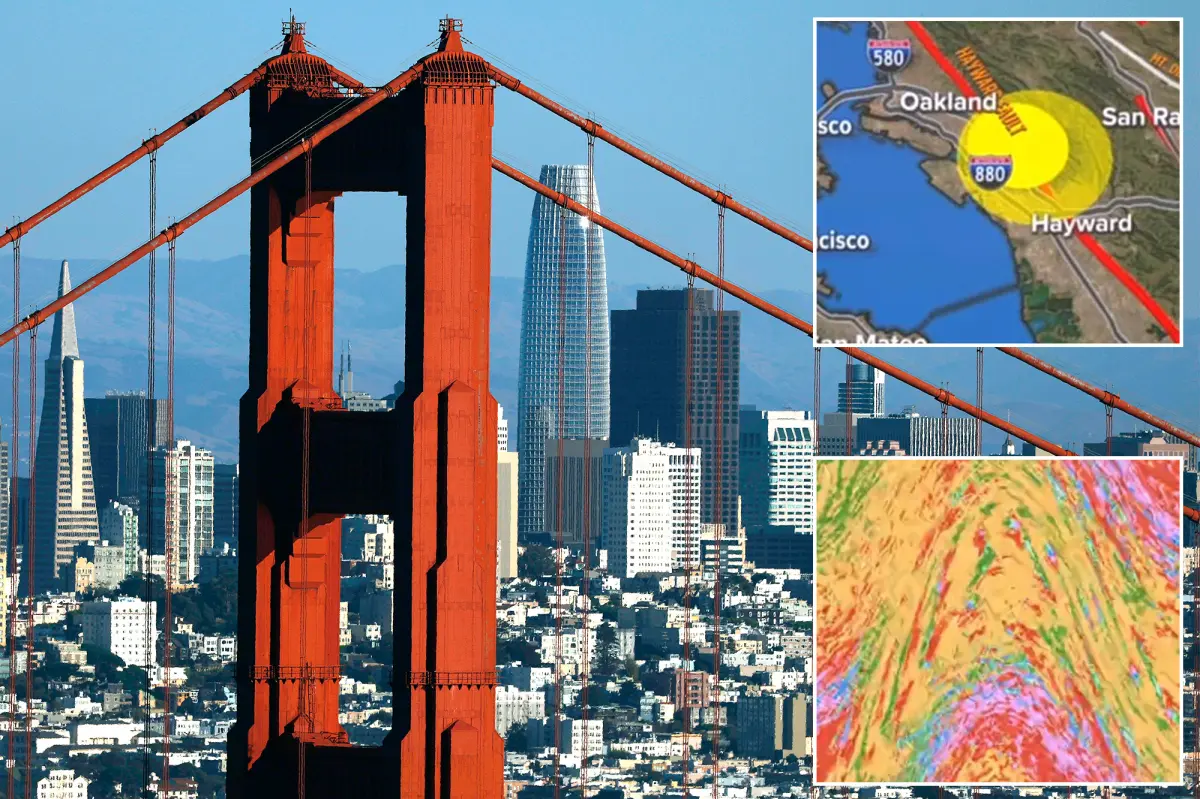
There’s a particular kind of quiet that settles over the Bay Area in the morning, especially before the coffee has had a chance to do its work. But on Thursday, that quiet was abruptly broken. At 8:30 a.m., a 3.8-magnitude earthquake rattled the region, sending a jolt through neighborhoods from Oakland to Berkeley and far beyond. The epicenter was located near the Oakland Zoo and Bishop O’Dowd High School, a familiar and well-trafficked corner of the East Bay that suddenly became the focus of scientific and public attention. At first, the U.S. Geological Survey pegged the quake at a slightly stronger 4.1 magnitude, only to downgrade it shortly after. That initial confusion is common in the chaos of an earthquake, when instruments and human nerves are both still settling. To make the morning feel even more unsettled, two aftershocks followed at 9:07 a.m., measuring 3.0 and 2.8, both centered in the same area. Thousands of people reported feeling the first shock, and the shaking wasn’t contained to Oakland. It reached all the way north to Santa Rosa and Sacramento, and stretched south to Santa Cruz—a reminder that even a moderate quake can travel far, especially along a fault system as connected as California’s.
For many, the immediate response was probably a pause, a look around, a quick check of family or pets. But for those who know the region’s geology, Thursday’s tremor delivered something more than a fleeting adrenaline rush. It was a pointed reminder that the ground beneath the Bay Area is alive with tension, and particularly along the Hayward Fault. That fault, a 74-mile seismic scar cutting through some of the most densely populated communities in California—Berkeley, Oakland, Fremont, San Leandro, Hayward, and beyond—has long been considered one of the most dangerous in the country. The fact that Thursday’s quake occurred so close to the Oakland Zoo, a place where families gather on weekends, and Bishop O’Dowd High School, where teenagers sit in classrooms, makes the threat feel intimate rather than abstract. Scientists have spent decades studying what could happen when this fault truly lets go. And their findings aren’t comfortable reading. The Hayward Fault is more than capable of producing a major earthquake, one exceeding magnitude 7, and it has done so before. Its last great rupture came in 1868, when California was still a young state and the Bay Area was far less developed. If a similar quake happened today, the stakes would be unimaginably higher.
In some ways, the Hayward Fault lives in the shadow of its more famous neighbor, the San Andreas Fault. The San Andreas gets the movie roles and the dramatic headlines, but geologists know that the Hayward Fault is potentially just as frightening, if not more so, because of what lies directly on top of it. It is part of the larger San Andreas system, a sprawling network of fractures that accommodates the slow, grinding movement of tectonic plates. But the Hayward Fault runs directly beneath homes, schools, hospitals, highways, and apartment buildings. It is not a remote wilderness fault; it’s an urban one. And perhaps the most unsettling part is that it appears to be overdue. Experts have long warned that the fault follows a rough rhythm, with major quakes striking every 95 to 183 years on average. If that pattern holds, the Bay Area is squarely within the window for another potentially devastating rupture. The U.S. Geological Survey has put numbers on that anxiety: an estimated 14.3% probability of a magnitude 6.7 or greater earthquake on the Hayward Fault by 2034, and a 33% chance before 2043. Those aren’t abstract probabilities. They’re rolling dice with entire communities.
David Schwartz, a USGS earthquake geologist emeritus, once described the Hayward Fault with a phrase that has stuck in the minds of many who study it. “This fault is what we sort of call a tectonic time bomb,” he told the Los Angeles Times. “It’s just waiting to go off.” That metaphor isn’t melodrama; it’s based on decades of observation, historical records, and careful modeling. Researchers at the Lawrence Livermore National Laboratory and the Lawrence Berkeley National Laboratory have tried to imagine what that bomb might look like when it detonates. They ran 50 simulations of a magnitude 7 rupture along the Hayward Fault, each one a different way the fault might break, each one a distinct but plausible version of chaos. The results were sobering, to say the least. The simulations suggested that shaking in some Bay Area communities could be up to 50% stronger than previous forecasts had anticipated. That is a massive leap in expected ground motion, and it has serious implications for buildings, bridges, and lives. The areas most vulnerable to particularly powerful shaking include Oakland, Berkeley, Hayward, San Leandro, Emeryville, Alameda, and Livermore. These are not empty stretches of land; they are vibrant, crowded places where people live, work, and raise families. The idea that the ground movement could be half again as forceful as once believed changes the calculus of preparedness.
Then there is the grim scenario that emergency planners have spent years constructing. The USGS has developed a disaster scenario for a major Hayward Fault earthquake, and the numbers read more like a dystopian novel than a government report. If the fault ruptures at magnitude 7, the agency estimates that roughly 800 people could be killed, with as many as 18,000 injured. But the destruction would not be limited to collapsed buildings. Hundreds of fires could erupt from broken gas lines and downed power lines, turning individual tragedies into neighborhood-level catastrophes. Tens of thousands of homes could be destroyed, leaving families with nothing but the clothes they are wearing. And perhaps most staggering of all, nearly half a million people could be displaced, forced out of the region that has been their home, their community, their sanctuary. The human toll of such an event would take years, if not decades, to process. The physical and emotional scars would etch themselves into the landscape and the people who live there. It’s easy to read those numbers quickly and move on, but behind each statistic is a person—a child in a classroom, an elderly woman in a retirement home, a construction worker on a scaffold, a nurse in a hospital. The thought is enough to make anyone pause, especially after a morning like Thursday’s.
And yet, Thursday’s earthquake caused no major damage and no reported injuries. The shaking was real, but so was the relief. For a moment, the Bay Area held its breath, then exhaled. Life returned to normal. Coffee cups were refilled, meetings resumed, and the news cycle moved on to the next story. But something subtle may have changed in the back of people’s minds. Every quake is a reminder, whether we want to hear it or not, that the Earth is not finished with California. The Hayward Fault will not wait patiently forever. The structural vulnerabilities that scientists have identified cannot be ignored without consequences. The question is not whether the big one will happen, but whether we will be ready when it does. The best answer to that question isn’t fear. It’s preparation. It’s retrofitting old buildings, securing water heaters, knowing what to do when the ground starts to shake. It’s having a plan, a kit, and a community that looks out for one another. It’s remembering that on a quiet Thursday morning, the Earth can decide to speak, and the only way to meet that moment with grace is to have done the work long before the shaking starts. Thursday’s tremor was not a tragedy. It was a warning, and it was also a gift—a chance to hear the alarm while there is still time to act. The fault will keep its own schedule. Our job is to be ready for it.