



Summarize and humanize this content to 2000 words in 6 paragraphs in English
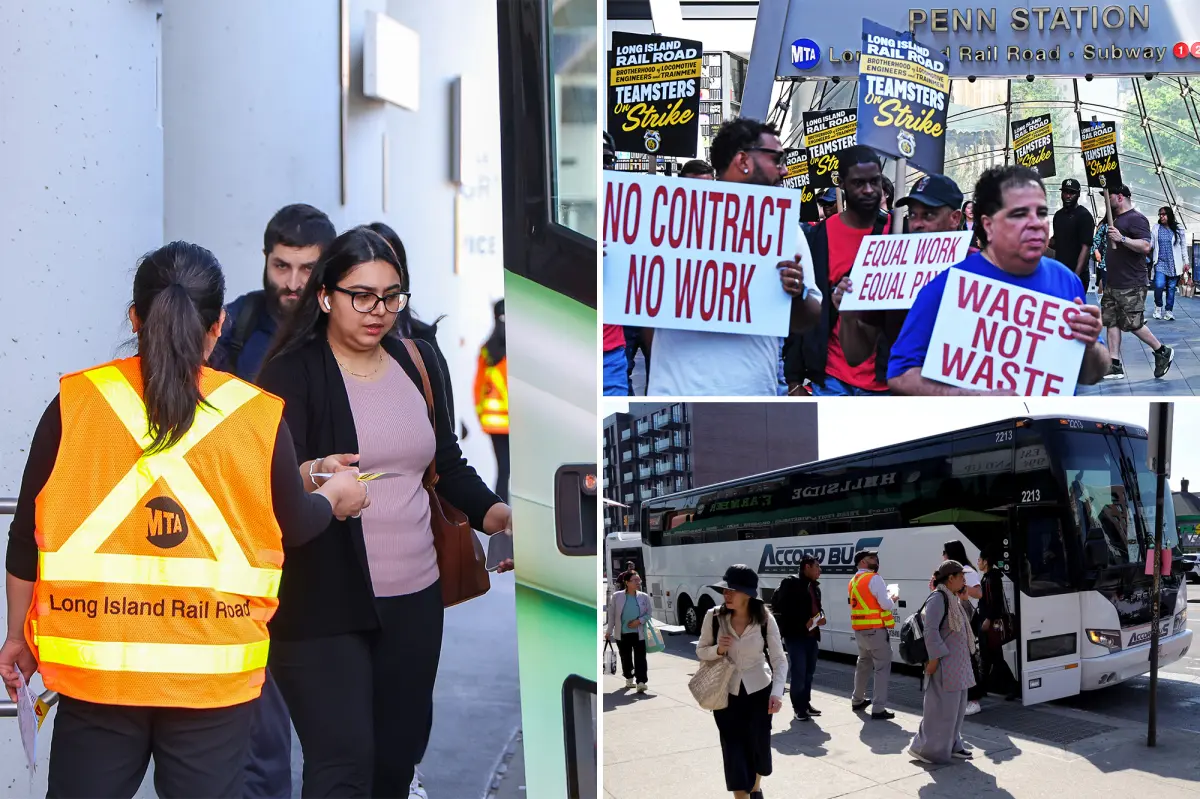
The Long Island Rail Road strike forced some commuters to waste two extra hours on the road as they scrambled to catch shuttle buses while motorists who drove into the city struggled to find parking Monday morning.
Nassau and Suffolk county residents who typically rely on the LIRR to get into work described their trip into the Big Apple as a “nightmare” and “hell” as they were reduced to pawns in the heated bickering between the MTA and the picketing unions.
“Everyone’s miserable, but the people really getting screwed are the ones who physically have to show up somewhere,” Wantagh local Kevin Haller, 38, told The Post as he boarded a bus at the Bellmore station.
Diane Carlucci, 54, was forced to leave her house at 5:30 a.m. to catch a shuttle bus from the same station and it took her nearly three hours to reach her job where she works as a billing coordinator at a doctor’s office.
Usually, she would enter Penn Station in less than an hour as she blasted the unions for the train shutdown that started Saturday morning.
“So it’s really terrible, and I’m getting palpitations thinking about doing this every day while those stubborn a–holes – who already get paid way above national average and get out-of-control overtime – stop the system and make life hell for hundreds of thousands of people,” the Bellmore resident fumed.
The MTA-provided buses picked up workers from six locations across Long Island, then dropped them off at different subway stations in Queens, leaving workers to take subways the rest of the way as train workers picketed outside Penn Station and other spots in the region.
Paralegal Marisol Vega, 39, said her commute, which involved a bus, a subway and then another bus added almost two hours to her travel.
“I’m already exhausted before I even start work,” the Seaford resident said.
Ricky Persaud, who took a bus from Ronkonkoma to Queens called the arrangement “mayhem,” while Andrea, who did not want to share her last name, described her commute from the same station as a “nightmare.”
“I now have to spend 30 hours per week just commuting, on top of working my regular 40 hours per week,” added Matt, who is a construction project manager.
“Go to work, do the work, go home, go to sleep, repeat — nonstop,” he griped as he estimated he’ll spend 10 extra hours on the road this week if the strike drags on.
The coalition of five labor groups and the MTA continued to be at odds mostly over how much of a pay raise union workers should receive over the next several years.
The MTA’s chief negotiator Gary Dellaverson said at a press conference Monday he was “pretty optimistic” about reaching a deal predawn Monday morning, but progress appeared to stall.
“Look, it is 2 o’clock,” he said Monday afternoon. “That didn’t happen.”
Gov. Kathy Hochul bizarrely claimed the morning commute “went smoother than expected” as she thanked office workers who worked from home instead of venturing into the city.
“Our goal is get this over as soon as possible,” she said. “We know people are inconvenienced.”
Other workers who didn’t take the bus ended up driving, leading to more frustration and confusion.
Drivers were advised by officials to park at Citi Field in Queens and then catch a 7 subway train into other parts of the city – but were actually directed to drop their cars off at lots across the street, which are MTA train yard and bus yard lots.
“There’s no signage. No signage, really. I came from Long Island. I saw it on the news this morning,” said Northport resident Steve Betzios.
“You could get to Citi Field and park here all day for 6 bucks and take the 7 train in and you can get to Manhattan. I come down here and I’ve been going around the block trying to find where the parking is.”
Motorists were also stuck waiting to get into Midtown garages, including Icon Parking near Penn Station where a line of cars led to gridlock on the street.
“This is my normal parking garage — I’ve been parking here for over 10 years — I’ve never seen it this bad before,” said Ronnette, who lives in the area.
A Connecticut resident who drives in said he had to swing by three lots before finally getting a spot.
“I have never seen it like this,” he added.
State Comptroller Tom DiNapoli’s office warned last week before the strike began that the region would lose about $61 million each day if the train workers walked off the job.
“A LIRR strike will be felt far beyond the tracks, triggering the loss of millions of dollars per day in lost economic activity, disrupting thousands of riders and throwing the region’s transit service into chaos and gridlock,” DiNapoli in a statement.