


The Horizon of an Endless Conflict: How the War in Ukraine Outlasted the Great War
The war in Ukraine has frequently been compared to the first global catastrophe of the twentieth century, a comparison born of its muddy, shell-pounded trenches, relentless artillery duels, and devastating infantry charges. Yet, for a long time, the notion that this modern conflict could surpass the duration of World War I—a meat-grinder so vast and agonizing that French soldiers desperately christened it la der des ders, “the last of the last”—seemed intellectually and historically absurd. That unthinkable boundary has now been crossed: the full-scale war in Ukraine has hit its 1,569th day, officially outlasting the four years and three months of the Great War. When Russian President Vladimir V. Putin ordered his armored columns to cross the Ukrainian border in February 2022, Kremlin strategists confidently predicted a victory achieved in mere days, envisioning a swift decapitation of the Kyiv government followed by a celebratory parade. Instead, the invasion shattered against fierce Ukrainian resistance, rapidly devolving into a grueling war of attrition that has defied the expectations of both the invading generals and the soldiers fighting on the front lines. A Ukrainian combatant operating under the call sign “France”—named in honor of his previous service in the prestigious French Foreign Legion—reflected on this grim longevity from a muddy dugout, admitting that he originally expected politicians to broker a diplomatic compromise within two or three years. His experience mirrors a broader civilian weariness: public opinion polls reveal that roughly half of the Ukrainian population now believes this war will drag on well past next year, pushing it toward another grim historical milestone—the six-year span of World War II. For many Ukrainians, however, even this calculation is conservative; they argue the war did not begin with the dramatic air raids of 2022, but rather in 2014, when Russian forces systematically occupied and annexed the Crimean Peninsula.
A Century of Blood and Iron: Mapping the Geopolitical Cartography of a New Europe
While academic historians caution that direct comparisons with the two world wars are inherently limited due to differences in global mobilization, industrial scale, and total human cost, the geopolitical magnitude of the Russia-Ukraine war undeniably matches those epochal conflicts. A century ago, Ukraine did not exist as an independent, sovereign state on the global stage, its territory instead carved up as a bloody prize between the collapsing Russian and Austro-Hungarian empires. Today, as the Ukrainian historian Yaroslav Hrytsak observes, this conflict has fundamentally transformed the security architecture of Europe, forcing a massive domestic defense buildup and revitalizing military alliances, such as NATO, in a manner not witnessed since the height of the Cold War. The parallel also extends to the rapid evolution of military technology: just as the battlefields of Flanders and the Somme drove the development of the military aircraft, the heavy tank, and chemical weapons, the plains of the Donbas have become a testing ground for cutting-edge drone warfare across the air, land, and sea. In both eras, these technological breakthroughs did not alleviate the suffering of the individual soldier; instead, they stripped away any remaining romance of combat, making the battlefield infinitely more systematic, lethal, and difficult to survive. Former French colonel and military historian Michel Goya points out that, in terms of tactical stagnation and defensive dominance, the daily experience of the modern Ukrainian soldier resembles the operational environment of 1914 to 1918 more closely than any geopolitical conflict of the intervening century.
The Great Freeze: From Blitzkrieg Dreams to the Brutal Reality of Trench Warfare
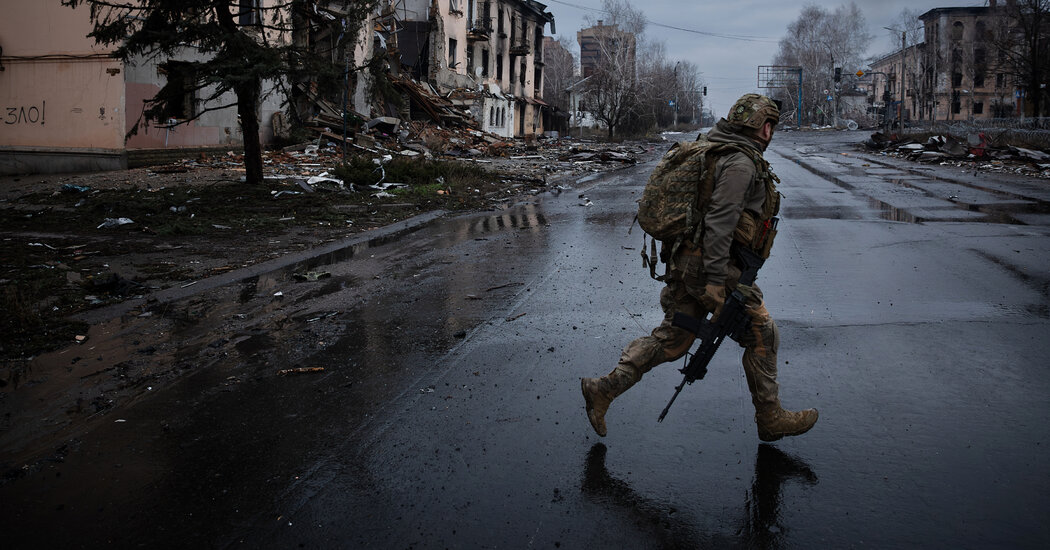
The striking symmetry between the two conflicts begins with their opening maneuvers, where initial plans for a rapid, decisive victory collapsed into static endurance. In the late summer of 1914, Imperial German forces executed the Schlieffen Plan, launching a massive, high-speed offensive through Belgium toward Paris with the intention of knocking France out of the war within weeks. A century later, Russian commanders attempted a remarkably similar operational maneuver, dispatching elite airborne units and massive armored columns toward Kyiv to secure a rapid victory. In both historical instances, the invading forces came within striking distance of their objectives, only to be repulsed by determined counteroffensives that forced a chaotic retreat. As the initial war of maneuver ground to a halt in late 2022, both armies dug into the earth, creating a frozen, heavily fortified front line stretching hundreds of miles across eastern Ukraine. The landscape quickly transformed into a visual echo of northern France in 1916: opposing units separated by mere hundreds of yards of scarred, muddy earth, close enough to hear the voices of their enemies across the void of no man’s land. Combat reverted to a brutal rhythm, beginning with thunderous, multi-day artillery barrages designed to shatter defenses, followed by infantry squads clambering over parapets to storm enemy trenches in close-quarters combat.
Eyes in the Sky and Fortresses in the Earth: The High-Tech Evolution of Survival
However, the classic World War I-style trench network, once a reliable shield against industrial firepower, has been rendered obsolete by the ubiquitous presence of uncrewed aerial vehicles (UAVs). While heavy artillery initially forced soldiers to bury themselves in the earth to survive, the introduction of first-person view (FPV) reconnaissance and strike drones has stripped away the safety of open trench lines. These aerial eyes watch the battlefield around the clock, mapping every pathway and striking with a degree of precision that conventional, unguided artillery could never achieve. Survival on the modern battlefield has therefore forced a transition from expansive linear trenches to tiny, deeply buried subterranean bunkers. Soldiers now construct miniature dugouts, reinforced with heavy timber and metal sheets to absorb explosive shockwaves, that house only a handful of troops and are virtually invisible to infrared sensors from above. A foreign volunteer commander using the call sign “Sour” recalled his squad having to assault a single, meticulously fortified Russian dugout four times before forcing its occupant to surrender. He was so impressed by its defensive design—featuring right-angled entryways configured specifically to diffuse the blast wave of grenades—that he had the captured soldier reconstruct it at a training facility to study its engineering. In this hostile environment, the open trench has been replaced by a miles-wide, drone-monitored “kill zone,” where any visible movement, from armored vehicle patrols to individual supply runs, is instantly targeted and destroyed.
The Calculus of Attrition: Comparing the Human Toll of Industrialized Offensives
Although the physical devastation of the Ukrainian landscape—with its splintered forests, shattered villages, and crater-pocked fields—looks identical to the archives of the Western Front, the scale of human mobilization and casualties belongs to a different mathematical reality. The Great War was a clash of empires that mobilized tens of millions of soldiers across multiple global fronts, resulting in an estimated nine to eleven million military deaths. In contrast, the current war in Ukraine involves active forces numbering in the hundreds of thousands, with total casualties estimated at roughly half a million lives lost or altered by catastrophic injury. Despite this difference in absolute numbers, military experts and high-ranking Alliance officials, including NATO’s Supreme Allied Commander Transformation, Admiral Pierre Vandier, note that drone technology has elevated tactical lethality to levels that mirror the worst days of the early twentieth century. This technological deadlock has slowed territorial advances to a crawl that is sometimes slower than the infamous stalemates of 1916. For example, during Russia’s protracted, bloody offensive to capture the strategic logistics hub of Pokrovsk, its forces advanced at an average rate of just seventy-five yards per day. An analysis by the Washington-based Center for Strategic and International Studies (CSIS) reveals that this pace is slower than the territorial progress made by Allied forces during the catastrophic Battle of the Somme, highlighting how modern defensive technology has neutralized offensive maneuvers.
The Modern Siege: Economic Warfare, Technological Attrition, and the Search for an Endgame
As the war enters this deeply entrenched phase, the strategic challenge for both Kyiv and Moscow is identifying a realistic path to break the operational deadlock and force a conclusion. During the Great War, the Allied powers eventually broke the German Empire not through a single, decisive breakthrough on the battlefield, but through a multi-faceted strategy of economic exhaustion, utilizing a naval blockade to starve the German industrial war machine while maintaining relentless, coordinated military pressure. Ukraine’s current strategic doctrine carries clear echoes of this historical approach, adapted for the technology of the twenty-first century. Lacking the massive population reserves required to launch sweeping, human-wave offensives, Kyiv has unleashed swarms of domestic, long-range strike drones against Russia’s oil refineries, supply depots, and economic infrastructure. By targeting the financial engine that funds Moscow’s military operations and flooding the front lines with thousands of small, highly lethal tactical drones, Ukraine hopes to inflict unsustainable material and human costs on the occupying forces. As the historian Yaroslav Hrytsak grimly summarizes, the world is witnessing a haunting reincarnation of the Western Front—a resource-draining, industrially exhausted struggle of attrition that is, in every sense, World War I fought with twenty-first-century silicon and software.