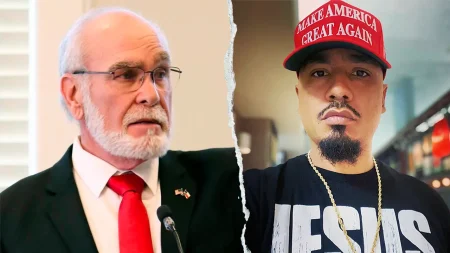







The complex and often grueling theater of modern American politics demands a level of flawless performance that is frequently at odds with the messy reality of human nature, a truth that became painfully clear during a recent progressive rally in Portland, Maine. Graham Platner, a prominent far-left candidate who has positioned himself as an uncompromising voice against economic inequality, stood before an eager crowd alongside his political mentor, the self-described democratic socialist Senator Bernie Sanders, just one week ahead of the highly anticipated Maine primary elections. The atmosphere inside the venue was charged with hope and high stakes, with banners proclaiming a passionate commitment to “Fight the Oligarchy” hanging above an audience looking for a champion to voice their frustrations. As Platner took his place at the podium to build momentum for his campaign to unseat the formidable, long-term Republican incumbent Senator Susan Collins, he carried the weighty expectations of a state party’s progressive wing. However, as the intense spotlight focused on him and the cameras of national media outlets began to roll, the extreme psychological pressure of the moment seemed to manifest physically. Amidst his impassioned speech, while attempting to introduce the legendary Vermont senator, Platner experienced a notable cognitive slip, stumbling over the name of his ideological idol not once, but twice, calling him “Senator Standers.” The first mistake came early in his address when he recalled sharing a stage with Sanders in Portland at the very beginning of his campaign, noting with raw awe how surreal the entire journey had felt. Yet, instead of correcting the record or laughing off the error, his nerves seemed to compound under the heavy gaze of the crowd, leading to an identical linguistic blunder as he concluded his speech and attempted to yield the floor to Sanders. While a simple mispronunciation can happen to any exhausted candidate navigating the physical toll of the relentless campaign trail, this double gaffe served as an early, highly visible fracture in Platner’s public persona, reminding voters of the simple, inescapable realities of human exhaustion, performance anxiety, and the psychological vulnerability that exists beneath the polished speeches of those who seek the nation’s highest legislative offices.
Yet, the temporary embarrassment of a tongue-tied introduction on a Portland stage was quickly eclipsed by a far more damaging, deeply troubling revelation that emerged from the digital shadows of Platner’s past, demonstrating how the internet permanently preserves our most human—and sometimes our most monstrous—indiscretions. In the ruthless arena of modern political opposition research, anonymity is a fragile shield, a lesson Platner learned when a series of historic social media posts from a defunct Reddit burner account were unearthed and conclusively linked to his identity. The most devastating of these digital artifacts centered on a deeply offensive commentary regarding a decorated American infantryman who had braved a relentless hail of enemy gunfire during a combat mission to help his pinned-down squad members escape to safety. Rather than expressing the customary reverence, respect, or basic human empathy expected of a public servant, a then-34-year-old Platner had written online, in deeply cynical and profane terms, of the soldier’s frantic, life-saving efforts. Using the anonymous safety of his screen to mock a real combat situation, Platner branded the soldier a “dumb motherf—er” who “didn’t deserve to live” and mocked his physical distress and heavy breathing caught on combat footage, claiming his survival was only due to the poor marksmanship of the Taliban and that his tactical decisions deserved contempt. The soldier, who was later awarded a Purple Heart for his bravery and wounds sustained during the harrowing rescue, had his valor dismissed by Platner as sheer stupidity. This shocking revelation struck an agonizing nerve with veterans, military families, and ordinary citizens alike, exposing a profound, jarring disconnect between the progressive platform of collective empathy and human dignity that Platner championed on the campaign trail, and the cruel, dismissive vitriol he poured into the digital void. It highlighted the psychological phenomenon of online disinhibition, where individuals safe behind a keyboard shed their social graces to reveal a darker, deeply unsympathetic side of their character, leaving voters to wonder which version of Graham Platner is real: the compassionate progressive champion standing on stage, or the cynical commentator mocking wounded soldiers online.
The investigation into Platner’s digital history did not end with his dismissive critique of military heroism, but instead descended into the deeply vulgar, bizarre, and intensely personal corners of the internet, stripping away any remaining pretense of senatorial dignity. Additional archived posts linked to the same defunct Reddit account revealed a candidate who engaged in highly inappropriate, juvenile online commentary, including a fascination with crude graffiti depicting male genitalia and candid, gleeful admissions of masturbating in public porta-potties. For the average voter, encountering these highly explicit, back-alley confessions from a presumptive major-party nominee for the United States Senate was both deeply discomforting and profoundly bizarre, casting a shadow of absolute absurdity over what should be a serious democratic process. It forced a raw, societal conversation about the boundaries of personal privacy, emotional maturity, and the absolute permanence of our worst digital impulses in an era where nothing is ever truly deleted. In our current, hyper-connected political landscape, the boundaries between a public figure’s professional competence and their private, often deeply embarrassing idiosyncrasies have completely evaporated. What might have once been dismissed as the regrettable, immature humor of a young person was made far more troubling by the fact that Platner was a fully grown adult in his mid-thirties when these posts were authored, suggesting a persistent pattern of behavior that was drastically at odds with the gravity of the office he sought. This exposure points to a larger, uncomfortable truth about the modern political arena: we are no longer merely vetting a candidate’s legislative proposals, foreign policy views, or economic philosophies. Instead, we are forced to grapple with the lowest common denominators of their private internet habits, transforming what should be a dignified debate over the future of the federal government into a voyeuristic exploration of a candidate’s most embarrassing, undignified, and tasteless private behaviors, permanently lowering the bar of public discourse.
Recognizing the dynamic vulnerability of their opponent and the sheer shock value of his internet history, the National Republican Senatorial Committee (NRSC) wasted no time in capitalizing on these deeply compromising revelations, weaponizing Platner’s digital footprint with ruthless strategic precision. However, rather than relying on traditional, text-based press releases or standard television attack ads, the NRSC pushed the envelope of modern campaign warfare by employing cutting-edge generative artificial intelligence to amplify the scandal. The organization produced and released a controversial, AI-generated short video designed to mock Platner’s alleged porta-potty behavior in the most visceral, memorable, and unsettling way possible. The digital spot featured a simulated, realistic depiction of a man closely resembling Platner entering a portable restroom, building psychological tension before concluding with a jarring, highly suggestive scene where an innocent young child is shown exiting an adjacent stall. Distributed widely across social media platforms like X, the ad was accompanied by a stark, ominous warning to voters: “This is who Graham Platner is. Don’t ignore the signs.” This aggressive maneuver signaled a terrifying and highly contentious new frontier in political media, where opposition groups no longer merely expose their rivals’ documented flaws, but actively construct simulated, computer-generated dramas to hyper-focus on personal humiliations and seed visceral disgust. The deployment of AI in this context raises profound ethical questions about the erosion of truth, the psychological toll on candidates facing synthesized public shaming, and the degradation of campaign ethics. It shows how easily complex debates over governance and federal policy can be derailed and reduced to algorithmic, highly provocative digital caricatures designed to manipulate voter emotions through raw shock value rather than substantive, respectful democracy.
These seismic controversies have thrown the politically unique state of Maine into a state of intense turbulence, complicating a high-stakes legislative race that has captured national attention and threatened to rewrite the state’s electoral future. Platner had emerged as the presumptive Democratic nominee in what was expected to be a highly competitive and ideologically charged battle to unseat the Republican incumbent, Senator Susan Collins. Senator Collins, a formidable political moderate who has managed to maintain her grip on her Senate seat for decades by projecting an image of independent, bipartisan cooperation and steady pragmatism, was supposed to face a massive, coordinated challenge from an energized progressive coalition. Platner’s unexpected rise to the top of the Democratic ticket occurred in the wake of a sudden and dramatic shift in the local political landscape, when Maine’s popular Governor, Janet Mills, made the shocking decision to abruptly suspend her own well-funded and highly anticipated Senate campaign. This sudden power vacuum immediately positioned the far-left Platner as the standard-bearer for the state’s Democratic party, thrusting his radical agenda of democratic socialism into the mainstream spotlight and exposing a sharp geographic divide between the liberal municipal centers like Portland and the more conservative, rural wilderness of northern Maine. The race was originally framed as a historic, substantive contest of ideas between Collins’ established, institutional experience and Platner’s populist vision. Instead, the sudden collapse of Platner’s personal credibility under the weight of his verbal blunders and deeply offensive digital history has left progressive activists in a state of quiet panic. They must now grapple with the agonizing reality that their historic opportunity to challenge a political titan has been compromised by a candidate whose deeply flawed personal history makes him an easy target for devastating, non-stop political attacks from his ideological opponents.
Ultimately, the turbulent saga of Graham Platner’s embattled Senate campaign serves as a fascinating, raw, and cautionary case study of the modern digital age, highlighting the complex intersection of human fallibility, technological advancement, and the grueling trial of democracy. It forces us as a society to ask deep, existential questions about the nature of character, redemption, and what we truly expect from those who seek the privilege of representing us in the highest halls of power. Can voters look past simple cognitive slips on a stage and distasteful, anonymous remarks made years ago to focus entirely on the transformative policies a candidate champions? Or does a nominee’s private, digital behavior, especially when characterized by a profound lack of empathy for military veterans and a persistent pattern of vulgar online commentary, reveal a fundamental defect of character that disqualifies them from public service? The upcoming Maine primaries will serve as a crucial referendum on these very questions, testing whether an increasingly polarized electorate can separate the public-facing ideals of a progressive movement from the deeply flawed, deeply human vessel carrying its banner. In an era where artificial intelligence can instantly weaponize our darkest, most embarrassing secrets and broadcast them to millions, we are left to ponder the grueling personal cost of public service and whether authentic human leadership can even survive such brutal scrutiny. As Maine’s citizens prepare to make their voices heard, they are not just choosing a senator; they are defining the moral boundaries of modern political culture, proving that in the end, our leaders will always be a mirror of both our highest, most elevated national aspirations and our lowest, most vulnerable human impulses, reminding us that politics, like the people who run it, is a beautifully flawed human endeavor.