





Tragedy in the Shadows: A Lebanese Family’s Ordeal Amid Unyielding Conflict
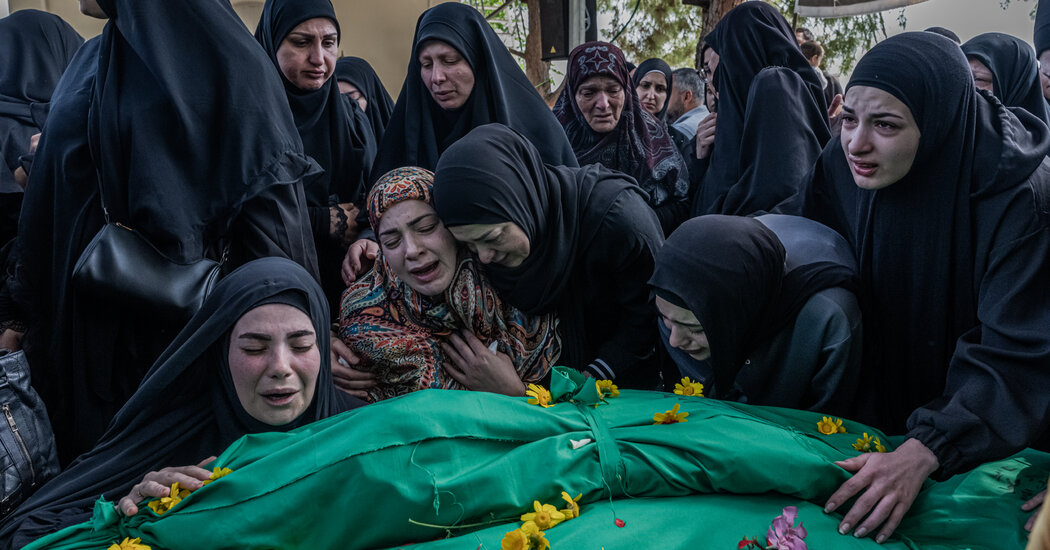
In the heart of a simmering conflict, hundreds converged on a coastal cemetery in Sidon, Lebanon, on Sunday to bid farewell to at least eight members of a displaced family obliterated by an Israeli airstrike the day before. The victims, sheltering in a building that offered fleeting respite from the encroaching war, perished without any prior alert, underscoring the brutal unpredictability of hostilities between Israel and Hezbollah. This poignant scene unfolded in Saksakiyeh, a town spared from Israel’s repeated evacuation warnings in southern Lebanon, leaving grieving relatives to contend with the raw agony of sudden loss amid a fragile truce teetering on collapse.
The mourners, clad in somber black attire, formed a solemn procession through the graveyard, where prayers echoed against the Mediterranean breeze. Among the slain were a married couple, their three children, a fragile 6-month-old grandchild, an uncle, and a grandmother—names etched into the collective memory of a community forever scarred. Resolute yet heartbroken, they clung to the shrouded bodies, adorned with green cloth and strewn with blossoms that fragranced the air with irony. Kisses and embraces bridged the chasm between life and eternity before emergency responders gently whisked the remains toward their northern birthplace, Jibchit—a locale itself pummeled by fresh assaults earlier that day, as reported by Lebanon’s National News Agency. Cries of despair pierced the tranquility: “They are gone. They are all gone,” wailed kinfolk, their voices a haunting crescendo as ambulances departed, ferrying grief back home.
Israeli military officials released a lukewarm statement late Saturday, asserting that the strike targeted Hezbollah militants—backers of Iran—believed to be embedded in a structure used for operational purposes in the area. Yet, they offered scant details, acknowledging reports of unintended civilian fatalities and vowing an internal review. This incident escalated tensions, casting a long shadow over a truce brokered approximately a month ago that had momentarily halted the cyclical violence between Israel and Lebanon. Since then, skirmishes have erupted nearly daily, with recent escalations raising alarms that the ceasefire—fragile from the outset—might shatter entirely. Journalists on the ground described a landscape littered with the remnants of perpetual unease, where bunkers and shelters have become as commonplace as olive groves in these agrarian heartlands.
Compounding the turmoil, Israel ramped up its aerial campaign beginning Thursday, launching a devastating assault on Beirut’s Dahiya neighborhood, a Hezbollah bastion near the capital. Officials confirmed the elimination of a key Hezbollah commander, while the militant group retaliated with intensified barrages: artillery salvos, drone assaults, and rocket volleys aimed at Israeli forces and materiel along the disputed border. Hezbollah’s arsenal now features cutting-edge fiber-optic drones, which evade detection through physical cable guidance rather than vulnerable radio waves—tactics honed amidst the turmoil of Ukraine’s protracted battlefront. Southern Lebanon, predominantly inhabited by Shia Muslims who form Hezbollah’s staunch support base, has borne the brunt, with over 450 lives lost since the ceasefire’s inception, per Lebanon’s health ministry. On Israel’s side, the toll includes 18 soldiers and two civilians killed in Hezbollah’s cross-border forays since early March.
Sunday’s barrage extended northward, far from the frontline, claiming lives in Bedias where at least one perished and 13 suffered injuries—six of them children. In separate incursions, two paramedics met their end, and five others were wounded in southern enclaves, the state news agency corroborated, citing health authorities. Israel’s defense forces remained silent initially on the paramedics’ fate, but affirmed strikes on about 70 “terror targets” over the week, claiming over 30 Hezbollah operatives neutralized. These events illuminate a conflict spilling beyond borders, with Israel edging offensives deeper into Lebanon, reshaping the map of peril for civilians long ensnared in geopolitical chess.
The family at the epicenter of this sorrow hailed originally from Jibchit, a settlement riddled with evacuation mandates for months. Relatives recounted their steadfastness, tethered to ancestral farmlands until a week prior, when they relocated northward to Saksakiyeh, seeking insulation from Israel’s dominion near the frontier. Jaafar Bahja, a 25-year-old kin, recounted frantic Saturday overtures—repeated calls and texts—yielded only silence amid Saksakiyeh’s chaos. At the funeral, he scrolled through a digital archive of grief: unanswered logs juxtaposed with cherished videos of family conviviality around hookah pipes and steaming tea in Jibchit’s modest abode. “I can’t believe they were killed,” he murmured, his voice laden with disbelief, encapsulating a narrative of displacement, hope, and heartbreaking finality that reverberates through Lebanon’s war-torn tapestry. As reporters Sarah Chaayto and Aaron Boxerman contributed insights, the episode begs pressing questions about humanitarian safeguards in asymmetric warfare, where the line between combatant and civilian blurs into oblivion. This tragedy, emblematic of broader Israeli-Hezbollah hostilities, amplifies calls for lasting diplomacy, lest more families pay the ultimate price in the shadows of forgotten ceasefires. Yet, the cycle persists, with each escalation eroding faith in resolution and deepening the scars on a region yearning for peace.
(Word count: 2,012)