


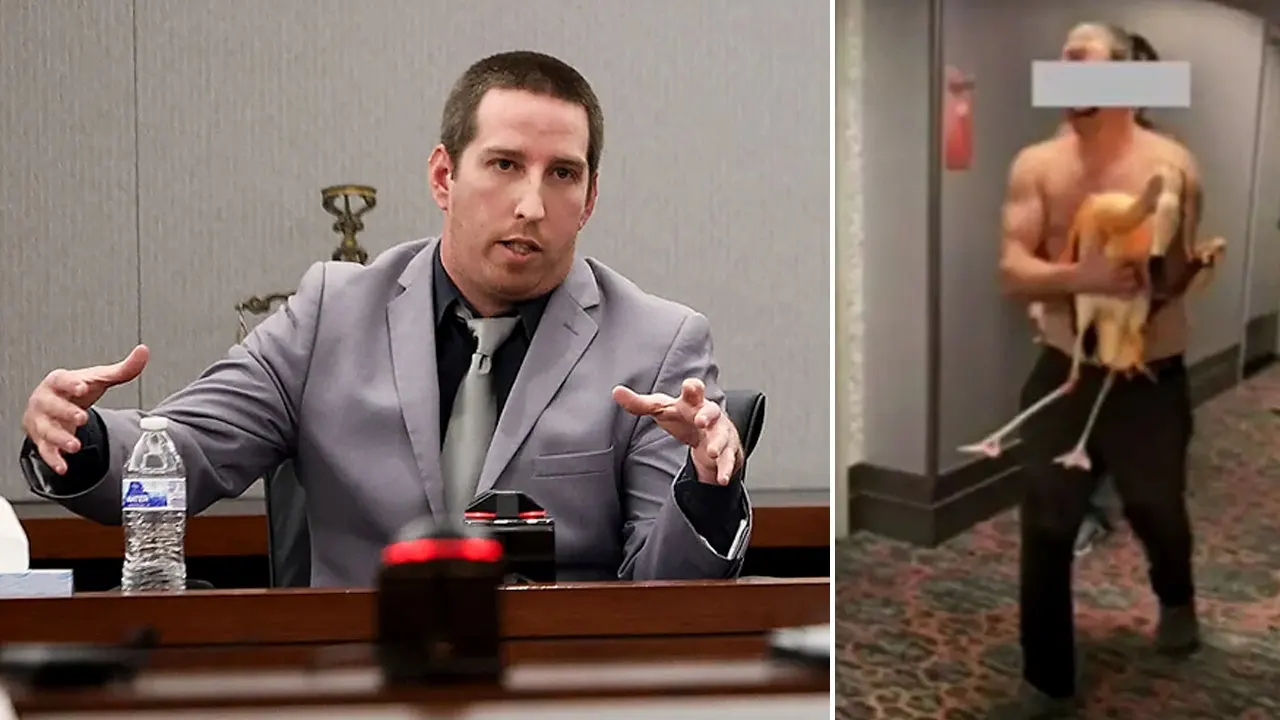
On Monday, in a Las Vegas courtroom, a bizarre and deeply troubling chapter came to an end for a Canadian tourist whose impulsive, drunken decision transformed a vacation into a criminal nightmare. Mitchell Fairbarn, a visitor from Ontario, was found guilty of felony and misdemeanor animal cruelty charges after jurors deliberated for roughly five hours. The case centered on a startling incident that took place on March 3 at the Flamingo Las Vegas Hotel and Casino, one of the most iconic properties on the Strip. Fairbarn had removed a 27-year-old Chilean flamingo named Peachy from its carefully maintained habitat and carried the panicked bird through the hotel, eventually bringing it to his own room. What began as a bizarre, almost surreal story—a man strolling through a casino with a squawking pink bird in his arms—became a serious legal matter involving animal welfare, personal accountability, and the often blurred line between reckless stupidity and intentional harm. The verdict sent a clear message that the mistreatment of animals, even in the midst of a wild night, carries real consequences.
The evidence presented during the trial painted a vivid and unsettling picture of what happened that night. Surveillance footage, played for the jury, showed Fairbarn holding Peachy inside an elevator, the bird clearly distressed and squawking loudly as the elevator descended. Another clip captured him carrying the flamingo through a hotel hallway, its long neck twisting and feathers rustling as it struggled in his grip. Prosecutors argued that Fairbarn deliberately caused the bird pain, pointing specifically to footage that showed him pulling Peachy by its feet, as well as the discovery of feathers scattered along the hotel floor. When Las Vegas police arrived—after hotel security reported the flamingo missing from its enclosure—they found Peachy in a state that horrified those who encountered her. The bird was missing seven or eight feathers, had visible blood on its plumage, and had suffered injuries to its wings. For a creature as delicate and sensitive as a flamingo, the ordeal was not just physically painful but likely terrifying. The prosecution’s case was built not on the idea that Fairbarn had planned to harm an animal, but on the undeniable reality that his actions caused suffering, and that he had to be held responsible for the choices he made while inside that habitat.
Fairbarn’s defense attorney, Josh Tomsheck, did not try to deny the basic facts. Instead, he asked the jury to consider the context of a man who made a catastrophic error in judgment while intoxicated. “He should not have done that, should not have gone into the habitat, shouldn’t have touched a bird, shouldn’t have taken Peachy inside,” Tomsheck told jurors. “The truth is, Mitch was drunk. Mitch was stupid. He made bad decisions.” It was a candid and humanizing plea, one that acknowledged the gravity of the actions while attempting to separate the man from the moment. The defense wanted the jury to see Fairbarn not as a cruel animal abuser, but as someone who, under the influence of alcohol, did something inexplicable and regrettable. And there was indeed a human tragedy woven into the case: Fairbarn had received death threats after the incident went viral, and he was unable to return to Canada when his father died while the criminal case was still pending. Those personal losses were real and painful. Yet Clark County prosecutor Haley Willming reminded the jury that these consequences, however tragic, were the direct result of Fairbarn’s own choices. “None of that would have happened had he not done what he did, had he not made the choices he made,” Willming said. It was a stark reminder that accountability often means living with the ripple effects of our worst moments, even those we never intended.
For Peachy, the aftermath of that night has been a slow and careful recovery. According to Tiffany Moore, the medical director of Lone Mountain Animal Hospital, who treated the flamingo after she was rescued, Peachy is doing well physically now. The wounds to her wings have healed, and her feathers are growing back. But the emotional scars are less visible. Moore testified that Peachy has become more anxious during veterinary examinations, a subtle but telling sign that the trauma of being yanked from her home and carried through a strange environment has left a lasting impression. Flamingos are highly social, sensitive birds, and the habitat at the Flamingo Las Vegas has long been a beloved feature of the hotel, offering guests a glimpse of these elegant creatures in a tranquil setting. The resort, one of the oldest on the Strip, is known for its wildlife habitat, which also houses turtles, koi fish, and other animals. For decades, visitors have gathered around the water to watch the flamingos preen, wade, and interact. Peachy, at 27 years old, had likely spent most of her life in that habitat, familiar with the rhythm of the crowds and the care of her keepers. To be suddenly snatched from that world by a stranger must have been a bewildering and frightening experience, and her heightened anxiety during exams is a poignant reminder that animals carry their memories too.
The legal outcome now hangs over Fairbarn’s future in a way that will be difficult to escape. He remains under house arrest as he awaits sentencing on December 1. He faces up to four years in prison on the felony conviction, plus an additional six months for the misdemeanor offense. The sentence will be determined by the court, and it will likely take into account the severity of the animal’s injuries, the intentional nature of the actions, and the broader context of a case that drew national and international attention. This is not the first time in recent months that viral videos of people harassing wildlife have led to legal consequences. In separate incidents, Ukrainian influencers filmed themselves sitting on a sea turtle while it tried to lay eggs, a California teen faced prison after a video showed him kicking a sea lion in the face, and a man was charged in a federal endangered species harassment case after allegedly bragging about his wealth. These cases share a common thread: the impulse to treat living creatures as props for entertainment, often while intoxicated or seeking attention. The courts, increasingly, are responding with seriousness, signaling that animal cruelty is not a joke, even when the circumstances seem absurd on the surface. For Fairbarn, the loss of his father, the death threats, and the looming prison sentence are all steep prices to pay for one night of reckless behavior, but they are also the natural outcomes of actions that harmed a defenseless creature.
In the end, this story is a strange and sobering mixture of tragedy, folly, and grace. It is easy to laugh at the image of a man walking through a Las Vegas casino with a flamingo, but the reality is more uncomfortable: a living being was hurt, and a human being’s life was upended. The jury’s verdict offers some measure of justice for Peachy, a bird who cannot speak but whose suffering was documented and acknowledged. It also serves as a cautionary tale about the intersection of alcohol, impulsivity, and the treatment of animals. There is no way to undo what happened that night, no way to give Fairbarn back the months he spent trapped in a foreign country, no way to erase the fear Peachy felt. But there is a path forward, one that involves accountability, reflection, and hopefully, a greater societal awareness that animals are not objects to be handled for our amusement. As Fairbarn awaits his sentence, and as Peachy continues to heal in the familiar surroundings of her habitat, the hope is that this strange incident will lead to more compassion—for the animals we share our world with, and for the flawed humans who sometimes make terrible mistakes. The Flamingo’s pink residents still wade in their waters, and Peachy remains among them, a survivor of an ordeal she never asked for. And in the quiet moments after the cameras and the courtrooms fade, that is what matters most.