


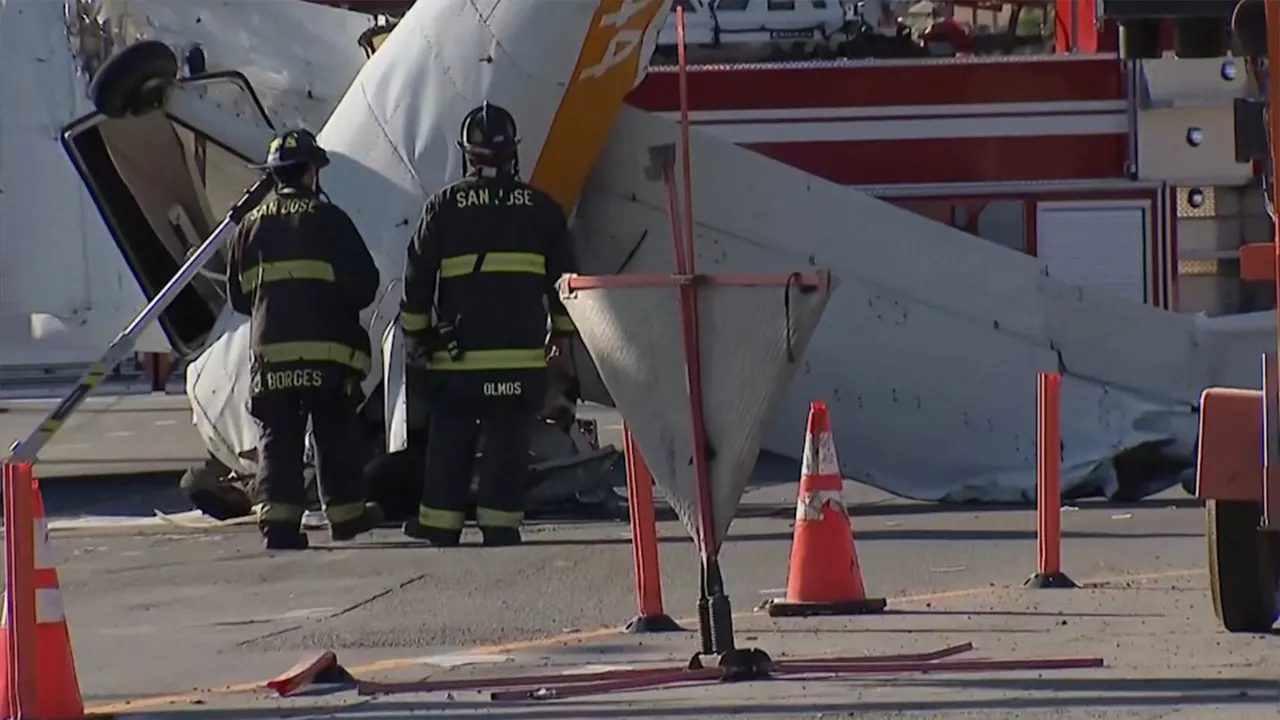
On a Saturday that began like any other along the Capitol Expressway in San Jose, California, the ordinary rhythm of traffic was violently interrupted by a sight that no one expects to see against the backdrop of an urban skyline. Dash camera footage, the ever-present witness of modern life, captured the dramatic moment a single-engine Cessna 177 descended from the sky and slammed into the overpass arching above the roadway. The video shows the small plane careening into the concrete structure with a brutal finality, a stark collision between the improbable freedom of flight and the fixed reality of the ground below. For those driving along the expressway in that moment, the sequence must have unfolded both quickly and in surreal slow motion—a buzzing engine, a low-flying shape, and then the sickening impact of metal against the infrastructure of the city. The fact that the crash did not involve a single vehicle on the busy expressway below remains nothing short of miraculous, a detail that speaks to luck, timing, and the narrow margins that separate an astonishing near-miss from an unthinkable catastrophe.
Aboard that plane were three people: two adults and a child, souls who would step into the daylight after the wreckage settled, thanks to the resilience of small aircraft construction and a measure of fortune that defies explanation. When the San Jose Fire Department arrived on the scene at the intersection of Capitol Expressway and Excalibur Drive, the first reports painted a picture of tension and uncertainty, but as the smoke cleared and the responders reached the occupants, a different story emerged. The three individuals were transported to local hospitals with non-life-threatening injuries, a phrase that carries with it an immense weight of relief when one considers the alternative. The fire department’s announcement, delivered through a post on X, was measured and professional, noting that two adults and one child were taken out of an abundance of caution. But beneath that clinical language lies the raw human truth of what occurred: a family or a group of friends took to the skies in a small aircraft and found themselves fighting for survival in the moments after something went terribly wrong, only to emerge bruised but alive, with the gift of being able to walk away from an ordeal that could have ended in far greater tragedy.
Behind the scenes, the response was a symphony of coordinated urgency. Firefighters, police officers, and emergency medical personnel converged on the scene with the focus that comes from training for exactly this kind of unforeseen event. The San Jose Fire Department not only managed the rescue of the plane’s occupants but also contended with a minor fuel spill, which was quickly absorbed, neutralizing a secondary hazard that could have turned an already dangerous situation into a catastrophic fire. Their efficiency reflects a broader truth about first responders: they are the ones who run toward the chaos, sorting through the wreckage of shattered expectations to find the pulse of humanity within. For the residents of the nearby area, the sirens and the sight of emergency vehicles filling the expressway were a jarring reminder of how a moment can transform a familiar stretch of road into a scene of high drama. The decision to transport the injured individuals out of an abundance of caution underscores the mindset of these professionals, who understand that hidden injuries warrant vigilance, and that the first clear sign of trouble is not always the most telling one.
The broader context of the crash invites reflection on the nature of small aircraft and the environments they fly over. The Cessna 177, a four-seat, high-wing aircraft beloved by private pilots for its forgiving handling and reliable performance, is a workhorse of general aviation. Yet when a plane like this encounters trouble—be it a mechanical failure, a sudden loss of engine power, or an error in pilot judgment—the pilot must search for a place to bring the craft down. Making an emergency landing on a road is a desperate gamble, a calculated attempt to trade speed and altitude for the safety of a flat, open surface. In this case, the gamble resulted in a crash into the overpass, a hard impact that could have been far worse. The fact that no one on the ground was harmed is a testament to the isolation of the moment, perhaps a quiet day on the expressway, and the sheer fortune that the plane did not plow into a line of stopped cars. The city of San Jose, a hub of innovation and technology, was briefly the stage for a primal drama of survival, and its people—the witnesses, the responders, the hospital staff—played their parts with resilience and care.
Now, the investigation begins, a methodical process that will peel back the layers of this incident to seek the truth. The San Jose Fire Department, the Federal Aviation Administration, and the National Transportation Safety Board have all stepped in to piece together the sequence of events that led to the crash. Their investigators will examine the wreckage for signs of mechanical failure, review the pilot’s history and recent maintenance records, analyze weather conditions, and listen to air traffic control communications in an effort to understand what happened in the cabin in those final moments before impact. The San Jose Police Department has already offered one piece of clarity: drugs and alcohol are not believed to have played a role in the crash, a preliminary finding that, while not conclusive, removes one unsettling possibility from the table. The public may not hear a definitive answer for weeks or even months, as the NTSB is known for its exhaustive and deliberate approach to aviation accidents, treating each incident as a puzzle to be solved not with haste, but with precision. In the meantime, the community is left with the image of that Cessna against the overpass and the questions that such an event always raises.
What remains at the heart of this story is a reflection on fragility and gratitude. Air travel, whether in a commercial jet or a small propeller plane, relies on a delicate balance of engineering, skill, and circumstance, and when that balance is disrupted, the consequences can be profound. For the three individuals aboard the plane, the crash was surely a terrifying experience, a tunnel of noise and impact that could have ended their lives. Instead, they are now recovering, facing the mundane but beautiful challenges of healing, of explaining to friends and family what happened, of processing the awareness that they were given a second chance. For the witnesses whose dashcams recorded the event, this crash will linger as a vivid memory, a reminder that any day can turn extraordinary in an instant. And for the rest of us, reading about this incident from a distance, it offers an invitation to pause and consider the delicate threads that hold our lives together. Tomorrow, they will begin to repair the overpass, clean up the last remnants of the spill, and return the Capitol Expressway to its ordinary purpose. But the story of the plane that fell from the sky, and the people who survived it, will remain etched in the memory of San Jose—a reminder of our resilience, our capacity for hope, and the quiet miracles that happen when we least expect them.