




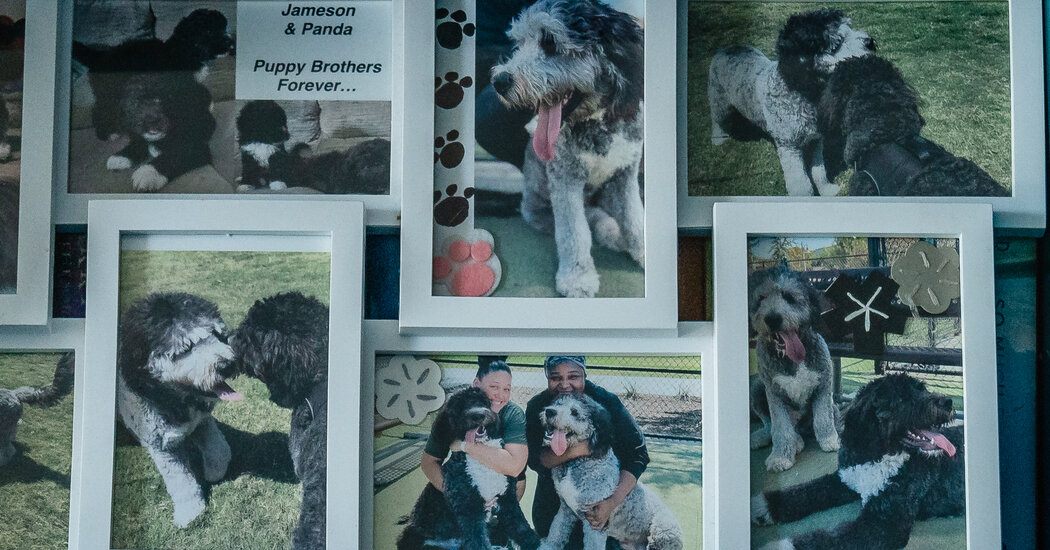
In the quiet warmth of a Saturday evening, what should have been a moment of unbridled joy quickly spiraled into an unimaginable nightmare inside a Los Angeles apartment building. Marie Marseille was in her home, swept up in the electric excitement of watching her favorite basketball team, the New York Knicks, clinch an emotional victory in the NBA championship. Her ecstatic cheers and cries of “Oh, my god!” echoed down the hallway—expressions of pure celebration that a concerned neighbor unfortunately misinterpreted as a desperate cry for help. Seeking to ensure her safety, the neighbor dialed 911, bringing two Los Angeles Police Department officers to Marseille’s doorstep for what was intended to be a routine wellness check. By her side during this moment of celebration was Jameson, her beloved two-year-old Golden Saint Berdoodle. To those who knew him, Jameson was a gentle giant, a floppy-haired, sweet-natured companion who wore a miniature blue shirt and brought endless comfort and affection to Marseille’s daily life. Yet, in the high-stakes, hyper-vigilant world of modern policing, the presence of a large, excited dog can instantly transform a welfare check into a volatile and tragic confrontation, highlighting a deep societal divide in how we define safety and the value of non-human life.
The newly released police body camera footage, which weaves together the perspectives of both responding officers, captures the agonizingly brief minutes leading up to the tragedy. Arriving just before nine o’clock in the evening, the officers stand on opposite sides of Marseille’s door, their posture tense as they knock and announce their presence. When the door swings open, they are met not with a victim in distress, but with the boisterous, barking energy of Jameson, who stands at the threshold eager to see who has arrived. Instantly, the atmosphere shifts from a routine inquiry to a defensive standoff; one officer immediately unholsters his handgun, his instincts primed for danger. Marseille quickly tries to stabilize the situation by apologizing and agreeing to secure her pet, while the officers step back down the hallway, attempting to put distance between themselves and the massive animal. During this brief interlude of waiting, a poignant exchange is captured on the audio feed: one officer remarks on the dog’s intimidating size, to which his partner candidly replies, “I ain’t getting bit by that, bro,” before temporarily returning his weapon to its holster. This candid admission of fear underscores a critical vulnerability in law enforcement training, where the natural, protective barking of a domestic pet is immediately perceived as an existential physical threat rather than a standard canine reaction to strangers at the door.
The fragile peace shattered seconds later when Marseille reopened her door, attempting to assure the officers of her dog’s gentle disposition. “He’s not aggressive,” she pleads softly in the footage, “At all. I apologize.” But the officers remain deeply anxious, pointing out how “huge” the animal is just before Jameson unexpectedly slips past Marseille’s grasp and bounds outside into the hallway. Excited and barking, the large dog moves rapidly toward one of the officers, who reacts with sudden panic. Backing away in a frantic retreat, the officer draws his firearm once more and fires four rapid shots directly into the dog. The deafening gunfire echoes through the narrow corridor, and Jameson immediately collapses to the floor, his life slipping away in an instant. The heartbreaking transition from a lively, beloved family member to a motionless body takes less than a minute from the officers’ initial knock at the door. Marseille’s agonizing, soul-crushing scream of “No!” pierces the air, capturing a raw, universal human grief that resonates deeply with anyone who has ever loved a pet. In that singular, violent moment, a home that had been filled with laughter and sports fandom just minutes prior was permanently shattered by trauma and profound loss.
The tragic loss of Jameson quickly transcended a localized incident, igniting a wave of international outrage and placing the Los Angeles Police Department under intense global scrutiny. As the Los Angeles Department of Animal Services arrived to take custody of Jameson’s lifeless body, communities worldwide began mourning alongside Marseille, using social media to express their grief and anger over what many viewed as an entirely preventable execution. The incident struck a deeply sensitive nerve regarding the emotional and psychological bonds humans share with their pets, who are widely regarded not merely as property, but as core family members. For Marseille, the pain of losing Jameson is compounded by the sheer absurdity of the circumstances: her companion was killed because she was celebrating a sports victory, and because a system designed to protect citizens was unable to accommodate the natural behavior of a startled dog. This outcry has forced a public-facing dialogue about the human cost of police reactions, questioning why law enforcement officers, who are trained to face human violence and complex crises, are so often quick to employ lethal options when encountering companion animals that pose a non-lethal, manageable threat.
In the wake of the mounting public anger, the LAPD has initiated its standard administrative protocol to evaluate the officer’s actions, a process detailed by police spokesman Captain Mike Bland. According to official statements, the department will spend the next several months meticulously investigating the shooting, a comprehensive review that includes analyzing body camera footage, conducting forensic tests, and interviewing potential witnesses. Once this exhaustive internal investigation is finalized, the findings will be reviewed by the Chief of Police, who will then submit a formal recommendation to the civilian-led Board of Police Commissioners. This board holds the ultimate authority to determine whether the officer’s rapid escalation to deadly force adhered to established departmental tactics and training standards. However, to a grieving owner and an outraged public, this cold, bureaucratic timeline offers little immediate solace. The painful reality of waiting months for an administrative body to decide if the violent death of a family pet was “within policy” highlights the stark disconnect between institutional self-preservation and the urgent, human demand for empathy, accountability, and immediate justice.
The immense tragedy has drawn direct condemnation from Los Angeles Mayor Karen Bass, who publicly labeled the body camera footage “disturbing and tragic” and demanded a fundamental reevaluation of how officers interact with domestic animals. While acknowledging the ongoing investigation, Mayor Bass raised critical questions about the necessity of the lethal force used against Jameson, emphasizing that the department’s existing written guidelines on dog encounters are clearly inadequate. Ironically, the LAPD had implemented a comprehensive use-of-force policy for hostile dog encounters just a year prior in 2023, which explicitly details seven non-lethal tools and tactics that officers should employ before resorting to firearms, including verbal commands, chemical deterrents, batons, tasers, and physical redirection. The tragic failure to utilize any of these graduated options in Jameson’s case underscores an urgent need not just for better policies on paper, but for a profound cultural shift in police training that prioritizes de-escalation, emotional self-regulation, and the preservation of all life. Moving forward, the conversation surrounding Jameson’s death must serve as a catalyst for systemic reform, ensuring that no more families are forced to pay the ultimate price of losing a cherished companion to a routine knock at the door.