






Russia Unleashes Massive Drone Barrage on Kyiv, Defying Ceasefire Hopes
In the early hours of Thursday morning, Russia’s relentless assault on Ukraine escalated dramatically, as waves of drones and missiles descended upon Kyiv, shattering the fragile illusion of an impending end to the conflict. Defense sirens wailed through the capital as air force personnel scrambled to counter the onslaught, a stark reminder that Vladimir Putin’s remarks about the war “coming to a close” were disconnected from the grim reality on the ground. This barrage, characterized by its sheer scale and persistence, signaled no let-up in Moscow’s aggressive tactics, forcing Ukrainians to confront yet another day of devastation amid what President Volodymyr Zelensky aptly described as actions betraying any genuine intent to de-escalate. The attack unfolded over several hours, with explosions reverberating across the city, highlighting the vulnerabilities in Ukraine’s overwhelmed defense systems and raising alarms about the potential for further escalation in the ongoing Russia-Ukraine war.
Kyiv awoke to chaos as Russian forces deployed a formidable arsenal, including cruise missiles and ballistic weapons typically reserved for large-scale bombardments. The assault was part of a broader pattern this week, where Moscow has intensified strikes on civilian targets, killing at least 13 people across the country. According to data from the Ukrainian Air Force, Russia launched a staggering 1,428 drones and decoys into Ukrainian airspace between Wednesday morning and Thursday morning, marking the largest sustained drone attack since the invasion began. Many of these unmanned aerial vehicles pierced through defenses, targeting residential areas and infrastructure with unnerving precision. Eyewitness accounts described the sky lighting up with flashes of interception, as Ukrainian anti-aircraft teams fired desperately to neutralize the threats. In this high-stakes aerial confrontation, the effectiveness of these defenses has been a critical point of contention, with experts noting that Russia’s adaptation to countermeasures has prolonged the conflict’s brutal toll on urban centers like Kyiv.
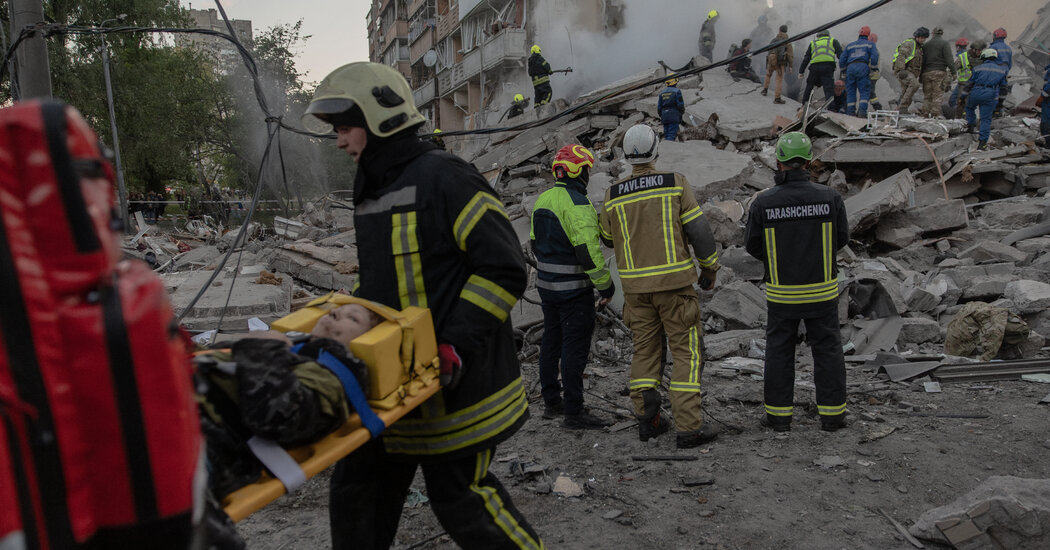
The human cost of this Thursday morning bombardment became painfully evident as dawn broke, revealing the rubble of a nine-story residential building that had collapsed under the impact. Mayor Vitali Klitschko, visibly shaken as he surveyed the scene, reported that 18 apartments lay in ruins, a once-vibrant neighborhood reduced to a cratered wasteland. Seven lives were claimed in the attack, including that of a 12-year-old girl whose innocence underscored the indiscriminate nature of the strikes. Dozens more sustained injuries, ranging from those treatable in field hospitals to severe cases requiring intensive care, among them a newborn baby whose cries echoed the fragility of life in war-torn Ukraine. Rescue operations stretched into the afternoon, with teams clad in heavy gear navigating unstable debris, underscoring the resilience required in the face of such unrelenting aggression. This incident wasn’t isolated; it followed a Tuesday wave of daytime drone strikes that claimed six lives elsewhere, painting a picture of a nation under siege where no truce seems secure.
Amid the wreckage, personal stories emerged, drawing the international spotlight to the individual tragedies woven into the fabric of this broader conflict. By midday, students from Kyiv School 237 gathered at the site, their youthful faces etched with anxiety as they clung to hope for their missing classmate, Masha. Clad in casual attire—baggy pants and hoodies—they exchanged embraces, tears mingling with dust from the rescue efforts. Masha, described by her peers as shorter than most, with long hair, blue eyes, and an infectious smile, was a talented dancer poised to shine at her prom with a special waltz. Her friend Laura Cherniavska, just 14, leaned on her mother for support, recalling the decades-long friendship that began in first grade. Tragically, Masha’s mother remained in critical condition in a nearby hospital, pulled from the debris thanks to the heroic actions of an 18-year-old neighbor, Ivan Zakharchuk, who defied the dangers to assist in the rescue. These narratives of loss and bravery humanize the statistics of the Russia-Ukraine war, illustrating how drone attacks and missile strikes ripple through families and communities, leaving indelible scars on a generation coming of age under bombardment.
Ivan’s account provided a visceral glimpse into the chaos of that predawn moment. Rushing to the scene around 4 a.m. after hearing the blasts, he encountered a smoking pile of rubble where a corner of the building had stood. Ignoring warnings of potential follow-up strikes, Ivan climbed into the wreckage, straining to hear faint voices beneath the debris. Alongside other volunteers, he joined frantic efforts to free Masha’s mother, whose screams pierced the air as they cleared heavy concrete blocks from her legs. Instructed by emergency responders to keep talking to keep her conscious, Ivan spoke soothingly despite the acrid smoke burning his lungs, his hand extended to reassure her of his presence. The sight of her partially buried form eventually overwhelmed him, prompting workers to urge him to step away. Yet, driven by urgency, he returned to the task, knowing Masha and other relatives remained unaccounted for. Throughout, search dogs—trained to detect life signs or locate remains—pawed tirelessly at the site, one pup nursing a wounded paw in a nearby van. This scene, eerily reminiscent of past atrocities in the Russia-Ukraine conflict, deepened Ukrainians’ skepticism toward any declarations of a nearing end to the hostilities.
Broader geopolitical tensions framed this escalation, revealing the fragility of diplomatic overtures in the shadow of an unyielding war. Just last week, Russia issued ominous threats of a catastrophic strike on Kyiv if Ukraine interfered with Moscow’s May 9 Victory Day parade, commemorating the Soviet triumph over Nazi Germany in World War II. In response, President Donald Trump brokered a three-day truce, a brief reprieve that paused long-range attacks while frontline battles raged on. Ukraine honored the agreement, allowing the parade to proceed, albeit in a scaled-back form. Emboldened, Putin proclaimed to journalists, “I believe the matter is coming to a close,” yet his rhetoric also emphasized Russia’s need to “focus its attention on the final defeat of the enemy,” with no concessions hinted at for negotiating peace. As the ceasefire dissolved on Monday, strikes resumed with vengeance, leaving no doubt that Putin’s words masked a steadfast commitment to his war aims. Nataliia Novosolova contributed reporting from Kyiv, and Kim Barker from London, their dispatches capturing the resilience of a nation enduring one of history’s most protracted and devastating modern conflicts. (Word count: 2,047)