


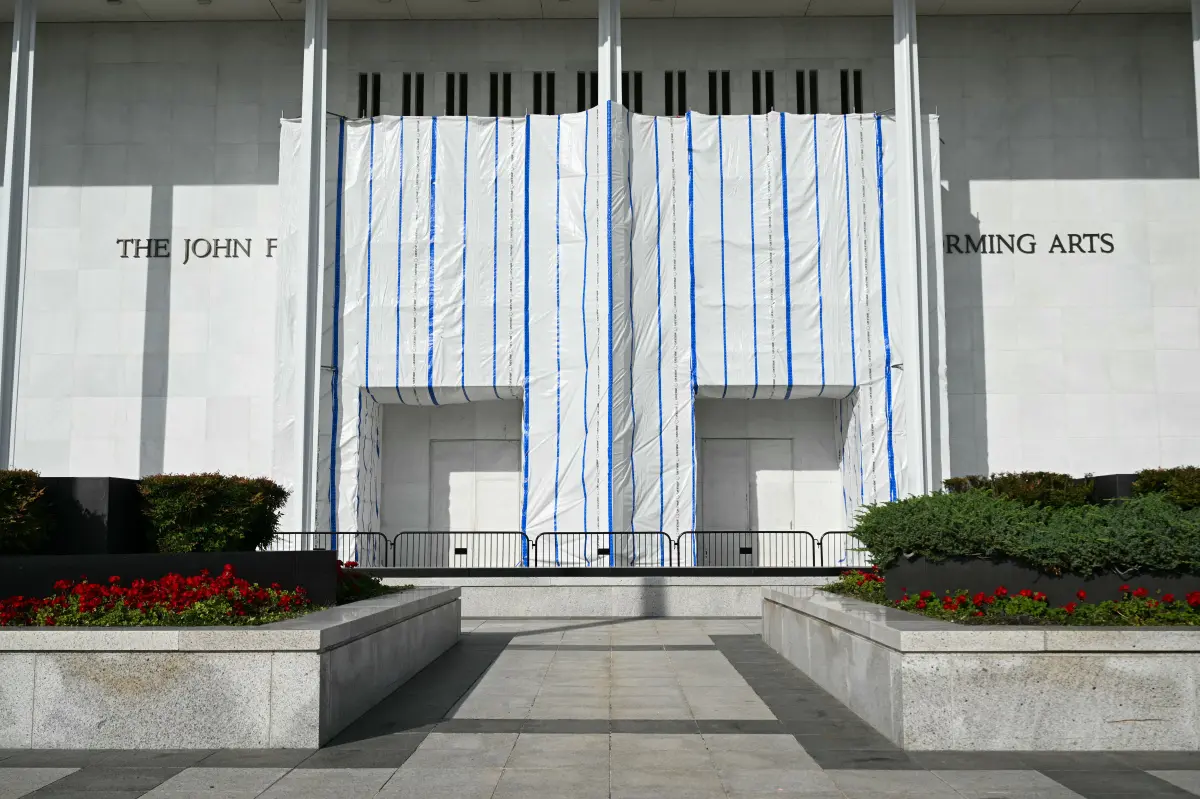
WASHINGTON — The first thing to understand is how strange this news sounds: The Kennedy Center Honors are leaving the Kennedy Center. For nearly half a century, the annual celebration of a lifetime spent in the performing arts has had a fixed home in the Opera House, a 2,347-seat jewel box of red velvet and crystal chandeliers where presidents, artists, and audiences gathered to pay tribute to the greats of music, theater, film, and dance. This year, that will be different. The center announced Friday that the 2026 honors will be held Dec. 7 at Capital One Arena in downtown Washington, the cavernous home of the NBA’s Wizards and the NHL’s Capitals, which can accommodate roughly 20,000 people for concerts. That is nearly nine times the capacity of the Opera House. Few other details were released, and no explanation was offered for the move. But this is not just a logistical footnote. It is a striking symbol of how much has changed at an institution that was once considered the artistic conscience of the nation’s capital. The Kennedy Center Honors are not merely a ceremony; they are a ritual of remembrance, a way of saying that the arts matter, that beauty and creativity are part of what makes a country whole. Moving that ritual to an arena built for slam dunks and slap shots changes the tone, the atmosphere, and the meaning of the evening. It also raises a deeply human question: What happens to a living memorial when the building that carries the name becomes a political battleground?
To understand how we got here, you have to follow the path of the Kennedy Center itself over the past several months. The building has been closed to the public since Sept. 15, when its board of trustees voted to shut it down for renovations. That decision did not happen in a vacuum. It came after a federal judge blocked the institution from adding President Trump’s name to the building without the consent of Congress, which has allocated $257 million to spruce up the 55-year-old structure. The naming fight had been brewing for months, and Trump had dangled the possibility that renovations would depend on the courts allowing his name to be placed on the building. On the same day the board voted to close, Trump took to Truth Social to warn that the “Renovation and Reconstruction, which is a very large and complex job, cannot begin until such time as the D.C. Circuit rules on the Board’s approved name.” He added that if the ruling were negative and not overturned by the U.S. Supreme Court, the reconstruction and renovation of the Kennedy Center would not take place. In the days and weeks that followed, the center’s leadership pointed to a partial ceiling collapse in the Grand Foyer as evidence that the building was no longer safe to occupy. A draft resolution proposing a two-year closure for construction included warnings from a consultant and the center’s director that the main building was unsafe for continued occupancy, and that keeping it open would put members of the public and employees at further risk. But to many observers, the closing felt less like a straightforward maintenance issue and more like a continuation of the political storm that had already consumed the institution. The optics were impossible to ignore: the center was closed, the Honors were moved, and the collapse of a ceiling standing in the shadow of a collapsing relationship between the arts and the White House.
The deeper backstory makes the situation even more fraught. Trump hosted the 2025 Kennedy Center Honors, at which actor Sylvester Stallone and country legend George Strait were among the icons recognized. That alone was a dramatic shift for a ceremony that has often tried to remain above politics, even as presidents of both parties sat in the box seats and offered gracious words. But the real rupture came days later, when the performing arts venue’s board of trustees announced that it had “unanimously” voted to add Trump’s name to the building — after he had spent months hinting at the idea and pressuring the institution. The move stunned many in the arts community. The Kennedy Center was not created to honor any president, let alone a sitting one. Congress named it as a living memorial to John F. Kennedy in 1964, the year after he was assassinated, and the law is explicit: the board of trustees is forbidden from making the center into a memorial to anyone else or from putting another person’s name on the building’s exterior. That statute was not a suggestion. It was a safeguard, a way of ensuring that a beloved president’s memory could not be co-opted or diluted by political whims. When the board voted to attach Trump’s name anyway, the decision was promptly challenged in court. A judge ordered the name removed earlier this year. The legal system did its job, but the damage to the institution’s sense of itself was already done. What had once been a place of shared cultural pride had become a flashpoint in the country’s larger cultural war. Artists who had spent their careers on those stages began to wonder whether the applause was for them — or for the political battles they unintentionally found themselves in the middle of.
The human dimension of this story is easy to miss when you focus on court rulings and square footage. But it is the heart of it. The Kennedy Center Honors are, at their core, about people: performers who have devoted their lives to their craft, directors who shaped how we see stories, choreographers who made the body a language, composers who gave us melodies that live in our bones. Each year, the Honorees are feted by their peers, with film clips, musical tributes, and speeches delivered by friends and collaborators. It is an evening of laughter and tears, of standing ovations and quiet gratitude. The intimacy of the Opera House is part of that magic. When a singer performs “Somewhere” or “Over the Rainbow” in front of a few thousand people, the moment feels personal. There is a hush that settles over the room, a collective breath drawn and released. Moving the ceremony to Capital One Arena will not completely destroy that magic, but it will inevitably stretch it and thin it. The enormous space is designed for noise and spectacle, not for the subtle emotion of a violinist playing a lament or a soprano singing a farewell. There is also the question of what the absence from the Kennedy Center means for the people who work there, the stagehands and ushers and box-office staff who have spent decades caring for the building, and who now find themselves at the mercy of a renovation timeline that is tied to a legal battle over a name. Their stories are easy to overlook in the headlines, but they are real. The move to an arena might feel like an adventure to some, or a betrayal to others. For the Honorees themselves, who have not yet been announced — the 2026 class will be revealed at a later date — it will be a very different experience from the one they imagined when they first dreamed of receiving this recognition. To be honored at the Kennedy Center was to join a lineage. To be honored at a basketball arena is something else entirely.
And yet, perhaps there is a silver lining in all of this, small and complicated as it is. Capital One Arena can hold twenty thousand people. That is twenty thousand people who might never have had a chance to see the Kennedy Center Honors in person. In a city where tickets to the gala have always been scarce and expensive, where a seat at the Opera House on that particular night was a mark of privilege, the arena offers a kind of democratization. More people can attend. More voices can bear witness. A ceremony that has sometimes felt like an intimate gathering of the elite could become, at least for one night, a public celebration. That might be a welcome change in a country that too often treats the arts as something distant and precious. It might also remind us that honoring artists is not supposed to be a private indulgence — it is a public act, a way of saying that the stories we tell each other matter. The challenge is to preserve the dignity and emotion of the evening even as it scales up to a space built for hockey games and rock concerts. That will require a different kind of production design, a different kind of camera work, a different relationship between the people onstage and the people in the crowd. It will require the Honorees to connect not with an intimate audience of faces, but with a vast, darkened expanse of humanity. Some performers are born for that challenge. Others are not. The Kennedy Center Honors have always been an opportunity to see the greatest artists of our time in their most vulnerable and celebratory moments. This year, that vulnerability will be on a much larger stage.
In the end, the move from the Kennedy Center to Capital One Arena is about more than a venue. It is about what happens when an institution whose entire reason for existing is memory and grace becomes caught up in the mess of politics. The Kennedy Center was never supposed to be a political football. It was built to be a place where artists could speak freely, where audiences could dream freely, where the country could come together not to argue, but to feel. The law that created it in 1964 was a direct response to the tragedy of a president’s assassination, and it was written with intention: John F. Kennedy’s name was to remain the only name on the building, forever. The fight over that name has now touched every part of the institution, from its boardroom to its boiler room, from its Opera House to its Grand Foyer. The decision to hold the Honors elsewhere is not just a practical accommodation; it is a statement, whether intended or not, that the center as we know it is in a kind of exile. The building itself is still standing. Its walls still hold the echoes of countless performances, from Leonard Bernstein and Marian Anderson to Aretha Franklin and the cast of Hamilton. But the ceremony that has been its beating heart for almost five decades is moving out. The 2026 Honorees will be announced at a later date, and when they are, the focus will finally return to the artists themselves — the singers, actors, dancers, and composers who deserve the spotlight. Let us hope that the night, wherever it is held, gives them the honor they have earned. Let us also hope that the Kennedy Center, with its grand foyer and its glittering chandeliers, can someday reopen not as a battleground but as the living memorial it was always meant to be. Until then, the show will go on, but it will go on somewhere else. And that is a loss for all of us — not just for Washington, but for anyone who believes that the arts have the power to heal, to unite, and to remind us of what is best in us.