


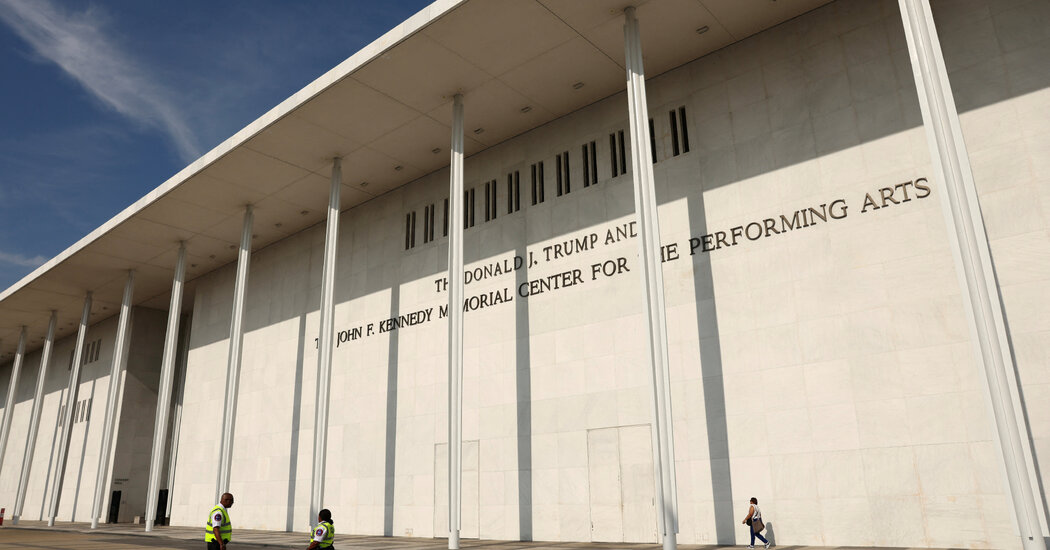
The grand, looming white marble facade of the John F. Kennedy Center for the Performing Arts has long stood as a stately beacon of American culture, perched gracefully along the banks of the Potomac River in Washington, D.C. Yet, in recent days, this celebrated monument to artistic expression has been transformed into the stage for a bitter, high-stakes political and legal drama that feels more like a tense courtroom thriller than a night at the opera. As a strict, court-mandated Friday deadline loomed to strip the name of President Donald J. Trump from the building’s exterior, lawyers representing both the former president and the institution scrambled to file an eleventh-hour appeal. This desperate legal maneuver sought not only to halt the imminent and highly public removal of Trump’s name from the historic structure but also to challenge a federal judge’s sweeping decision to block a controversial two-year shutdown of the facility for extensive renovations. For the past several months, the physical space of the Kennedy Center has been a battleground where national identity, political patronage, and the legacy of a slain president clash directly with the ambitions of a modern political movement. What was designed to be a sanctuary of unity and human creativity has instead found itself ensnared in an exhausting web of litigation, leaving employees, performance artists, and the general public caught in a state of suspended animation as they wait to see which name will ultimately grace the building’s walls.
The roots of this legal firefight trace back to a highly contentious decision made last December, when the center’s board of trustees—composed almost entirely of Donald Trump’s political allies—abruptly voted to rebrand the prestigious venue as the “Trump Kennedy Center.” The sudden modification of a landmark named in honor of a martyred president immediately ignited a firestorm of public outrage, generating fierce pushback from progressive lawmakers and artistic communities alike. Leading the charge against this sweeping rebranding was Representative Joyce Beatty, a prominent Democrat from Ohio who also serves as an ex officio member of the center’s board. Driven by a conviction that the board had drastically overreached its authority, Beatty launched a decisive lawsuit arguing that the name change was flatly unlawful. Late last month, U.S. District Judge Christopher R. Cooper delivered a resounding victory to Beatty and her supporters, ruling that the board had unilaterally attempted to seize a power it simply did not possess. In a clear and legally definitive message, Judge Cooper asserted that the authority to rename the institution belonged solely to the federal government, dryly noting that because Congress had given the Kennedy Center its name in the first place, only Congress maintained the constitutional power to alter it.
As the physical deadline to dismantle the physical signage approached, the atmosphere inside the center’s administrative ranks turned frantic, culminating in a highly charged, virtual emergency meeting on Thursday. With the clock ticking down, the board of trustees gathered online to coordinate their next move, a session that was joined by President Trump himself, who listened in from the phone lines. Amidst supportive commentary from allies like Commerce Secretary Howard Lutnick, who praised the president’s purported influence on the arts, the board voted decisively to appeal the federal court’s ruling. In the subsequent legal filings, Trump’s defense attorneys desperately pleaded for an emergency stay of Judge Cooper’s order, painted a portrait of administrative chaos if they were forced to comply immediately. They argued that tearing down the heavy marble letters of Trump’s name, only to potentially reinstall them should their appeal succeed in the future, would represent a collosal waste of public time and money. Furthermore, they emphasized the sheer logistical headache and public confusion that would inevitably result from subjecting the American theatergoing public to a dizzying, back-and-forth identity crisis on the building’s facade.
While the legal battle rages in the halls of justice, the human cost of this ideological warfare is being felt deeply by the everyday staff and creative professionals who keep the Kennedy Center running. Under President Trump’s oversight, the venue has suffered a devastating series of self-inflicted wounds, struggling under the weight of widespread artist boycotts, plummeting ticket sales, and constant executive turnover. The legendary stage, which once hosted the world’s finest talents, has seen its upcoming programming calendars left shockingly bare as administrators prepared to shutter the entire complex for a planned two-year renovation project. This aggressive shutdown proposal drew sharp criticism from Judge Cooper, who, in his exhaustive ninety-four-page ruling, lambasted the board for being “derelict” in its duty to protect the public interest. The judge pointedly reminded the trustees that they were far more than mere political figureheads; rather, they were legally bound to manage the national treasure with due care and a necessary modicum of independence. For the hundreds of stagehands, administrative clerks, and maintenance workers whose livelihoods have been disrupted by mass layoffs and organizational chaos, the courtroom battle is not just about a name on a wall, but about the survival of their careers.
The emotional and administrative whiplash experienced by the center’s internal staff reached a peak over the past week as administrators scrambled to keep up with the shifting political tides. Following Judge Cooper’s initial ruling, the president reacted with a characteristic series of digital outbursts on social media, angrily declaring that if he were not permitted complete control over the institution’s destiny, he had absolutely no interest in continuing what he labeled a hopeless journey into “NEVER NEVER LAND.” In the wake of these temperamental statements, Kennedy Center officials quietly instructed their exhausted staff members to begin the immediate process of scrubbing Trump’s name from the center’s digital footprint, including websites, mass email blasts, and official stationary. An internal memo distributed to employees explicitly acknowledged that physical, outdoor signage would need to be physically altered or taken down entirely to comply with the court’s strict Friday deadline. Yet, just as the staff prepared to carry out these monumental changes, the board’s sudden decision to appealing the ruling turned their efforts upside down once more, illustrating the agonizing uncertainty of working under a leadership team caught between judicial orders and political loyalty.
On the ground outside the arts complex, the physical manifestations of this political tug-of-war were plain for all to see as curious onlookers and television cameras gathered in anticipation of the scheduled Friday removal. By late Thursday afternoon, workers had already begun to implement temporary, stopgap measures, slapping thick white tape over the word “Trump” on parking garage signs and applying fresh stickers to shuttle buses to restore the venue’s original historical name. Now, with the filing of the formal notice of appeal and the request for an emergency stay, the physical dismantling of the signage stands frozen in a state of suspended animation, pending a final decision from either Judge Cooper or the U.S. Court of Appeals for the District of Columbia Circuit. As the crowds of journalists and disappointed visitors slowly trickled away from the plaza into the humid Washington evening, a heavy sense of exhaustion hung over the iconic structure. The ongoing feud has left the Kennedy Center stranded in a state of deep instability, serving as a powerful, melancholy symbol of how even America’s most sacred spaces of shared humanity can become deeply fractured by the relentless gravity of political division.