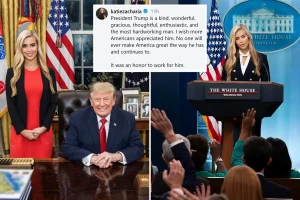


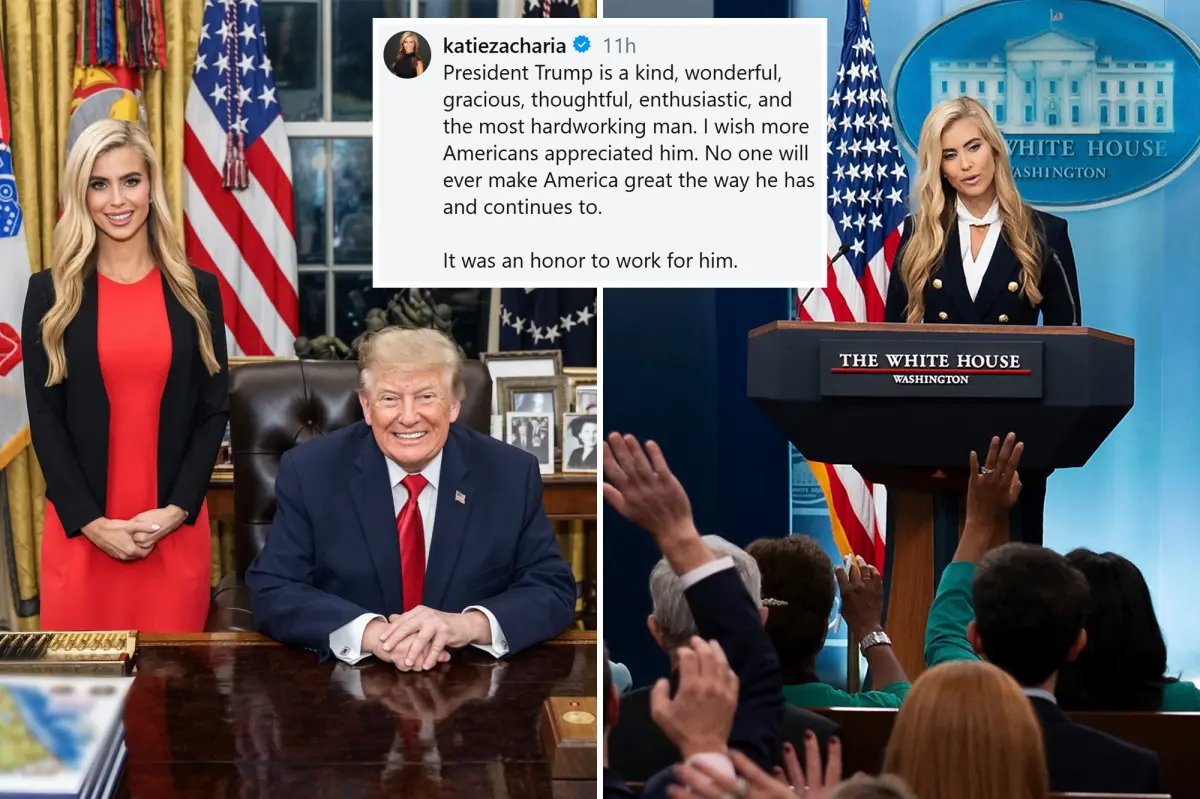
Five days. That is all it took for Katie Zacharia’s White House press secretary tenure to begin and end. When she walked out of the White House on Friday, most people in her position might have slammed the door—or at least retreated into silence. Instead, Zacharia chose a different path. In a message posted to X, she described President Trump as “kind, wonderful, gracious, thoughtful, enthusiastic, and hardworking.” She said she wished more Americans appreciated him. “No one will ever make America great the way he has and continues to,” she wrote. “It was an honor to work for him.” Attached was a photograph of her smiling beside Trump as he sat at the Resolute Desk, a map on his desk blurred to conceal whatever sensitive detail sat beneath the president’s hands. The post had racked up 7.2 million views by Saturday morning—a number that suggests far more than the usual political junkies were paying attention. There was something striking about the image: the easy smile, the formality of the Oval Office, the sense that this was a moment she had wanted to capture and keep. Yet the timeline told another story. Only days before, her account had pinned screenshots of Trump congratulating her on her appointment. Now those same followers were watching her say goodbye. The disconnect between the warm farewell and the abrupt reality of her departure was hard to miss. It was a human moment inside a political storm—one of those rare instances where a person faces public failure and chooses gratitude over grievance. Whether that gratitude was genuine, strategic, or a little of both, it said something about her character. In Washington, where exits are often bitter and grudges are worn like badges, Zacharia’s response felt almost old-fashioned. She did not blame the president, her colleagues, or the media. She thanked the man who had, in a way, let her go. And then she smiled for the camera as if the whole thing had been worth it.
To understand how she got there, it helps to remember the excitement that surrounded her appointment. Zacharia, a conservative commentator and lawyer by training, was not a veteran of White House press operations. She was known more for television appearances than for standing at the podium and facing the daily scrum of reporters. But Trump, who had watched her on TV for years, apparently believed she had the poise and presence to defend his administration. As recently as Oct. 9, her account had pinned screenshots of the president congratulating her on her appointment—a digital trophy of the moment she had been chosen. For anyone who has ever received an unexpected promotion, that feeling is familiar: the rush of validation, the sense that all the hard work and public battles had led to something real. She was going to be the voice of the White House, the person who stood before the cameras and explained the president’s actions. It was a job with enormous power and even more enormous risk. Press secretaries are not just spokespeople; they are human lightning rods. Every misstatement becomes a headline. Every fumble is played on loop. Every critic with a cable show gets a chance to take a swing. Zacharia stepped into this arena with the confidence of someone who had spent years offering opinions from the safety of a studio, only to discover that the arena has a different set of rules. The learning curve was not gradual; it was a cliff. And she would fall off it in a matter of days. Still, her initial reaction to the job suggests she understood the weight of it. She thanked Trump, she posed in the Oval Office, she tried to project strength. She was, by all appearances, determined to make the most of a once-in-a-lifetime opportunity. The problem was not her ambition or her attitude. It was the unforgiving speed of modern politics, where there is no time to learn on the job, no margin for error, and no patience for a press secretary who cannot immediately master the impossible.
The cracks appeared quickly. On Thursday, she sat down with Sean Hannity on Fox News—a friendly network, by any measure, and one where she might have expected a soft landing. Instead, Hannity brought up her first and only White House press briefing, which he said had been “widely panned.” Then he pressed her on a more personal issue: her habit of calling herself an “attorney” despite having failed the California bar exam after graduating from law school. It was a brutal moment. She had not walked into a hostile interview. She had walked into an interview with an ally, and even there, the questions were not about policy or the president’s agenda. They were about her credibility. By Friday morning, things had gotten worse. Appearing on “Fox & Friends,” she struggled to deliver talking points about the search of Representative Ilhan Omar’s home. She also could not say when her next press briefing would take place. It is worth pausing here to think about what that means. A press secretary’s entire job is to communicate clearly, to provide answers, to project certainty. When she cannot say when she will next face the press, she is no longer in control of her own narrative. The television segment must have been agonizing to watch—not just for her critics, but for anyone who has ever had a bad day at work broadcast to millions. There is a particular kind of humiliation that comes from failing in public, and Zacharia was experiencing it in real time. The fact that she was on Fox, the network where she had once been a familiar face, made it even sharper. She was not being attacked by the other side. She was being scrutinized by her own. The political world quickly began to smell blood. Behind the scenes, the White House was likely making calculations: Could she recover? Was this just first-week jitters? Or was she simply not ready? The answers were not kind. Within hours, her time as press secretary was effectively over.
The end came with a strange, almost tender twist. Hours after her “Fox & Friends” appearance, Trump spoke to reporters before leaving the White House for a rally. He did not fire her in anger. Instead, he suggested she should reconsider the role. “I’ve watched her for years on television, but I said, ‘Is this for you, Katie? Because honestly, you don’t need this.’” It was a strikingly personal comment from a president who often has little patience for public failure. Whether he was genuinely looking out for her or simply softening the blow, the words had the effect of making the decision sound mutual—even though it clearly was not. According to The Wall Street Journal, Zacharia was sitting down for an interview with the paper on Friday when she was summoned away to learn that her assignment had ended. She never returned to the interview. Imagine that scene: You are preparing to tell your side of the story, to explain your brief tenure, to frame it as a learning experience. Then a staffer appears at the door. You step out. When you come back—if you come back—the world has changed. Your title is gone. Your plans are gone. The story you were about to tell no longer exists. There is a particular loneliness in being dismissed before you have even had a chance to say goodbye in your own words. Yet within hours, Zacharia was scheduled to have dinner with Vice President JD Vance. A source familiar with the situation said she would transition to a new role, which suggests the White House was not simply throwing her out the door. She was being moved, not discarded. That does not make the sting any less real. But it does suggest that her relationships inside the administration remained intact. She was not a traitor or a scapegoat. She was a person who had been put in a position too big for her, and someone had decided, perhaps kindly, to pull her out before she did more damage to herself or the administration.
In Washington, no vacancy stays open for long. The speculation about who would replace Zacharia began almost immediately. Among the names mentioned was CNN commentator Scott Jennings, a familiar conservative voice who is close to White House chief of staff Susie Wiles. Asked on air Friday whether he was interested in the job, Jennings did not say yes, and he did not say no. “I haven’t spoken to anybody about it tonight or today,” he said carefully—the kind of non-answer that is itself an answer in the capital’s unspoken language. He was leaving the door open, but he was also smart enough not to appear eager for a job that had just swallowed someone whole in five days. The conversation around Jennings highlighted a deeper truth about the modern White House press office: the role of press secretary has become nearly impossible to fill with any lasting success. The job requires a person to be simultaneously aggressive and charming, factual and partisan, quick on their feet and deeply loyal to the president. They must face a press corps that often treats them as an adversary, and a president’s base that expects them to be a warrior. Every word is scrutinized; every misstep is magnified. In such an environment, even experienced communicators can struggle. Zacharia, who had never held a similar position, was perhaps doomed from the start. That does not mean she was not capable or intelligent. It means that the institution itself is a crucible, and not everyone can survive the heat. As the administration searched for a new face, the broader public could only wonder: Who would be brave—or foolish—enough to take the job? The answer might be Jennings, or someone else. But the cycle of quick appointments and quicker exits seems likely to continue. The White House press briefing room, after all, is not a place for the faint of heart.
At the center of this story is a simple human truth: Katie Zacharia did not want to leave. Or, at least, she did not want to leave this way. But she chose to leave with grace. Her final message to the public was not a list of grievances. It was a tribute to the very man who had taken away the job she had so briefly held. “President Trump is a kind, wonderful, gracious, thoughtful, enthusiastic, and hardworking man. I wish more Americans appreciated him.” In the current climate, those words will be read as either sincere loyalty or calculated spin. But for a woman who had just been publicly demoted, they were also a statement of dignity. She refused to be bitter. She refused to burn bridges. She thanked her boss, posed for a final photo, and walked away with her head held high. There is something admirable in that, regardless of one’s politics. We have all known what it is like to fail at something we desperately wanted to succeed at. We have all felt the shame of being told we are not enough. The difference is that most of us get to fail in private, away from cameras and commentators. Zacharia did not have that luxury. Her failure was dissected on cable news, discussed on social media, and analyzed by strangers who never had to stand in her shoes. Yet she emerged from the wreckage with a message of gratitude. Whether that was genuine or not is almost beside the point. It was a choice, and choices define character. Her tenure as White House press secretary lasted only five days. But the way she handled its end may be remembered much longer. In a city where power is everything and humiliation is often the price of ambition, Katie Zacharia chose kindness—or at least the appearance of it. That, in the end, is the human story behind the headlines. A person walked into the Oval Office, smiled for a photograph, and then discovered that even the most glittering rooms can vanish as quickly as they appear. What remains is what she decided to say afterward. And she decided to say thank you.