







Underneath the vast, wind-swept prairies of modern-day Kansas lies a secret world frozen in time, waiting for those with the patience and curiosity to look beneath the soil. Countless centuries ago, this landlocked expanse of the American Midwest was not a landscape of rolling wheat fields and quiet country roads, but rather the floor of a deep, warm, and treacherous prehistoric ocean. For the children of the Sedgwick County 4-H Geology Club, exploring this ancient history is a regular weekend adventure, a chance to step away from screens and connect directly with the deep history of our planet. On a beautiful, sunny afternoon in September 2025, an eleven-year-old boy named Corbin Bullard set out on what he assumed would be a typical field trip to a quarry near his hometown of Clearwater, Kansas. Armed with enthusiasm and a keen eye, Corbin joined his fellow club members in searching the rocky ground, hoping to find the usual treasures of the region, such as fossilized shark teeth or small fragments of ancient fish skeletons. The quarry was an active commercial site where industrial machinery regularly shaved away layers of stone to expose fresh surfaces, offering an ever-changing canvas of Earth’s geological layers. As the sun beat down on the chalky terrain, Corbin wandered slightly away from the main group, guided by a young explorer’s instinct that something extraordinary might be hiding just out of sight. Little did he know that his observant gaze was about to bridge a gap of eighty-five million years, turning a simple weekend hobby into a monumental paleontological event that would capture the imagination of his entire community. His discovery would serve as a powerful reminder of how nature still holds incredible secrets, just waiting for the next generation of curious minds to uncover them, if they only have the patience to seek them out.
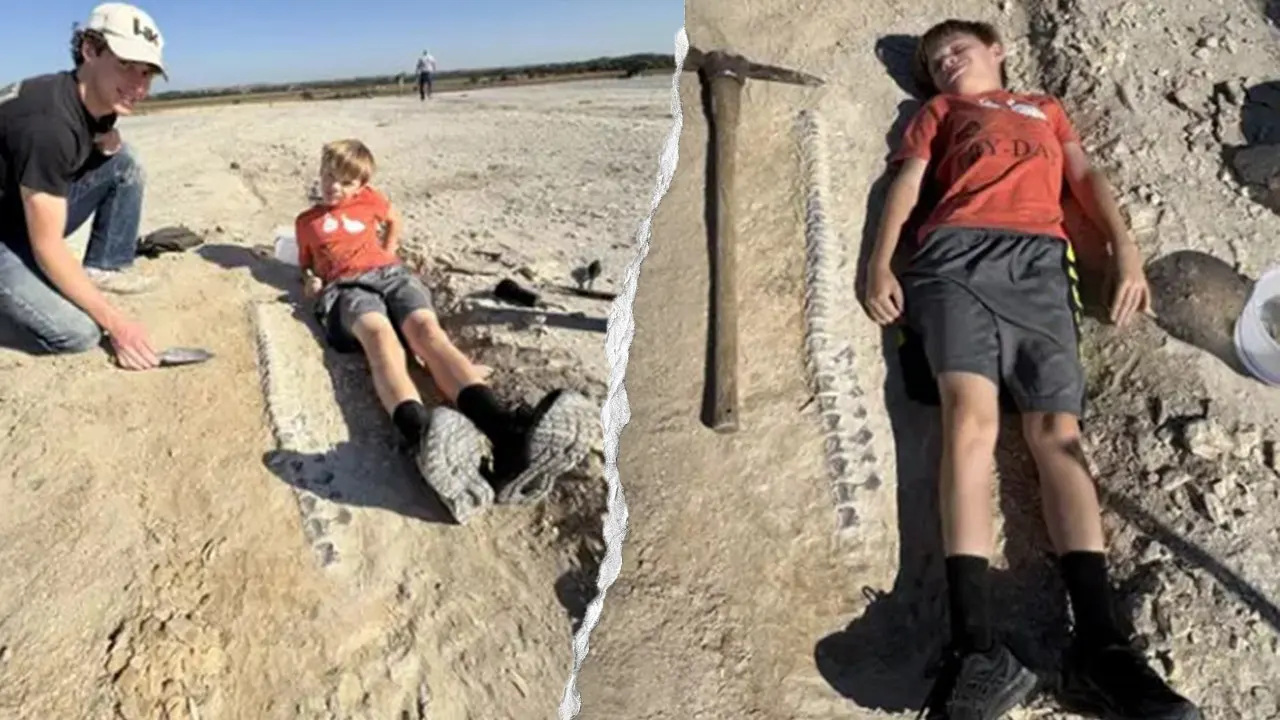
The fateful moment of discovery occurred when Corbin’s eyes locked onto an unusual shape protruding from a formation of solid, gray rock. Unlike the familiar, small fragments of marine life that the geology club typically gathered, these shapes were massive, presenting themselves as a series of heavy, petrified vertebrae locked tightly within the stone. At only eleven years old, Corbin did not possess the formal academic training of a professional paleontologist, but he possessed a deep, intuitive sense of wonder and an analytical mind that instantly recognized the unique nature of his find. Reflecting on that life-changing moment, the young researcher later shared that while he did not know the exact species or historical context of the creature, he knew with absolute certainty that he had stumbled upon something truly massive and historic. The sight of those ancient bones rising from the dust sent an immediate wave of excitement through his veins, prompting him to call over his club leaders and peers to share in the astonishment. The quiet quarry was suddenly filled with the electric energy of discovery as the group gathered around the protruding fossil, realization dawning upon them that this was not a minor relic, but the skeleton of a gargantuan creature. The physical reality of the fossil was striking; the weathered limestone seemed to gently cradle the dark, mineralized bone, preserving details that had remained untouched for eons. The sheer contrast between the pale, dry rock of the Kansas quarry and the deep gray outline of the fossilized spine created a visual spectacle that none of the onlookers would soon forget. It is this purity of childhood curiosity—the willingness to slow down, look closely at the earth, and listen to the silent stories of the past—that forms the beating heart of this remarkable story, showing that science is a living, breathing adventure.
The magnificent beast that Corbin had accidentally uncovered was later identified by scientific researchers as a Tylosaurus, an apex predator that ruled the ancient oceans during the Cretaceous Period, roughly eighty-two million to eighty-seven million years ago. To comprehend the scale and power of this creature is to understand the terrifying beauty of the prehistoric world; Tylosaurs were enormous marine reptiles, part of the mosasaur family, characterized by their streamlined bodies, powerful paddle-like limbs, and a muscular tail that propelled them through the water with deadly speed. With an elongated snout designed for ramming prey and a jaw lined with sharp, conical teeth, this fifteen-foot-long predator was the undisputed ruler of the Western Interior Seaway, an ancient body of water that once split the North American continent in half. This skeleton had spent millions of years encased within the Smoky Hill Chalk formation, a legendary layer of sediment stretching across portions of Kansas that is famous among geologists worldwide for its exceptional preservation of Cretaceous-era marine life. As prehistoric creatures died, their bodies sank into the soft, oxygen-poor mud of the ancient seabed, where they were protected from scavengers and slowly mineralized over tens of millions of years. For Corbin and his club members, realizing that they were looking at the remains of a creature that once swam where cornfields now grow was a profound lesson in cosmology and geology. This scientific context transformed Corbin’s find from an exciting curiosity into a vital piece of the Earth’s historical puzzle, offering researchers a beautifully preserved window into a long-lost ecosystem. It highlighted the impermanence of our current geography and illustrated how the very ground we walk upon today was once a bustling, dangerous, and beautiful aquatic wilderness teeming with species beyond our wildest imaginations.
Unearthing a prehistoric giant of this magnitude is a Herculean task that cannot be accomplished in a single afternoon, requiring an immense amount of patience, labor, and community cooperation. Following the initial discovery, Corbin and his dedicated companions from the Sedgwick County 4-H Geology Club organized three additional painstakingly detailed excavation trips to the Clearwater quarry to safely rescue the fossil. Under the guidance of experienced mentors, the children learned the delicate techniques of modern field paleontology, transforming themselves from casual weekend hobbyists into a disciplined, hardworking excavation crew. Using fine brushes, small dental picks, and precise hand tools, they slowly scraped away the surrounding matrix of stone, revealing more of the monster with every passing hour. The physical demands of the dig were significant, requiring hours of kneeling in the hot sun and dust, but the shared excitement of discovering new bones kept their spirits high. Over the course of these trips, the team successfully uncovered nearly the entire fifteen-foot-long skeleton, a rare and remarkable feat given how often fossils are scattered or destroyed by geological forces over millions of years. The crown jewel of their excavation was the animal’s monumental skull, which was recovered in astonishingly complete condition, along with the vast majority of its skeletal frame. To ensure the fossil’s safety during transport, the young geologists applied protective plaster jackets to the bones, a traditional paleontological method that felt to the children like placing a giant cast on a sleeping dinosaur. The shared sweat, laughter, and collective gasps of joy as each new vertebra was revealed forged unbreakable bonds among the participants, turning a scientific excavation into a precious lifelong memory for everyone involved, proving that the most profound discoveries are often those that are shared and celebrated by an entire community.
Now twelve years old and preparing to enter the seventh grade, Corbin Bullard finds himself at a unique transitional point in his life, wearing the jacket of both a normal middle-school student and an accomplished young paleontologist. The experience of discovering and excavating a Cretaceous-era apex predator has left an indelible mark on his character, fostering a sense of maturity, patience, and dedication that is rare for someone his age. While his classmates might spend their summer vacations playing video games or lounging by the pool, Corbin has dedicated countless hours to the post-excavation care of his fossil, learning about the preservation techniques required to keep the ancient bone from deteriorating. The human element of this story shines brightest when visualizing this young boy standing next to the massive skull of a creature that lived eighty-five million years before human civilization existed. It is a striking juxtaposition: a polite, modern seventh-grader who is worried about his upcoming school year, meticulously cleaning the razor-sharp jaw of an ancient marine leviathan that once terrorized the deep. Corbin’s journey is a beautiful testament to the power of youthful curiosity, illustrating that when we encourage youth to look closer at the world around them and provide them with the supportive community needed to pursue their interests, they can achieve things that leave even seasoned adults in absolute awe. His transformation over the past year reflects a deeper understanding of the natural world and a growing confidence in his own ability to unlock its deepest mysteries. By providing children with the tools, freedom, and encouragement to explore the world around them, these programs empower youth to make real, valuable contributions to science and history, showing them that their efforts matter and that they are capable of achieving greatness at any age.
Looking forward to the future, Corbin’s immediate focus is centered on a classic and beloved American tradition: the upcoming Sedgwick County Fair in July. There, among the displays of prize-winning livestock, homemade jams, and crafted woodworking, Corbin plans to showcase the stunning skull of his fifteen-foot Tylosaurus to the public and the fair’s panel of judges. With the characteristic humility of a Midwestern boy, Corbin expressed a simple, heartwarming hope for the event, wishing that the judges will appreciate the aesthetic beauty of the fossil and, above all, recognize the immense amount of hard work and joint effort that went into its retrieval. This humble aspiration beautifully captures the spirit of the entire endeavor; despite having discovered an internationally significant piece of Earth’s prehistory, Corbin remains grounded, valuing the process, the learning, and the appreciation of his peers far more than any fleeting fame. This incredible find will undoubtedly stand as a highlight of the exhibition, inspiring other young children in attendance to look up from their phones, step outside into the sunshine, and begin their own search for the magic hidden right in their own backyards. The story of Corbin Bullard and his prehistoric sea monster is a heartwarming narrative that seamlessly blends the grand, epic scale of deep-time paleontology with the cozy, tight-knit charm of community-focused life in Kansas. It serves as an elegant reminder that our planet is crowded with wonder, and that sometimes, the key to unlocking the secrets of the past is simply a curious child with a sharp eye, a supportive community, and the willingness to look just a little bit closer at the stones beneath our feet. As the residents of Clearwater gather at the fairgrounds this summer, they will not just be looking at the bones of an ancient predator; they will be celebrating the curiosity, tenacity, and bright future of a young boy who dared to dig.