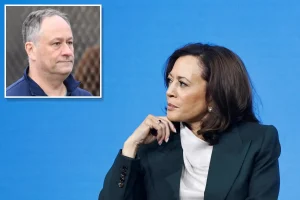


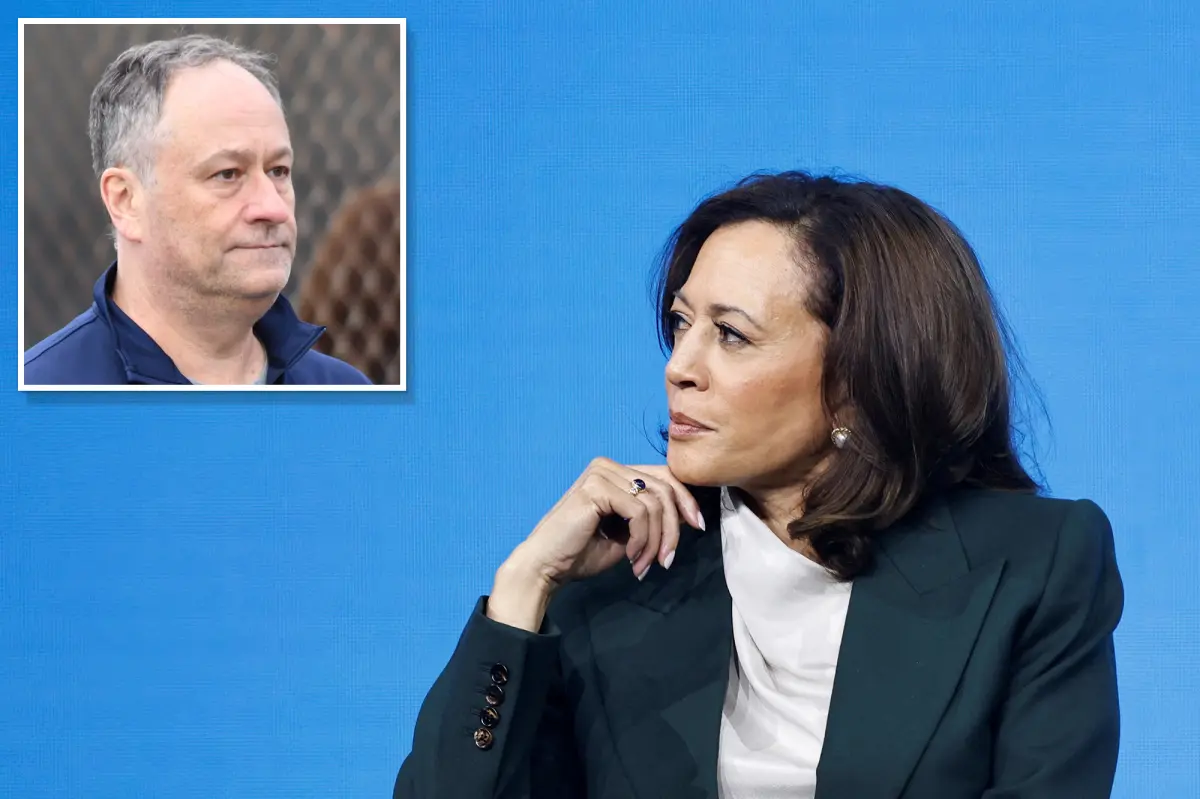
Kamala Harris is no stranger to hard choices, but the one now looming in front of her might be the most personal and public yet. Less than two years after a devastating defeat at the hands of Donald Trump, the former vice president is reportedly facing a wave of doubt about another White House bid, and some of that pushback is coming from the person who knows her best. According to a Wall Street Journal report, her husband, Doug Emhoff, has privately told people that he would prefer she stay out of the 2028 presidential race. That quiet confession, shared among family and close confidants, paints a striking picture of a woman caught between her own ambition and the emotional weariness of those around her. People close to Emhoff expect he would ultimately be supportive if Harris decides to run, but his reluctance is a telling sign. It suggests that the personal cost of the 2024 campaign has not been forgotten by those who lived through it. Behind closed doors, the conversation is not about why Harris should run, but what another campaign would cost her, her marriage, her sanity and her sense of self. The public has seen Harris as a trailblazer, a prosecutor, a senator, a vice president, a woman who shattered ceilings. But the private Harris must now weigh what her own household wants against an unfinished ambition that has defined much of her adult life.
Emhoff’s apparent hesitation is not the stuff of dramatic opposition, but rather the quieter resistance of a spouse who has seen the toll firsthand. Since losing the presidency, Harris and Emhoff have tried to build a life outside politics. They bought an $8 million Malibu mansion, a sunlit place where the ocean can drown out cable news. Emhoff, who spent four years as the first-ever second gentleman, has taken a job as a partner at the Los Angeles law firm Willkie Farr & Gallagher LLP. It is a return to legal work and a semblance of normalcy. For a man who stood beside his wife through the grueling 2024 campaign, through the brutal loss of the popular vote, the Electoral College and every swing state, the idea of repeating that ordeal may feel less like duty and more like endurance. It is not that Emhoff lacks faith in Harris. People who know him say he remains fiercely loyal and would stand with her if she made a decision to run. But there is a difference between supporting a partner’s choice and hoping she chooses differently. He has reportedly made that hope known in private conversations, not by issuing ultimatums, but by being honest about what fills him with dread. He has every reason to want a quieter future. He has watched his wife be celebrated and torn to pieces in equal measure, watched her raise $1.5 billion, watched television pundits dissect her every word, and then watched her lose to a man who had spent the entire cycle attacking her. To want to shield her from that again is not a betrayal of her dreams; it is the protective instinct of someone who loves her.
It is not just Emhoff who has doubts. Many donors who were once eager to open their wallets for Harris have reportedly told her directly that a 2028 White House run would be a long shot. That is a diplomatic way of saying something far more painful: the political world does not believe she can win. The 2024 result was humiliating in its completeness. Harris lost the popular vote, the Electoral College and every swing state to Trump, despite having raised an eye-popping $1.5 billion and enjoying a wave of enthusiasm when President Joe Biden stepped aside in the summer. That loss was not close. It was a sweeping rejection, and the kind that leaves scars. Donors are a notoriously unsentimental lot. They invest in winners, and they are not eager to back what feels like a grudge match on behalf of a losing candidate. They see the math, the fundraising, the endless parade of cable interviews, and they wonder what has genuinely changed since November 2024. Would the same voters who abandoned Harris suddenly come back? Would she face another brutal primary with candidates who have spent years building a new coalition? These are not idle questions. They are the stuff of nervous telephone calls and strained dinners. Yet despite all of this skepticism, Harris continues to lead virtually every hypothetical 2028 Democratic poll by double digits. Her name recognition, her history-making career and her ongoing presence in the Democratic imagination keep her at the top of a battered party’s list. But donors are not poll numbers. They are people with money, pride and memory, and they remember the smell of defeat far more clearly than they remember the excitement of her short-lived candidacy.
Harris, for her part, has not decided to walk away. In fact, she has been doing the opposite. She has made the rounds at Democratic fundraisers, attending private events for gubernatorial candidates like Wisconsin’s David Crowley and Nevada’s Aaron Ford. Just last week, she joined a call with the Democratic National Committee and more than 2,000 volunteers, urging them to get out the vote in a dozen states. At a NAACP event in Michigan, she addressed the speculation directly. “I have not decided if I’m going to run again,” she said. “I do sincerely believe ’28 won’t matter if we don’t get through ’26.” That line is both a dodge and a statement of purpose. It is the language of someone who refuses to close a door, but also the language of someone who understands that there are more immediate battles. She is not behaving like a woman who has surrendered; she is behaving like a woman who is trying to keep every option alive. It is possible that she is simply maintaining her relevance for a future that may never come. But it is equally possible that she is laying the groundwork, carefully and methodically, to run again. Her focus on the midterms is strategic. If Democrats do well in 2026, Harris can claim to be a unifying force who fought for the party. If they do poorly, she can say she was busy helping and deserves another shot. She is playing a long game, the kind of slow, patient positioning that her background as a prosecutor and senator taught her. But behind the fundraising calls and public rallies, there is still a human being wrestling with an enormous question. She has already run for president twice, in 2020 and 2024. A third attempt would require an extraordinary amount of courage, energy, money and sheer emotional endurance, and no one knows that better than Harris herself.
Some of her closest allies, the people who have known and worked with her for years, are reportedly skeptical that she will ever run again. They see the signs of a life moving in a different direction. The Malibu mansion is the most obvious symbol. It is a home designed for comfort, for quiet evenings with family, for a life far away from the green rooms and camera lights of campaign trail. Emhoff’s new law firm job is another sign. A partner at a major firm is not a temporary placeholder; it is a serious investment in a long-term professional life. These are not the moves of people who are packing their bags for Iowa. But they are also not necessarily the moves of people who have made a final decision. Harris may be trying to build a life that is worth returning to, regardless of whether she runs. She may be healing, filling the hours with family and work and the California coastline, waiting to see if the pull of a presidential campaign becomes too strong to ignore. Her allies know that the easy choice is to walk away. The hard choice is to run again, to expose herself to a brutal primary, to face the same questions about her record, her authenticity and her electability, to raise another billion dollars and listen to another four years of attacks. To choose that path is to choose suffering. And so her allies watch, unsure whether she will decide that the cause is greater than the cost, or whether she will finally allow herself to put down the weight she has carried for so long.
There is something deeply human about this moment. Harris is standing in a doorway, unsure whether to step through. She is being pulled in opposite directions, by duty and desire, by ambition and exhaustion, by the chorus of donors who call her a long shot and the polls that still put her ahead. She has the love of a husband who would rather not see her hurt again, but who would stand beside her anyway. She has a party still looking for a leader, and a nation that is tired of hearing about 2028 when the present feels so fragile. She has a $1.5 billion campaign’s ashes behind her and a golden California sunset in front of her. In the end, the decision is hers alone. There is no calculation that can fully explain why a person chooses to run for president. It is part ego, part duty, part conviction that she can still serve her country. But it is also part fear, the fear of living with what-ifs, the fear of becoming a historical footnote when she still believes she has more to give. For all the analysis of polls and donors and strategy, the real story is a private one. A woman is trying to decide whether what she wants is still worth what she has to lose. And right now, in the quiet moments away from the cameras, even the people closest to her cannot say which answer she will choose.