



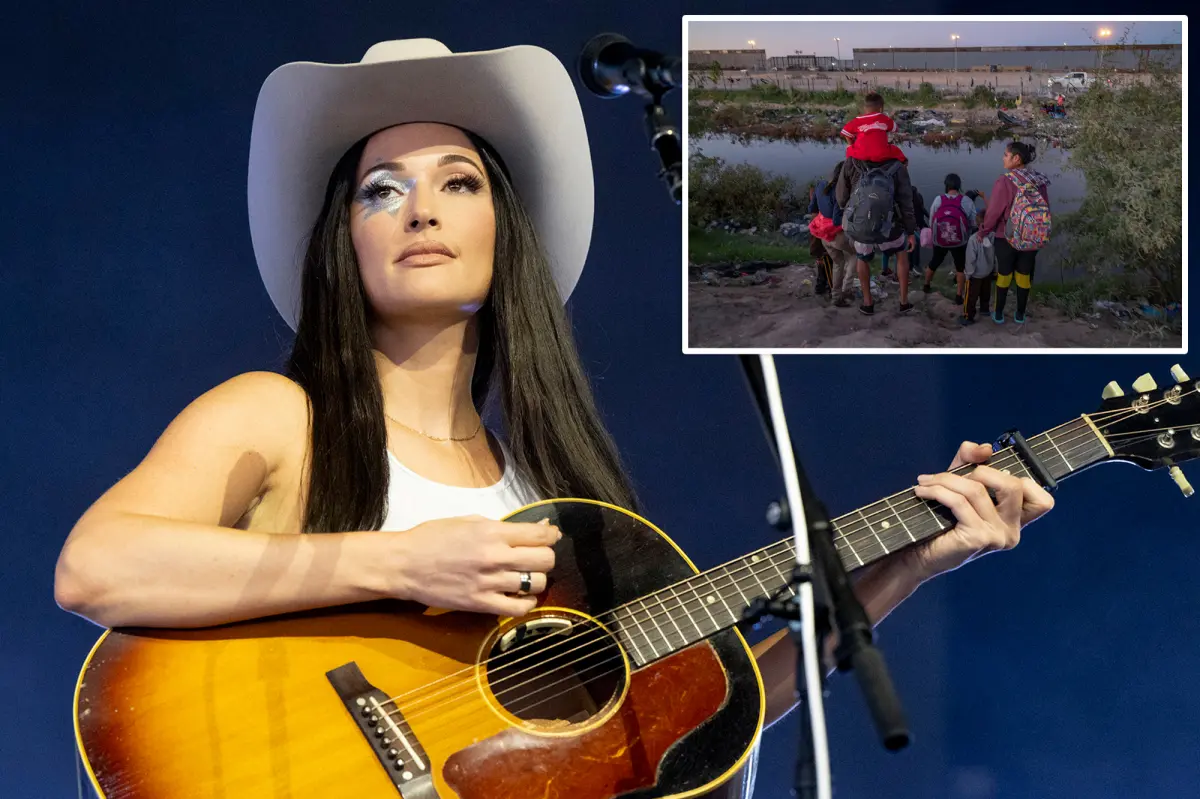
Kacey Musgraves, the eight-time Grammy Award-winning country music artist, found herself at the center of a digital firestorm this past Friday. The occasion wasn’t a controversial album release or a spat with another celebrity, but rather a simple, heartfelt request made from the stage during the opening night of her “Middle of Nowhere” tour at Chicago’s United Center. As she marked her 38th birthday, Musgraves took a moment away from her performance to ask the thousands of concertgoers in the audience to consider a donation to the Young Center for Immigrant Children’s Rights. Her words were earnest, as she described the organization’s mission to provide legal aid and financial support to children whose parents have been deported. Moving the conversation away from legal jargon and pushing it into a realm of pure empathy, she framed it less as a political manifesto and more as a call to tend for the vulnerable. “It’s not a political thing,” she told the crowd, repeatedly emphasizes what she sees as the foundational truth of the cause. “It’s just, these kids need help.”
The appeal was delivered with a soft touch characteristic of her on-stage persona. Musgraves carefully described the precarious situation facing these children, saying, “They have no guidance and no way to get through this thing without their homebase or their parents.” By insisting on the non-partisan nature of her request, she seemed to be attempting to create a charitable opening that could welcome everyone in the room, regardless of their politics. She lowered the barrier to entry, even suggesting a humble “50 cents” would be just as meaningful as a larger contribution, sparing fans any guilt about contributing. “If you don’t want to, that’s totally fine too,” she added, as if to lay a final groundwork for understanding. The immediate response from the Chicago crowd was supportive, featuring an eruption of applause and cheers. However, on this glaring, hyper-visible platform, in the realm of the digital bullhorn, a drastically different and far more hostile reaction was already taking shape.
The applause from the arena became a digital battlefield, as the very concept of an “unfair deportation” became a flashpoint for right-wing commentators. Prominent conservative voices seized on the video footage and broadcasted their displeasure to their social media followers. Tomi Lahren, the host of a popular political podcast, publicly questioned the singer’s phrasing, asking “What is an unfair deportation?” on X, which amplified the context of the request. The criticism quickly escalated from rhetorical questions to pointed accusations of betrayal. A popular influencer, Vince Langman, accused the singer of ignoring American children in favor of helping the parents who were in the crosshairs. “How about donating money to help kids whose parents have been killed by illegal immigrants! What happened to the country music industry?” his comment read, perfectly capturing the crux of the conservative backlash. Others chimed in with outright hostility, casting the singer through a harsh lens. One user labeled her “another TRAITOROUS woman,” while others adopted a more common refrain: “Shut up and sing Kacey!! Why do musicians think they can draw a line in the sand? You alienate 50% of your audience.”
The online criticism didn’t stop at the immediate comments; it became a vindictive list of motivations and absurd a boycott she and her music. For a number of fans, or former fans, the call to action was enough to instigate a professional disavowal. “You just earned yourself a big ol’ boycott, you traitor,” one detractor proclaimed, attaching the charitable urging to the concept of national loyalty, declaring, “Illegal aliens and their kids don’t deserve our patronage and neither do you!” Others attempted a more conciliatory yet critical approach, questioning the financial rationale of her request. They hypothesized the singer-songwriter, worth an estimated $15 million, or one of the biggest on stage, could easily write a check to the organization without bothering the fans for change. “Everyone she is speaking too gave her their money when they bought tickets. Now she has the money—shouldn’t she donate? She’s on stage at a show the audience had to pay admission to, and now she asks for more?” was the argument, painting a direct contradiction between her wealth and her pitch.
Yet, for every critic, there was at least one supporter ready to defend her. The conversation online ultimately became a messy, decentralized arena, a space where the voices of these two sides struggled for dominance. Following the public spectacle, Musgraves stood by her words, taking to the “underdogs club” and reposting the charity’s message of gratitude. The Young Center, with the charitable workspace based out of Chicago, detailed its core function, which involves pairing volunteers with attorneys and social workers to advocate for unaccompanied immigrant children in government custody. Their mission, as they stated, is to see “unaccompanied immigrant children safe, free, and with their families.” They felt they were serving a growing wave of children, and the “Market” group cited a dramatic increase in average detention times and an exploding number of requests for assistance from parents who are also detained. In 2025, those in an approximately 2000 children were served, highlighting the tangible importance of the charity Musgrave’s endorsed.
This wasn’t a sudden, off-stage visit from her. The “Miracle” singer’s support for the Young Center had precedent, making her Chicago concert a continuation of her patronage. Earlier that April, on a resale platform like Depop, she announced that she would be selling off twenty pieces from her personal wardrobe, anything from her music video looks to tour outfits, with the entirety of the proceeds going to the very organization. In the build-up to that clothing sale, Musgraves updated on the cause without repeating the details from her concert. “I also adore the fact that the sales are supporting a really beautiful cause,” she said in an announcement, keeping the messaging apolitical and focused on the action rather than the policy. The choice of guests for her tour also spoke to her stance. For a series of shows in Texas, Musgraves invited three brothers in the ages of 18, 14, and 12, a mariachi band, to open after their family had been released from ICE custody. The family’s background was deeply complicated, had entered the country through a now-defunct protocol, and was seeking asylum from violence in Mexico, whereas the D.H.S. maintained that their entry was illegal and required detaining while claims were heard.
The event of the Chicago show, moving into the substantive center of the project, sits against the backdrop of a national debate. A major flashpoint for this tireless issue was the U.S. immigration enforcement. Federal sources have reported that in July alone, ICE agents made around 51,000 arrests, a massive record number in a single month, indicating the aggressive enforcement. This push-and-pull dynamic, where the state rigorously enforces detention and deportation in response to a policy and a moment of the legal journey for the new arrivals, creates the very “only” desperation that Musgrave is attempting to soothe with his request. With an alarming comment, a DHS spokesperson reinforced the legalistic position, “Every day, men and women of ICE are arresting and DEPORTING dangerous criminal illegal aliens, including gang members, from our country.”
In the end, the “Dry Spell” singer’s career has always been a testament to the path of the human need for connection, and he’s lit just as much from that. It makes sense that she’d see the unhappy reality of a child living without a parent and shout it from the stage. Still, the 2025 audience has the reaction, skewering it in the political frame. The line in the sand isn’t between Musgraves and the fans who attended, but between him and the fans who are now in his voice, from the opposite side of politics. Kacey’s position—tone-filled, squarely aimed at the welfare of children—felt not to enough for some, who saw it as a political disloyalty and a misplaced banner. But to other part was exactly, exactly the right of place. She wasted no time for everyone to listen, but in doing so, she created the right aligned space for conversations. While it is likely the majority left the United Center in Chicago that night felt in a mutual moment of celebration and community after hearing her heartfelt, spontaneous plea, the internet was the input of proof that the shared platform is a fragile thing. In this country music, the worth of a song like “The Wind” or the golden mask, is not just in its melody, but in the meddling force of music in the emotionally imposing world. As the news and music continue to tour, the collision of her two lives threatens to sharpen the line between those who view its art as an escape and the ones who expect it as an altar.