





Paragraph 1: The Breaking News and Its Monumental Weight
In a stunning legal development that cuts through nearly a quarter-century of post-9/11 history, a military judge at Guantanamo Bay has issued a sweeping ruling invalidating a significant portion of the confession extracted from Khalid Sheikh Mohammed, the man widely celebrated and reviled as the principal architect of the September 11th attacks. The quiet shock of the ruling, delivered on a Friday, slices through the relentless bureaucratic fog of the base’s infamous courtroom, offering a stark reminder that even in the shadow of unspeakable violence, the meticulous, often maddening wheels of justice continue to grind—and occasionally, they grind against the prosecution. Judge Lt. Col. Michael Schrama, presiding over the military commissions, determined that statements Mohammed made to investigators in 2007 were obtained involuntarily, a ruling steeped in the murky history of the CIA’s enhanced interrogation program. This is not a mere procedural hiccup; it is a direct, legal blow that threatens to unravel the carefully constructed narrative the government has built over two decades, potentially delaying the long-awaited trial of the man who plotted the murder of 2,977 people. As news crackled through legal circles and survivors’ homes, the stark reality set in: the marathon to hold Mohammed accountable just took a deeply precarious turn. The ruling echoes beyond the barbed-wire fences of the U.S. naval base in Cuba, reaching into the living rooms of grieving families, the corridors of the Pentagon, and the quiet chambers of constitutional scholars who have spent years debating the very nature of justice in a time of terror. It is a moment that forces a collective reckoning with the uncomfortable truth that even the most heinous defendant possesses procedural protections—protections that, when violated, can render even the most damning admissions worthless in a court of law.
Paragraph 2: The Legal Mechanism and the Shadow of Coercion
To understand the gravity of Judge Schrama’s decision, one must wade into the grim details of Mohammed’s capture and subsequent imprisonment. Captured in Pakistan in March 2003, Mohammed was rendered to a series of secret CIA “black sites” where he was subjected to brutal interrogations, including waterboarding 183 times—a technique widely condemned as torture and later acknowledged by President Obama’s administration. By 2007, the CIA had transferred him to Guantanamo, but the shadow of those prior coercive encounters loomed large. The judge’s ruling specifically scrutinizes statements made in 2007, likely during interviews conducted by federal agents or military personnel. Schrama’s conclusion that these statements were not “given voluntarily” is grounded in the legal principle of coercion—the idea that if a suspect’s will is so completely overborne by prior abuse and psychological pressure, any subsequent confession cannot be considered a free choice. The judge reportedly found that the CIA’s relentless custody and the torture he endured in the years directly preceding 2007 created an atmosphere so inherently oppressive that any “confession” extracted later was simply an extension of that brutal environment. This is a colossal legal defeat for the government, which had hoped to use these detailed admissions—where Mohammed famously claimed responsibility for everything from the World Trade Center attacks to the shoe-bomber plot, from the Bali bombings to the killing of Daniel Pearl—as the centerpiece of its capital case. The prosecution now faces an uphill battle, forced to salvage whatever evidence remains while legal experts debate whether this ruling sets a dangerous precedent for the entire Guantanamo military commission system. The decision forces prosecutors to re-evaluate their entire case strategy, stripping away a critical evidentiary pillar that they have leaned on for years, and plunging the trial into a state of profound legal uncertainty.
Paragraph 3: Khalid Sheikh Mohammed – The Complex, Chilling Human Figure
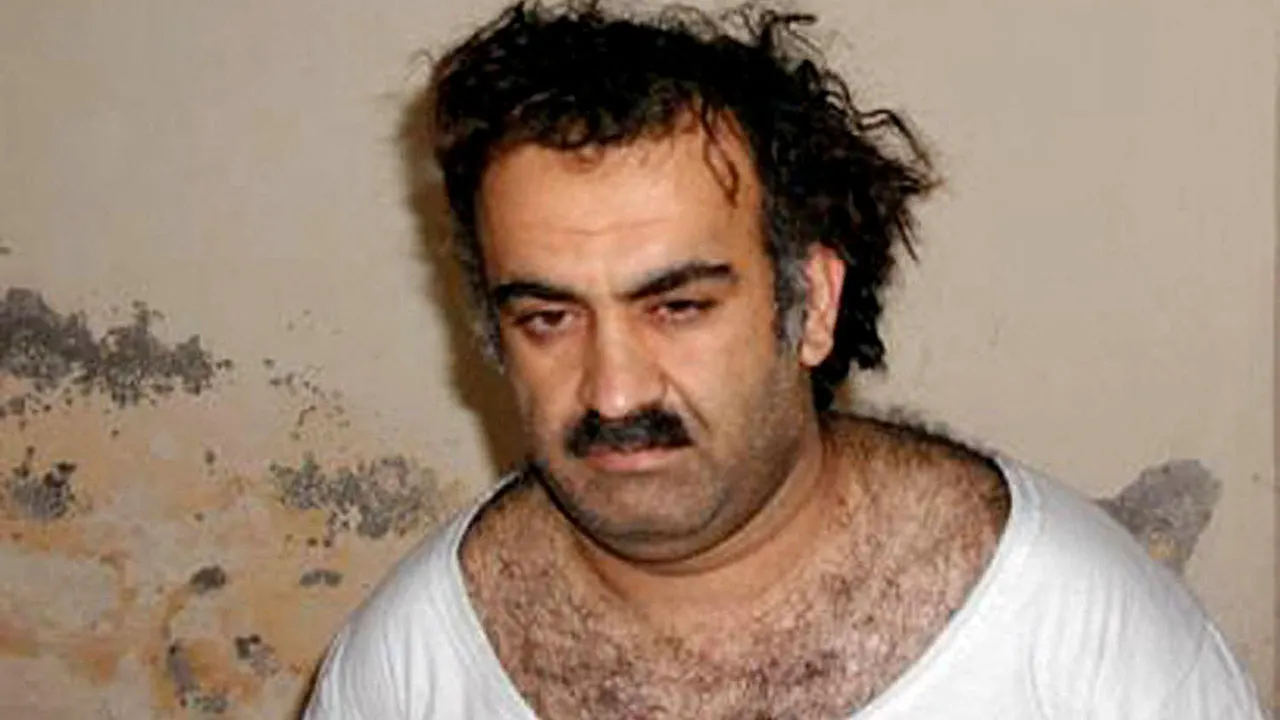
Beyond the dry legal jargon lies the complex, chilling human figure at the center of this saga: Khalid Sheikh Mohammed. He is not a nameless drone; he is a performative, arrogant, and deeply charismatic figure who has turned the courtroom into a stage for his own defiant theater. Often described as the brains of Al-Qaeda’s most audacious strikes, Mohammed’s background is surprisingly cosmopolitan—he was born in Kuwait to Pakistani parents, attended American universities, earning a degree in mechanical engineering from North Carolina Agricultural and Technical State University, and moved through the world with a fluency in Western culture that made him an effective operational terrorist. In the courtroom, he is known for his bushy beard, his refusal to recognize the court’s legitimacy, and his habit of sleeping during proceedings or loudly praying in Arabic. He has openly bragged about his role in the 9/11 attacks, memorably stating that he personally decapitated journalist Daniel Pearl, though this claim is disputed by other intelligence reports. In a macabre twist, his willingness to confess has always been a point of pride for him—he sees it as a victory, a testament to his cause, a way to martyr himself ideologically before a global audience. The judge’s ruling that his 2007 confessions were involuntary, therefore, cuts both ways: legally, it protects his rights, but it also infantilizes him, stripping him of the agency he so desperately tries to claim. To the world, he remains the embodiment of pure evil, a man whose hands orchestrated the death of thousands; to the law, he is now, unexpectedly, a victim of state-sponsored brutality whose words cannot be trusted. This paradox lies at the heart of the American legal dilemma in the War on Terror.
Paragraph 4: The Decades-Long Legal Wrangling and Political Gridlock
The road to this Friday’s ruling has been a grotesque labyrinth of legal malfeasance, political posturing, and raw human endurance. For over twenty years, the trial of the alleged 9/11 conspirators—including Mohammed—has been bogged down in pre-trial hearings, evidentiary challenges, and the philosophical quagmire of whether military commissions can ever dispense fair justice. The Obama administration’s attempt to try them in federal civilian court in New York was met with fierce opposition in Congress, which passed laws blocking the transfer of detainees to U.S. soil, thereby forcing the case back into the flawed military commission system. Since then, the process has been characterized by glacial speed, with defense attorneys fighting tooth and nail over every procedural point, and the prosecution desperately trying to push through the mountains of evidence tainted by the torture program. The recent proposed plea deal, which would have spared Mohammed and his co-defendants the death penalty in exchange for life sentences, was abruptly killed by Defense Secretary Lloyd Austin in July 2025, plunging the case back into uncertainty after months of delicate negotiations. And now this ruling by Lt. Col. Schrama is a monumental obstacle for the prosecution, as it strips away the most damning narrative the government possessed. While it does not acquit Mohammed, it fundamentally weakens the government’s hand, forcing them to rely on secondary evidence, communications intercepts, and witness testimony, all of which are more susceptible to challenge and cross-examination. The families of the victims, who have waited over two decades for closure, now face the agonizing prospect of yet another generation of litigation. The case has become a fixture of American geopolitical reality, a symbol of the perpetual conflict between confronting terrorism and upholding the rule of law.
Paragraph 5: The Human Cost and the Enduring Grief of the Victims’ Families
Behind the legal chess moves and the colonial-era architecture of Guantanamo’s courtrooms, there is the inescapable, aching presence of the victims’ families. For them, this ruling is not an abstract philosophical debate about torture and voluntary statements; it is a gut-wrenching emotional setback that reignites the trauma of that bright September morning in 2001. Many of these families have dedicated their lives to seeing Mohammed brought to justice. They have traveled to Cuba, year after year, to watch him smirk, to hear him chant, to feel the crushing weight of his proximity to the crimes he orchestrated. The news that a judge has deemed his confession inadmissible strikes them as a profound insult to the memory of their loved ones. They argue that the man who planned such an atrocity deserves no such procedural protections, that the scales of justice should weight the 2,977 deaths against the discomfort of a waterboarded terrorist. Yet, a fractured part of this community understands the delicate balance of the rule of law; they comprehend that a society that discards its legal principles to prosecute even its worst enemy risks becoming the very thing it hates. Still, the prevailing emotion is one of exhaustion. The clock keeps ticking. The financial and emotional drain of this 20-year process is measurable, with many families facing aging parents, health crises, and a growing sense of despair. This ruling, while legally sound to many scholars, feels to them like a grave betrayal—a validation of the terrorists’ defiance and a declaration that true accountability might remain forever out of reach. Their individual stories—of firefighters never coming home, of empty chairs at dinner tables, of children growing up without mothers and fathers—are the silent weight that presses upon every hearing, every appeal, and every legalistic pronouncement.
Paragraph 6: The Road Ahead and the Broader Implications for Justice
As the sun sets over the Caribbean, the world is left to ponder what happens next. The prosecution has several avenues: it can appeal Judge Schrama’s ruling to a higher military appellate court—a process that could take years—or it can attempt to introduce other statements made at different times, though the taint of the original torture will likely render those suspect as well. The most probable outcome is a further indefinite delay, turning this already interminable legal saga into a permanent stalemate. The ruling throws a wrench into the entire military commission system, prompting constitutional scholars and human rights advocates to question whether a fair trial is even possible for defendants who have suffered state-sanctioned abuse. The irony is stark: the United States, in its effort to hold the evildoers accountable, engaged in methods that have now become the legal shield for those very evildoers. In human terms, we are left to reconcile the immense appetite for revenge with the cold, slow discipline of due process. Perhaps justice is not a destination but a process, and the process here is demonstrably broken. For the families, for Mohammed, for the aging judges and lawyers, the conflict has become a surreal purgatory. Friday’s ruling, though a procedural victory for the defense, ultimately serves as a haunting reminder of the moral compromises made in the aftermath of terror. Whether Mohammed ever faces a jury, or whether he dies in his cell at Guantanamo Bay, the true cost of this case is measured not in legal opinions, but in the broken hearts and the unyielding, frustrating, very human wait for a resolution that may never come. The ghost of 9/11 will continue to haunt the American legal conscience, demanding a verdict that might forever remain elusive.