






In the quiet, heavily guarded corridors of Holman Correctional Facility in Atmore, Alabama, time is measured not by the passage of days, but by the slow, painful accumulation of anxious moments. For forty-nine-year-old death row inmate Jeffrey Lee, the countdown to his scheduled execution was suddenly arrested by an extraordinary legal intervention that has sent shockwaves through the American justice system. On a Tuesday that felt like both a desperate reprieve and a profound moral battleground, U.S. District Judge Emily C. Marks issued a permanent injunction blocking the state of Alabama from executing Lee using its newly developed and deeply controversial method of nitrogen hypoxia. This dramatic decision came merely hours after a federal appeals court reversed Judge Marks’ own initial finding that the state’s execution protocol was constitutional. The ruling did not save Lee from his death sentence itself, but it drew an unyielding line in the sand regarding the physical reality of how a state is permitted to end a human life. Inside the prison walls, the impending dread of state-sanctioned death was temporarily eclipsed by a monumental constitutional debate over what elements of physical suffering are considered too cruel to tolerate in a civilized society. For Lee, a man who has spent more than two decades reconciling his existence with the shadow of the gallows, this legal decision is not a dry academic precedent; it is a vital, breathing pause in a decades-long march toward his own demise. As the legal machinists of the state scramble to salvage their scheduled execution date, the ruling forces the public to look past the bureaucratic paperwork and confront the visceral, fragile reality of a human being sitting in a cell, waiting to find out if the air he breathes will be stripped from him by the clinical order of a court or preserved by the protective dictates of the United States Constitution.
At the heart of the legal paralysis stopping Jeffrey Lee’s execution is a terrifying clinical evaluation of what actually happens to a human being subjected to the state’s nitrogen gas protocol. In her ruling, Judge Marks highlighted a harrowing finding by a three-judge panel of the 11th U.S. Circuit Court of Appeals, which concluded that the state’s current nitrogen hypoxia setup carries an unacceptably high and “substantial risk of serious harm.” The appellate judges pointed specifically to a chilling three-minute window—the estimated time it takes for an inmate to lose consciousness under the forced flow of pure nitrogen. Far from a silent, peaceful drift into sleep, those three minutes represent what the court deemed an “tolerable” duration of suffering during which a conscious human being would endure the terrifying biological sensation of suffocation and physical panic. This is the raw reality that law professor Bernard Harcourt described as “conscious suffocation,” a process so inherently torturous that its execution on a human being strains the very boundaries of international human rights and constitutional law. When a state straps a tight, sealed respirator mask to a person’s face and systematically replaces their oxygen with pure nitrogen, it triggers a primitive, thrashing biological response to oxygen deprivation that is impossible for the human body to suppress. By legally recognizing this three-minute window of conscious agony as unconstitutional, the federal judiciary has forced a reckoning with the physical horror of administrative death. The Eighth Amendment’s historic ban on cruel and unusual punishment was drafted to prevent a return to the medieval dark ages of physical torture, and the court’s intervention suggests that modern technical innovation must not be allowed to act as a sanitized envelope for ancient, torturous cruelty.
To understand the complex human currents flowing through this case, one must look back to the cold winter evening of December 12, 1998, when a double tragedy struck a local community and forever altered the lives of multiple families. Inside Jimmy’s Pawnshop, a place of business that represented years of hard work and neighborhood connection, Jimmy Ellis, the store’s owner, and Elaine Thompson, a dedicated employee, were brutally shot and killed during an armed robbery. The state prosecuted Jeffrey Lee for these senseless, heartbreaking deaths, pointing to his use of a sawed-off shotgun to commit a crime that shattered the safety of their families forever. Yet, the story of Lee’s journey to death row is also deeply complicated by the flawed machinery of the justice system that put him there. When Lee was originally convicted, the jury tasked with determining his fate did not unanimously agree that he deserved to die; instead, they voted seven to five that he should be sentenced to life imprisonment without the possibility of parole. In a practice that has since been widely condemned and outlawed across the state of Alabama, a single trial judge had the power of “judicial override”—and used it to discard the jury’s merciful recommendation, unilaterally upgrading Lee’s sentence to death. Today, Alabama no longer permits judges to override jury sentencing decisions in capital cases, recognizing the practice as a deeply undemocratic violation of a defendant’s constitutional rights. For Lee, this leaves him in a surreal and agonizing limbo: he faces the ultimate punishment of death based on an arbitrary judicial mechanism that the state itself has determined is too unjust to ever be used again.
Under current federal legal doctrines, an inmate who seeks to challenge a state’s execution method must perform the morbid, tragic task of suggesting an alternative way for the state to take their life. For Jeffrey Lee, this bizarre legal requirement led him to petition for execution by a firing squad, a method he argued would be far more instantaneous and humane than the slow, gasping suffocation of nitrogen gas. This request reveals the profound existential absurdity of the death penalty process, where a condemned individual is forced to become the active architect of their own termination just to escape a more agonizing fate. Judge Marks’ ruling recognized this dynamic, noting that while Lee’s request for a firing squad could be accommodated if the state chose to adapt its methods, he holds no right to escape execution entirely through other legal channels, such as lethal injection or the electric chair. In her written opinion, Judge Marks offered a stark, unsentimental assessment of the constitutional boundary, writing that “the Constitution does not guarantee a painless death, and human life cannot be purposefully extinguished without some risk of pain.” This sobering statement lays bare the fundamental contradiction at the core of the state’s justice system. It admits that state-sponsored killing is inherently violent, but insists that the law must find a thin, razor-sharp boundary where that violence remains legally permissible. The choice between a firing squad and a gas mask is not a choice between life and death; it is a Faustian bargain forced upon an individual who must weigh the split-second violence of a bullet against the agonizing, claustrophobic panic of a respirator.
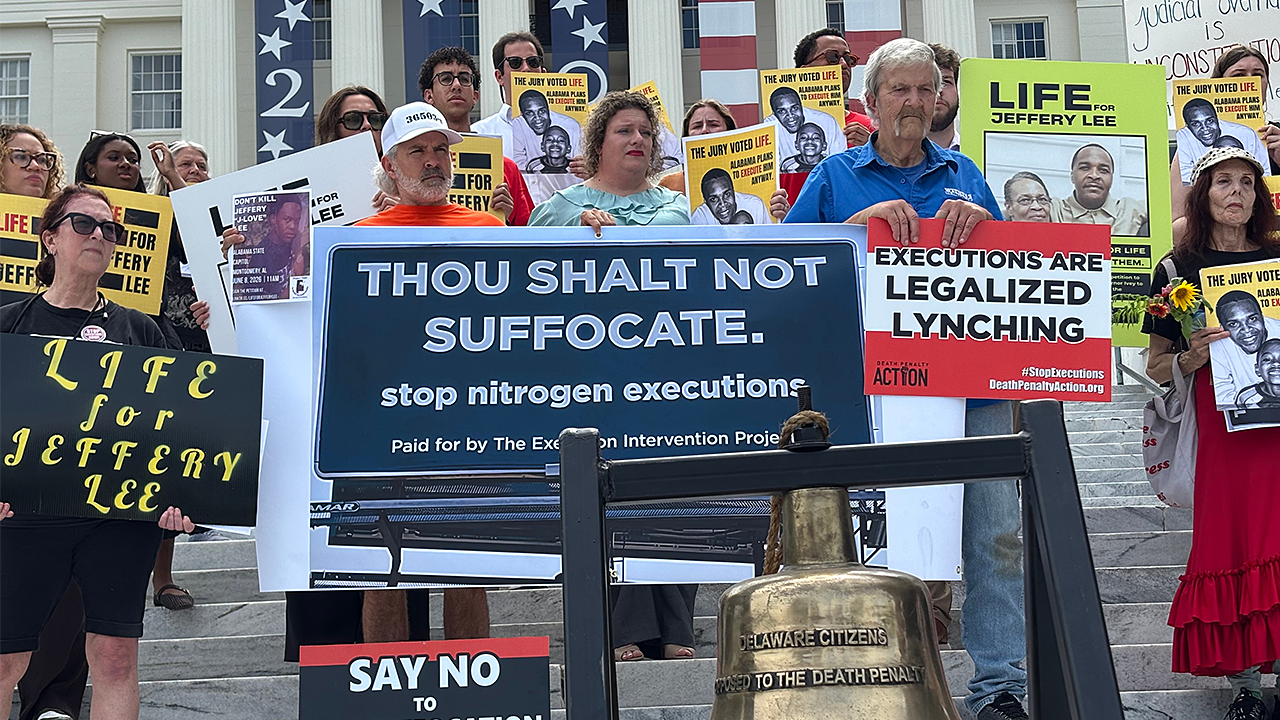
The shadow of Alabama’s nitrogen gas chamber has cast a long, dark pall over the national conversation on state executions since January 2024, when the state became the first in the country to use the method on Kenneth Eugene Smith. Since that fateful day, the state has emerged as a controversial testing ground, having carried out seven of the nation’s eight nitrogen executions, with Louisiana responsible for the other. Alabama’s correction officials have consistently defended the protocol as a sterile, peaceful, and constitutional advancement in capital punishment, but those who have stood inside the chamber tell a radically different, far more haunting story. Spiritual advisers like the Reverend Jeff Hood, who have walked alongside condemned men into the execution chamber and witnessed their final moments under the heavy plastic respirator, describe scenes of violent physical rebellion that mimic the horrific struggles of drowning. Hood has described the gut-wrenching sight of men gasping, thrashing, and straining against their gurney straps as their lungs screamed for an oxygen supply that would never arrive. These eyewitness testimonies clash directly with the clinical, sanitized propaganda promoted by state public relations teams, exposing a vast gulf between official press releases and human truth. For opponents of the death penalty, the federal court’s sudden intervention in Jeffrey Lee’s case represents a desperately needed moral firewall against a nationwide expansion of what they view as a barbaric human experiment. Reverend Hood, in expressing his relief following Judge Marks’ ruling, voiced a fervent prayer that this decision might mark the beginning of the end for nitrogen executions across the United States, signaling a return to basic human decency.
As Alabama Attorney General Steve Marshall’s office swiftly filed an appeal to challenge the federal judge’s landmark ruling, the case of Jeffrey Lee began its inevitable, high-stakes march toward the United States Supreme Court. The highest court in the land has historically maintained a deeply conservative stance on execution methods, having never once declared a state’s chosen method of capital punishment to be unconstitutional, which sets the stage for a monumental legal and ethical showdown. Yet, beyond the complex constitutional vocabulary and the dry mechanics of appellate law, the core of this struggle remains intensely human. It is a story about the families of Jimmy Ellis and Elaine Thompson, who have spent almost twenty-six years waiting for a sense of closure that the state has struggled to deliver. It is also the story of Jeffrey Lee, a middle-aged man whose life has been suspended in the balance of a legal system that has repeatedly shifted the rules of his survival and his death. Finally, it is a story about the conscious moral compass of a society that must decide how much suffering it is willing to tolerate in the name of justice. As the legal filings accumulate and the judges deliberate, the ultimate question is not merely whether Jeffrey Lee will live or die, but what kind of society we become when we allow our government to experiment with the breath of its citizens. By forcing the courts to confront the three minutes of terror inside a nitrogen mask, this ruling reminds us that even in the pursuit of retribution, the preservation of our shared humanity remains the most sacred law of all.