



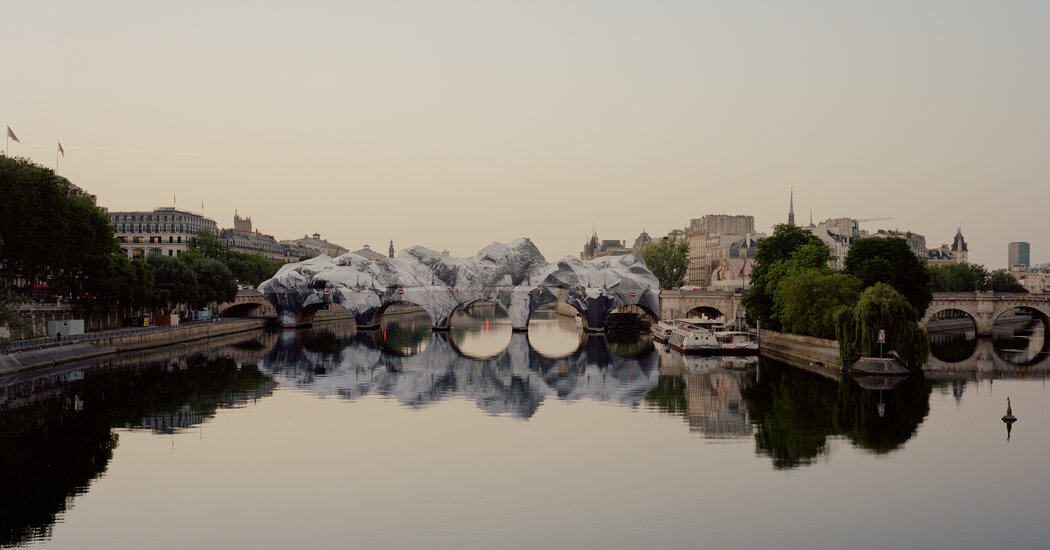
The Mountain on the Seine: How Artist JR Reimagined Paris’s Oldest Bridge in the Shadow of Christo
The Echo of a Masterpiece: Paris Welcomes a New Visual Spectacle on its Oldest Bridge
It has been more than four decades since the visionary artistic duo Christo and Jeanne-Claude wrapped the Pont Neuf in a luminous, sandstone-hued polyamide fabric, igniting an era of grand-scale, conversational urban art that challenged how citizens interact with their municipal architecture. Today, the legendary bridge—which, despite its name meaning “New Bridge,” stands as the oldest surviving stone crossing over the River Seine—has once again been dramatically cloaked, transformed this time into an ethereal, inflated simulation of a rugged mountain pass. From now through June 28, visitors to the French capital are invited to step out of the bustling Parisian thoroughfares and into “The Cave of Pont Neuf,” a monumental public art installation conceived by the celebrated, semi-incognito French street artist and photographer JR. Riding onto the scene on an electric bicycle, sporting his signature dark sunglasses and a fedora, the artist described the interior of this massive, fabric-constructed cavern as an intimate sanctuary designed to transport the pedestrian. Inside, moody, low-frequency lighting and an ambient, evocative soundtrack work in tandem with cutting-edge augmented reality art to envelop travelers in a space that JR describes as a warm, comforting cocoon away from the frantic pace of modern urban life.
The Art of the Elements: A Turbulent Birth and Technical Audacity
                _..._
              .'     '.
             /  _   _
             | (o) (o) |    <-- The artist JR, clad in his
             |    _    |        signature fedora and shades
                '-'  /
            .-'-..._.-'-.
           /         /
The realization of this high-altitude dream, however, was nearly thwarted by the volatile Parisian late-spring weather, proving that outdoor contemporary art Paris remains entirely at the mercy of nature. On June 2, just days before the scheduled debut, powerful wind gusts tore across the Seine, ripping the heavy fabric from the crown of the installation and forcing a week-long delay while engineering teams scrambled to repair the structural damage. This meteorological setback served as a striking historical echo of Christo’s own tribulations; in 1972, his famous “Valley Curtain” project in Colorado was shredded by ferocious mountain winds mere hours after its initial unfurling. To combat these intense aerodynamic pressures without resorting to hundreds of tons of unsightly and expensive metal scaffolding, JR and his design team utilized an advanced system of continuous air inflation. This brilliant engineering compromise—using high-volume blowers to keep the massive fabric peaks pressurized and structurally stable—was suggested by Vladimir Yavachev, Christo’s nephew and the dedicated guardian of his late uncle’s artistic legacy. Yavachev, who spent decades assisting Christo and Jeanne-Claude on historic projects such as “The Gates” in New York’s Central Park and the posthumous wrapping of the Arc de Triomphe, directed the concept to JR as a collaborative homage, celebrating the lineage of artists who dare to temporarily redesign the world’s most famous monuments.
From Subversion to Institution: How Public Art Conquered the City
 ===================================================
 ||  __   __   _  _    _____     _  _   ___   _  _  ||
 ||  |_) /   |  | |    |      | | | |__   |  |  ||
 ||  |   __/ |  | |    |      |  | | |___  |  |  ||
 ===================================================
           [~~~~~~~~~]  [~~~~~~~~~]  [~~~~~~~~~]
The relative ease with which JR secured municipal approval for this daring takeover of the Pont Neuf Paris highlights a profound shift in how city governments view creative interventions in public spaces. When Christo first proposed wrapping the bridge in the late 1970s, he was met with years of bureaucratic resistance, political skepticism, and outright hostility from traditionalists who viewed the gesture as a form of cultural desecration. Today, however, the paradigm has shifted entirely: public art installations are no longer viewed as subversive threats to historical preservation, but rather as powerful engines for cultural tourism in Paris, global media coverage, and civic engagement. Local officials, many of whom look back on Christo’s 1985 installation with immense nostalgia and affection, eagerly greenlit JR’s proposal, readily overlooking historical logistical headaches, such as when absent-minded pedestrians routinely tripped over Christo’s deck-level fabric. By embracing these temporary transformations, cities like Paris have learned to leverage their historical architecture as dynamic, living canvases, transforming ancient stone into social-media-friendly hubs that attract millions of curious travelers and locals alike.
A Multi-Sensory Tapestry: The Convergence of Tech, Music, and Scent
To elevate “The Cave of Pont Neuf” beyond a mere visual spectacle, JR assembled an extraordinary coalition of technological innovators, legendary musicians, and sensory designers to craft a truly holistic environment. The American technology company Snap played a pivotal role, designing an custom-made augmented reality app through its Parisian studio that allows visitors utilizing specialized smart-glasses or mobile screens to watch digital spirits, historical figures, and prehistoric fauna flicker across the faux-stone walls of the subterranean passage. This digital layer is paired with a haunting, minimalist soundtrack composed by Thomas Bangalter, the former co-founder of the legendary electronic music duo Daft Punk, whose ambient tones reverberate through the synthetic cavern to evoke a sense of deep, geologic time. Even the sense of smell has been curated: the historic French perfume house Odore Scola developed a bespoke, earthy fragrance that is subtly dispersed throughout the installation, mimicking the damp, mineral-rich aroma of a deep underground grotto. Despite the heavy corporate sponsorship from tech giant Salesforce and the cultural philanthropic group Bloomberg Connects, JR has drawn a firm line against commercialism, refusing to permit the sale of branded souvenirs or character T-shirts, insisting that the space must remain a pure, uncompromised artistic sanctuary.
Stone, Shelter, and Silicon: The Intellectual Core of the Grotto
 __________________________
(  The Primordial Grotto   )
 _________________________/
           /
 (o)_   _ (o)   <- Seeking refuge from the
    '-'  /        non-stop glare of screens...
  /   _
 |  (   )  |
At its core, this installation represents a profound philosophical inquiry into the relationship between ancient history, human shelter, and the isolating nature of our modern digital existence. JR, whose previous public art installations at the Louvre and the Palais Garnier utilized brilliant trompe l’oeil photography to create the illusion of deep chasms and hidden interiors, designed the craggy synthetic rocks of the cave to mirror the limestone quarried to build the bridge in 1607. By placing a primordial cave atop a Renaissance monument, the artist invites the public to contemplate the duality of the sanctuary: the ancient stone cave represents our ancestral need for warmth, protection, and communal gathering, while our modern smartphones have become “electronic caves” that isolate us even when we are surrounded by a crowd. For JR, who grew up in the concrete-dominated suburbs of Paris far from any natural wilderness, the project is a deeply personal attempt to reconnect urban dwellers with the raw, elemental textures of the earth. By staging this intervention on a bridge—a structure explicitly designed to connect two separate shores—he reminds us of art’s unique capacity to bridge the gap between our high-tech present and our ancient, shared human heritage.
A Divided City: The Eternal Parisian Debate on Beauty and Brutalism
As with any major artistic intervention in a city fiercely protective of its classic aesthetic tradition, “The Cave of Pont Neuf” has sparked a lively, quintessentially Parisian debate split along generational and philosophical lines. While many onlookers have lauded the project’s boldness, traditionalists have taken to social media to voice their displeasure, with retired French broadcaster Jérôme Godefroy lamenting the replacement of Christo’s elegant, fluid drapery with what he disparaged as a “brutalist grotto” forced upon a historic treasure. Yet along the banks of the Seine, where crowds of onlookers gather daily to watch the shifting light illuminate the synthetic mountain peaks, the public response is far more nuanced, reflecting the timeless tension between conservation and innovation. Pointing toward the massive installation, seventy-six-year-old local Dominique Vendeville recalled how Christo’s original wrapping transformed the bridge into a vibrant collective living room, expressing hope that JR’s cave would similarly foster a sense of shared human warmth. When her eighty-year-old partner, Laurent de la Chaux, dismissively sniffed that the piece was “original but certainly not beautiful,” Vendeville simply laughed, shrugging him off with a wry, affectionate observation that perfectly captures the critical spirit of the city: “He’s an old man, and he’s French.”