




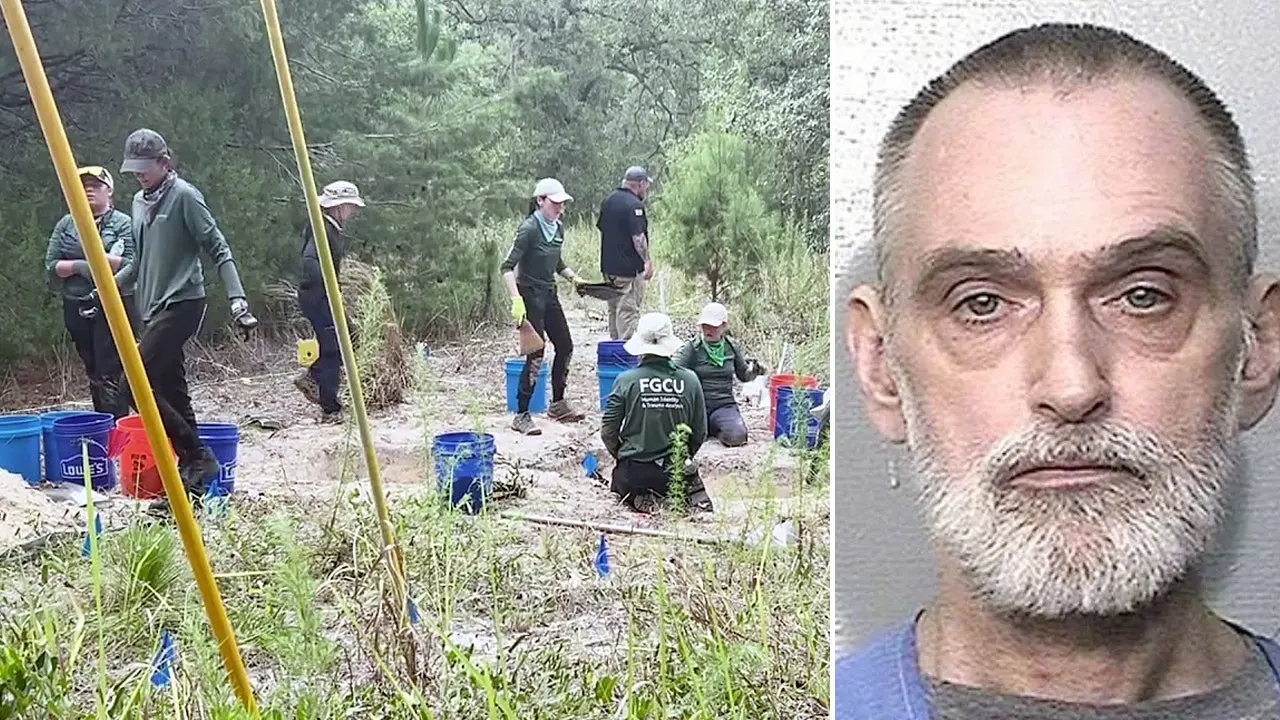
The heavy, humid air of Hernando County, Florida, has always carried a quiet stillness, but beneath the serene canopy of Spanish moss and towering live oaks lies a landscape haunted by a dark, unresolved history. This week, that stillness was broken as a dedicated task force comprised of local deputies, federal agents from the Federal Bureau of Investigation (FBI), and forensic experts from the State Attorney’s Office converged upon the secluded, wooded acreage of Dry Creek Ranch. Guided by the highly sensitive instincts of trained cadaver dogs who recently alerted to signs of decomposition beneath the earth, investigators have begun a painstaking excavation process. The atmosphere on site is thick with a solemn, respectful gravity; this is not merely a modern crime scene, but a portal back to a terrifying era when a ruthless predator walked these very woods. The current search represents a renewed, desperate effort to find the forgotten victims of convicted serial killer Billy Mansfield, a man whose name still sends a cold shiver through the local community decades after his reign of terror seemed to have ended. For the families of young women who vanished into the warm Florida nights during the late 1970s and early 1980s, the roaring of excavation machinery at Dry Creek Ranch is a deeply emotional, bittersweet sound. It is a painful reminder of raw, open wounds that have never truly healed, yet it also carries a fragile, precious whisper of hope that their decades-long nightmare of not knowing might finally come to an end. This operation is a physical manifestation of a promise made by law enforcement never to forget those who were stolen away, illustrating that no matter how many years pass, the pursuit of justice and human dignity remains an unyielding force that refuses to let the dead remain forgotten in the shadows of the wilderness. It is an act of defiance against the silence of the grave, reminding us that every human soul deserves to be searched for, remembered, and ultimately brought home under the warm light of day.
To understand the dark weight of the current search, one must look back to the late 1970s, a chaotic and frightening era when Billy Mansfield and his brother, Gary Mansfield, traveled between Florida and California, leaving a trail of violence and unanswered questions in their wake. The siblings moved quietly through society, blending into the background of a rapidly growing Florida suburb while harboring impulses of unimaginable cruelty. The Mansfield family lived on Centerwood Avenue in Hernando County, a property that would eventually become synonymous with unspeakable horror in the local consciousness. In the early 1980s, following a homicide investigation in California that implicated the brothers, investigators secured a search warrant for the family’s Florida home. What they discovered shook the quiet, rural community of Spring Hill to its core: neighbors watched in absolute disbelief as investigators carried out evidence bag after evidence bag, eventually uncovering the skeletal remains of four young women. These victims were buried shallowly beneath the family property, and in some cases, even under the concrete slabs of the home itself, shattering the illusion of safety that had previously defined their rural neighborhood. Three of those victims were eventually identified, their names restored to them after years of being listed as missing persons, but the identity of the fourth victim has remained a frustrating, heartbreaking mystery for over forty years. Today, investigators are leveraging modern scientific advancements, such as investigative genetic genealogy, in a race against time to finally find this nameless girl’s living relatives and give her back her identity. The initial discoveries in the 1980s left an indelible scar, fostering a lingering suspicion that the four bodies found on Centerwood Avenue were not the only secrets the Mansfield family had buried in the sandy Florida soil. For decades, the community has lived with the unsettling knowledge that a monster had operated in their backyards, and the current excavation at Dry Creek Ranch is a direct confrontation of that enduring ghost.
The current excavation is the culmination of an exhaustive, three-year-long effort by the Hernando County Sheriff’s Office to meticulously re-examine every dusty file, interview transcript, and piece of physical evidence connected to the Mansfield case. Recognizing that time was running out as witnesses aged and memories faded, Sheriff Al Nienhuis and his cold-case detectives made the conscious decision to reopen portions of the investigation, refusing to let these cold cases die. Driven by a quiet determination, investigators spent countless hours conducting fresh interviews with Billy Mansfield in his California prison cell, trying to piece together a map of his past movements from fragmented memories and elusive clues. This exhausting intellectual and emotional labor eventually led authorities to pivot their focus north and west of the original search sites, culminating in the current focus on the sprawling rural lands near Fort Dade Avenue and Citrus Way. While initial searches of some areas yielded no human remains, the breakthrough came at Dry Creek Ranch, where the cadaver dogs’ behavior changed dramatically, signaling with unmistakable urgency that something lay buried beneath the surface. Watching these highly trained animals working in tandem with forensic anthropologists highlights the incredible intersection of natural instincts and advanced science in modern investigations. These professionals do not view their work as a mere academic exercise or a bureaucratic box to check; rather, they approach the moist, turned earth with a deep sense of reverence, understanding that every shovel of dirt they clear brings them closer to restoring a voice to a soul that was brutally silenced decades ago. It is a slow, methodical process where every root, rock, and layer of clay is treated with the utmost respect, ensuring that if human remains are indeed present, they are recovered with the dignity that was so cruelly stripped from them in their final moments of life.
The psychological chess match between law enforcement and Billy Mansfield has been a source of immense frustration and profound sorrow for investigators over the years. In past interrogation sessions, Mansfield tantalizingly hinted that there were more bodies hidden across the counties of Hernando, Pasco, and Pinellas, using the locations of his victims as currency to bargain for lighter sentences or better prison conditions. However, because law enforcement rightfully refused to compromise on justice or grant leniency to an unrepentant killer, no agreements were ever finalized, leaving detectives to search for needle-in-a-haystack gravesites based on sparse, cryptic clues. This manipulative behavior is characteristic of serial predators who derive power from withholding information, prolonging the suffering of the victims’ families as a final act of control from behind prison walls. Dealing with such sociopathic minds requires detectives to possess an extraordinary level of emotional resilience, compartmentalizing their own anger and disgust to maintain a professional, analytical focus. The cold-case team had to look past Mansfield’s games, analyzing the geography of his movements, the timing of his past crimes, and historical property records to find the locations he refused to clearly disclose. Each new search is a direct challenge to the power Mansfield tried to exert from behind bars, a statement that the truth cannot be indefinitely bargained away or hidden in the dark recesses of a killer’s memory. It is a grueling, slow-moving battle of wills, but the relentless persistence of the detectives proves that the human drive to seek justice and show compassion for the lost is far more enduring than any criminal’s desire to keep his dark secrets buried. By returning to the dirt, the sheriff’s office is stripping Mansfield of his final bit of leverage, declaring that they will find his victims with or without his cooperation, showing that a community’s love and commitment to its lost souls will always outlast a killer’s silence.
The urgency of the renewed search in Hernando County is further fueled by a stunning breakthrough that occurred earlier this year, reminding the world of the vast, terrifying scope of Mansfield’s crimes. In January 2024, Mansfield formally confessed to the 1980 abduction and murder of Carol Ann Barrett, an eighteen-year-old high school student from Ohio whose tragic death had haunted her family and investigators for forty-four years. Barrett had traveled to Daytona Beach for a celebratory spring break trip with high school classmates, a joyful rite of passage that turned into an unimaginable nightmare when she was abducted from her motel room in the middle of the night. Her body was discovered a day later in a ditch along Interstate 95 in Jacksonville, but with only a vague composite sketch of a suspect and no physical DNA matches at the time, the case slowly went cold. For decades, her family was left to mourn a vibrant young woman whose life was stolen just as it was beginning, their grief compounded by the painful lack of answers. The breakthrough finally arrived through the relentless application of modern DNA technology and investigative genealogy, which eventually forced Mansfield to confess after two years of intense, careful questioning by cold-case detectives in his prison. Mansfield was just twenty-four years old when he took Barrett’s life, and his confession served as a chilling confirmation of his nomadic, predatory habits during that era. It proved that his violence was not confined to the boundaries of his family’s property, but was a widespread plague that devastated lives across state lines, emphasizing the vital importance of examining every inch of ground he ever occupied. Her story is a poignant reminder of the human cost of these crimes, illustrating how a single act of violence ripples through generations, leaving families forever changed but ultimately kept alive by the hope of the truth.
As the excavation at Dry Creek Ranch continues under the watchful eyes of the community, Sheriff Al Nienhuis has made it clear that the primary objective of this massive, resource-intensive operation is not prosecution, but peace. Billy Mansfield is already serving a life sentence in California alongside four concurrent life sentences in Florida, meaning he will never again taste freedom, and any new criminal charges would do little to change his physical reality behind bars. Instead, this operation is driven by a much higher, more humanitarian purpose: the identification of nameless victims and the delivery of long-sought answers to aging parents, siblings, and children who have spent decades wondering about the fate of their missing loved ones. The passage of forty years does not diminish the value of a human life, nor does it quiet the persistent ache of a family left in the dark about a loved one’s final resting place. Every bucket of dirt carefully sifted, every coordinate mapped, and every effort made by these modern investigators is a testament to the belief that everyone deserves to have their story told and their remains returned to those who loved them. In a world that often moves on too quickly from past tragedies, the solemn, exhausting work taking place in the quiet woods of Hernando County stands as a beautiful, profound monument to empathy, justice, and the enduring human spirit. It is a powerful declaration that no victim is ever truly forgotten, and that even in the face of absolute darkness, the light of truth will keep digging until the lost are finally brought home. Every shovel and screen used by the search teams is a small but vital instrument of healing, carrying the hopes of families who simply want to lay their loved ones to rest, proving that the human heart’s capacity for love and closure spans across generations.