



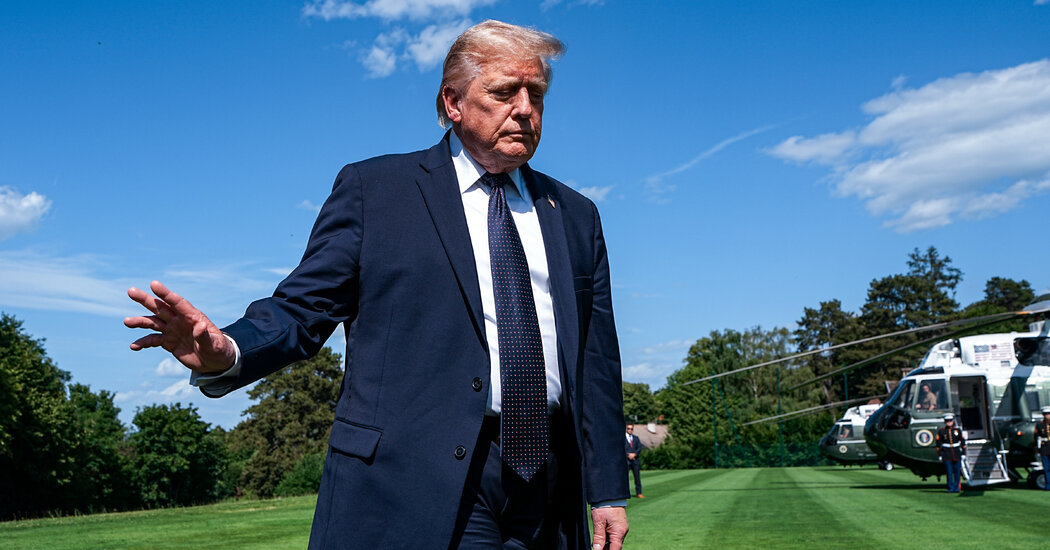
The financial markets rarely sleep, but for the portfolio of the Trump family, they recently experienced a sudden, electrifying jolt. In the opening months of the year, brokerage accounts tied to Donald Trump executed an astonishing surge of financial activity, registering more than 3,600 trades in a mere ninety-day window. This hyperactive trading stood in stark contrast to previous years, where the president’s accounts typically logged only a few dozen transactions, with one disclosure showing a quiet period of just 25 trades. Instantly, this dramatic spike in volume triggered intense skepticism among political opponents and government ethics watchdogs. Critics raised alarms over the exquisite timing of several high-value transactions, most notably a lucrative purchase of Dell Technologies shares that occurred shortly before the company secured a multibillion-dollar government contract. As accusations of potential insider trading and presidential self-enrichment began to swirl, supporters and corporate representatives quickly stepped in to defuse the tension. The Trump Organization released firm statements explaining that the family has absolutely no hands-on control over these portfolios, which are managed entirely by independent, third-party brokerage firms. To unpack the truth behind this financial whirlwind, journalists and market experts analyzed recent financial disclosures, court records, and internal institutional documents, painting a complex picture of modern wealth management intersecting with the highest office in the land.
The true catalyst for this unprecedented mountain of trades was not a sudden, aggressive pivot in investment strategy, but rather the resolution of a high-stakes legal drama that freed up an immense reservoir of personal capital. In 2024, a New York judge had hit Trump with a staggering civil fraud judgment of nearly $500 million, forcing him to lock up $175 million in liquid funds as collateral for an appellate bond. This massive sum sat idle and frozen in holding accounts, entirely removed from the active market, until an appellate court eventually struck down the massive judgment. Suddenly, this enormous wave of cash was returned to Trump’s possession, creating a lucrative opportunity and a practical challenge for his wealth managers. In the upper echelons of finance, leaving hundreds of millions of dollars in low-yield cash is considered a major missed opportunity, prompting his advisors to immediately redeploy the capital back into active investments. The resulting trade volume was essentially a massive, robotic rebalancing act, as automated systems distributed the freed capital across a highly diversified spread of more than a thousand different corporate bonds, mutual funds, and individual equities, creating the illusion of a human-directed trading spree.
To appreciate how these transactions occurred without direct family involvement, one must look closely at the protective systems used by elite financial institutions like Charles Schwab and JPMorgan Chase. Trump’s liquid millions are held securely within a family trust overseen by his eldest son, Donald Trump Jr., who serves as the sole trustee. The day-to-day trading operations are governed by “discretionary accounts,” a standard industry structure where the financial institutions hold exclusive decision-making authority over what to buy and sell. Legal documents and internal policies reveal that the Trump family is strictly prohibited from directing, suggesting, or even receiving advanced notice of any individual trades. Furthermore, these institutions rely heavily on an investment methodology known as “direct indexing,” in which automated algorithms buy fractional shares of individual companies to mirror giant indexes like the S&P 500 or the Schwab 1000. This highly automated, hands-off approach makes it impossible for an individual client to log in and manually alter the portfolio’s direction. While the former president does sit down annually with a top financial advisor for a broad, high-level briefing on his portfolio’s general performance, advisors confirm he is never given a granular, stock-by-stock breakdown of his active holdings.
Despite these systematic safeguards, the court of public opinion is rarely swayed by compliance documents alone when the visual timing of a trade looks incredibly convenient. This skepticism crystallized around a massive purchase of Dell Technologies stock executed by Trump’s discretionary account in February. Just over a week after the investment was made, Trump stood before a crowd at a campaign event in Georgia and enthusiastically urged his supporters to “go out and buy a Dell computer,” while publicly praising the company’s founder, Michael Dell. The narrative took an even more dramatic turn when the Pentagon subsequently awarded Dell a massive $9.7 billion defense contract. Democratic Senator Elizabeth Warren seized on the sequence of events, publicly calling for a formal investigation and arguing that utilizing the presidential bully pulpit to champion a company in which one holds a million-dollar stake constitutes a clear abuse of power. Trump’s supporters, alongside Treasury Secretary Scott Bessent, quickly dismissed the outrage, pointing out that Trump was not sitting in the executive quarters acting as a high-frequency day trader, and that his long-standing friendship with Michael Dell—who had recently pledged billions to launch youth savings accounts branded as “Trump Accounts”—predated the routine, automated stock purchase.
The persistent public anxiety surrounding these transactions highlights a deeper, unresolved ethical debate stemming from Trump’s historic decision to reject a traditional blind trust. Since the post-Watergate era of the 1970s, modern American presidents have routinely placed their private business holdings and stock portfolios into blind trusts managed by completely independent trustees who liquidate the assets and reinvest them in secret. This traditional guardrail ensures that a president can never know if an executive order, tax policy, or foreign tariff will directly impact their personal net worth. By choosing to bypass this norm, Trump created an unavoidable ethical blind spot; even if he does not have the technical power to execute a trade, he still possesses clear knowledge of the major brands and industries that underpin his massive fortune. Presidential historians point out that the primary function of a blind trust is to preserve the integrity of the office and keep a leader’s virtue from ever being called into question. Without this protective barrier, every policy announcement, tax cut, or casual social media endorsement is inevitably viewed through a cynical lens of potential self-interest, leaving the public to wonder whether official actions are designed to benefit the nation or simply bolster a private portfolio.
Ultimately, this ongoing controversy shines a bright light on the unique legal landscape of the American presidency, which remains largely exempt from standard conflict-of-interest statutes. Under current federal law, the president and vice president are legally permitted to influence policies that directly impact their personal financial holdings, a broad exemption established to prevent the executive branch from being constantly paralyzed by civil litigation and constant ethical challenges. White House representatives have repeatedly emphasized that Trump’s actions are guided strictly by the best interests of the American public, maintaining that there are absolutely no conflicts of interest in his financial affairs. Meanwhile, Trump’s personal wealth continues to experience significant growth, fueled by fresh windfalls from highly successful brand licensing and cryptocurrency ventures that are expected to push his liquid portfolio to historic heights in upcoming disclosures. As legislative pushes to ban stock trading for high-ranking government officials continue to gain traction in Congress, the debate over presidential portfolios serves as a compelling reminder of the delicate balance between private enterprise and public trust, illustrating how difficult it is to separate personal wealth from the levers of global power.