





For weeks, the desolate industrial park on the outskirts of Newark, New Jersey, has been transformed from a forgotten wasteland into a roaring battleground for human dignity. Nestled in a landscape choked by the thick, putrid stench of raw sewage drifting from the nearby Passaic River, the Delaney Hall immigration detention center has become the focal point of an intense, emotionally charged standoff. Since the Memorial Day weekend, a dedicated group of advocates, community members, and distraught families have pitched tents and gathered in the facility’s bleak parking lot, their voices echoing off the concrete walls as they demand justice for the migrants held inside. The atmosphere is heavy with anguish and desperation; inside the makeshift encampment, the physical toll of the vigil is visual and raw, marked by the weeping of mothers and the defiant chants of activists refusing to let those locked away be forgotten. This barren stretch of pavement has become a sanctuary of solidarity, where the grim reality of America’s immigration system clashes directly with the resilient spirit of a community demanding basic human rights.
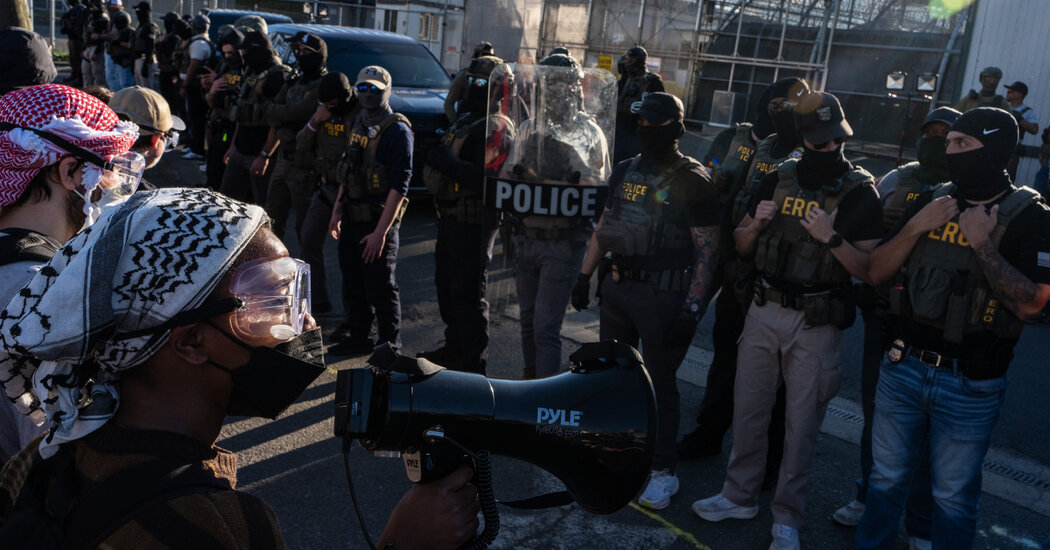
The fragile peace of this protest camp was shattered on Friday night when the handoff of security operations between federal agents and state authorities devolved into fresh chaos. For days, the parking lot had been a theater of violence as federal officers dressed in tactical gear repeatedly charged into civilian crowds, knocking demonstrators to the asphalt, deploying burning chemical irritants, and aggressively beating fleeing individuals with batons. In a bid to defuse what had become a public relations nightmare and a human rights crisis, state officials negotiated a deal for federal Immigration and Customs Enforcement agents to withdraw from the perimeter, allowing the New Jersey State Police to take over security. However, any hope that this tactical shift would Pacify the situation was quickly extinguished. Just hours after the state troopers assumed control, they launched their own aggressive dispersal operations, charging the remaining fifty protesters on foot and on horseback under the cover of darkness. The chaotic night ended with terrified demonstrators shouting at unidentified plainclothes men who slipped hastily past police barricades into the detention center, proving that a change in uniform did little to alter the underlying brutality of the state’s response.
At the heart of this physical violence lies a bitter political chess match between state progressives and federal hardliners, with human lives serving as the pawns. Following the withdrawal of federal agents from the parking lot, Homeland Security Secretary Markwayne Mullin issued a sharply sarcastic and triumphant statement, framing the retreat as a major victory for federal law and order while mocking New Jersey Governor Mikie Sherrill for her initial refusal to coordinate state resources with immigration enforcement. Gov. Sherrill, on her part, has fought a defensive political campaign, attempting to establish a designated “protest zone” to give demonstrators a safe venue while preventing federal authorities from finding a pretext to expand their operations deeper into the state. Yet, the governor’s efforts to “lower the temperature” have consistently been undermined by the raw reality on the ground. Earlier in the week, shortly after Sherrill and other prominent figures like Newark Mayor Ras J. Baraka left the site, federal agents fired barrage after barrage of pepper balls and chemical sprays at peaceful crowds blocking an entrance—a reckless deployment that even caught U.S. Senator Andy Kim in its suffocating crossfire as he desperately tried to de-escalate the conflict.
The escalating gridlock has turned the area surrounding Delaney Hall into a militarized zone of constant anxiety, with nighttime skirmishes occurring with terrifying regularity. As the sun sets over the industrial park, the nature of the enforcement changes, shifting from a standoff of endurance during the daylight hours to sudden, aggressive raids in the freezing pre-dawn dark. Families who had gathered to pray and show support for their detained loved ones found themselves fleeing clouds of blinding gas, while others were physically tackled and dragged past the towering razor-wire fences to be processed inside the very facility they were protesting. Arrests have mounted steadily as the week progressed, turning peaceful citizens into targets of state violence simply for refusing to look away from the suffering of others. The stark contrast between the civilian clothes of the plainclothes agents slipping into the facility and the riot armor of the uniform police lines underscores a deeply unsettling reality: the state’s primary objective remains the quiet containment of human beings, achieved through whatever physical force is deemed necessary.
While the violence outside has captured media headlines, a far more agonizing and silent struggle has been unfolding behind the heavily fortified walls of the detention center itself. Reports have slipped out from relatives and immigrant advocacy groups painting a harrowing picture of systemic abuse inside Delaney Hall, where detainees have allegedly launched a massive hunger strike to protest inedible, spoiled food and a near-complete lack of medical attention. The retaliation from guards was immediate and severe, with reports emerging of striking migrants being subjected to physical beatings and chemical dousings within the cramped confines of their cells. Predictably, the Department of Homeland Security has vigorously denied these allegations, dismissing the reports of a hunger strike entirely and instead downplaying the internal violence as an isolated, minor altercation between detainees that was quickly resolved by staff. In a move that highlighted the cold, bureaucratic apathy of the federal apparatus, homeland security officials even went so far as to publicly urge the suffering detainees to simply give up their legal battles and “self-deport” back to the dangers they originally fled.
This narrative of denial, however, has been fiercely countered by the American Civil Liberties Union of New Jersey, which confirmed that hundreds of detainees have indeed put their bodies on the line in a synchronized hunger strike, joining a broader regional wave of migrant resistance against inhumane living conditions. The crisis at Delaney Hall is not an isolated incident, but rather a concentrated symbol of a broken and deeply punitive immigration system that prioritizes deterrence over human dignity. By choosing to starve themselves, the detainees have reclaimed the only agency left to them, forcing the squalor of their daily confinement into the public consciousness. As the state police and federal agencies continue to pass the buck of responsibility and swap jurisdictions in the sewage-scented Newark night, the central, human question of the protest remains unanswered. Those standing vigil outside, bruised by batons and choked by chemical sprays, continue to remind the world that behind the sterile statistics, political posturing, and razor-wire fences are real people—fathers, mothers, sisters, and brothers—whose basic right to exist with dignity cannot be surrendered.