




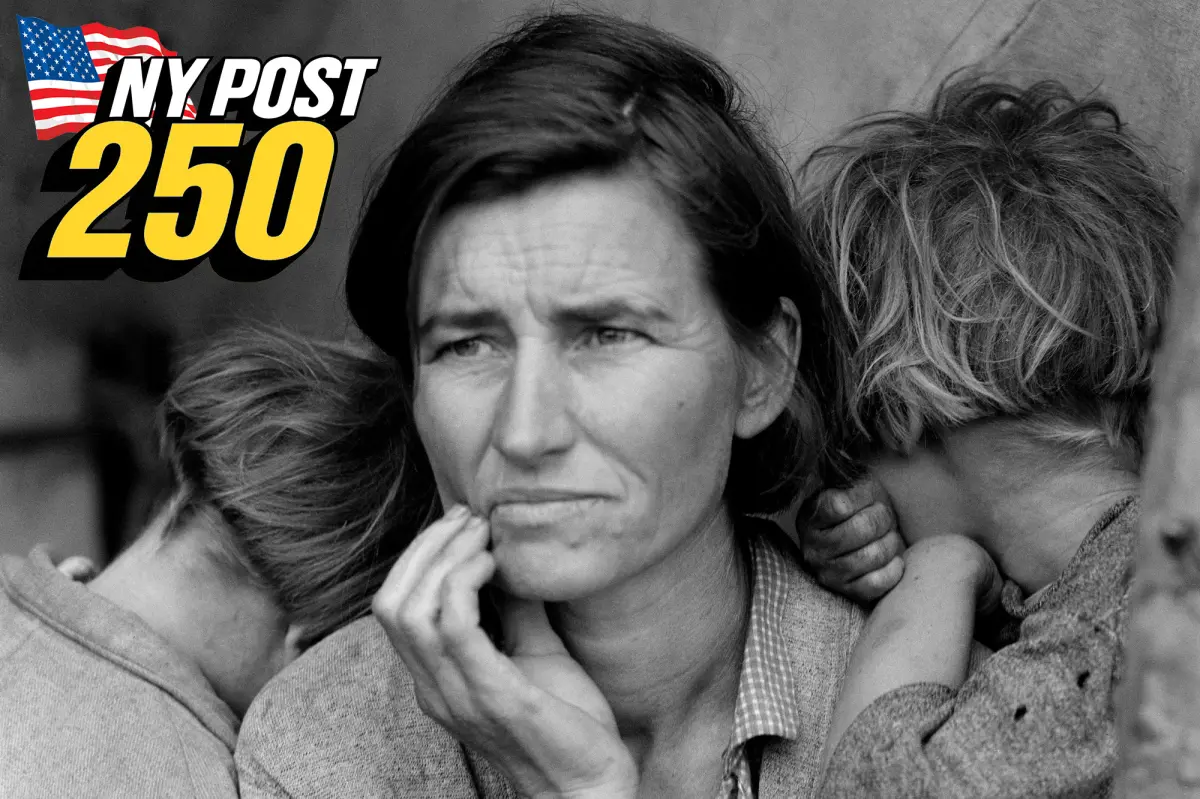
More than half a decade into the crushing darkness of the Great Depression, an observer in Muncie, Indiana, penned a quiet, deeply sympathetic profile of his neighbors. He asked a simple but haunting question: “Who is the ‘forgotten man’ in Muncie?” His answer was intimate, raw, and instantly recognizable to anyone living through that bleak era. He described this forgotten soul as the ordinary, overlooked citizen who quietly took odd jobs whenever they materialized, keeping his head down and his dignity intact. There were hundreds of him in Muncie, and thousands more across the country, representing what the writer called the “original spirit that is America.” This resilient, unyielding spirit is precisely what we still celebrate today when we look back at the men and women of the 1930s and 1940s, admiringly calling them the “Greatest Generation.” They survived an unprecedented economic apocalypse not through state-mandated miracles, but through a deeply ingrained, personal resourcefulness. These were people who had no safety nets, no modern retirement accounts, and no guarantees. They were so desperately poor that they saved every scrap of survival they could find—tin cans, worn rubber bands, tangled balls of string, and tiny flakes of gold hidden carefully inside worn-out mattresses. Yet, despite being stripped of their financial security, they never surrendered their hope, eventually rising together to defeat global tyranny in World War II. To truly understand their triumph, we must first appreciate the staggering, terrifying scale of the economic abyss they stood before in 1932, a year when one in four Americans was entirely jobless, the stock market had withered to a mere fraction of its former glory, and a charismatic new leader named Franklin Delano Roosevelt stepped onto the national stage promising a desperate public a “New Deal.”
Roosevelt entered the White House with a bold, almost revolutionary promise to rebuild the shattered country by championing this very “forgotten man,” whom he defined as the struggling citizen at the absolute bottom of the economic pyramid. The nation, paralyzed by fear and eager for any sign of progress, threw its complete faith behind him, with iconic figures like humorist Will Rogers joking that if Roosevelt decided to burn down the entire Capitol building, the public would still cheer just because he had finally managed to start a fire. Initially, the warmth of that fire brought genuine relief to a freezing nation. The introduction of Deposit Insurance gave families a peaceful night’s sleep knowing their meager life savings wouldn’t vanish if their local bank closed its doors, while the creation of Social Security provided a vital safety net for elderly citizens whose children could no longer afford to feed them. Yet, as the administration grew more powerful, some of the fires Roosevelt lit began to burn the very foundations of American industry rather than warm them. Instead of merely helping the manufacturing sector recover, the President sought to dominate it directly, establishing a massive, highly centralized federal bureaucracy known as the National Industrial Recovery Administration (NIRA). Swept up in the emergency of the crisis, a compliant Congress granted Roosevelt unprecedented authority over almost every facet of the American economy, extending this top-down control to agriculture, wages, prices, and even the gold in citizens’ pockets, which they were ordered to surrender directly to the federal government.
The economic philosophy driving this sweeping takeover was based on a bizarre, upside-down logic: that by artificially forcing a reduction in the supply of goods and basic crops, prices would rise, and the economy would somehow recover. This theory completely ignored the common-sense realities of everyday life, and when ordinary business owners or desperate citizens objected to these strange new mandates, the administration responded with aggressive legal prosecutions and public scapegoating. The visual and human results of these policies on the ground were nothing short of tragic. In the American South, struggling farmers were ordered to destroy their own valuable crops, leading to a heartbreaking spectacle where work mules, meticulously trained over years to walk carefully between cotton rows, flatly refused to step on and destroy the healthy plants they had spent their lives protecting. Even more devastating to the public conscience was the government-mandated slaughter of millions of innocent young piglets in a desperate bid to artificially inflate meat prices. This prompted a deeply saddened housewife to write a letter of protest to the Secretary of Agriculture, expressing her physical sickness at the sheer waste of food while her own impoverished family could no longer afford a single slice of bacon. The high-minded theories of Washington bureaucrats were clashing directly with the instincts of regular Americans, and soon, even the Supreme Court stepped in to declare these overreaching programs completely unconstitutional.
Despite these legal setbacks, the administration continued its push for federal control, passing the highly controversial Wagner Act in 1935, which empowered unions but inadvertently discouraged struggling businesses from hiring new staff due to artificially high wage requirements. This constant uncertainty surrounding government regulations, currency values, and private property rights acted as a heavy anchor, dragging down the natural recovery of the market and leaving millions of Americans feeling as though they were destined to remain “forgotten men” forever. By the election year of 1936, the American electorate was frozen in a state of absolute survival panic. The Republican opposition, led by Alf Landon, failed to offer a compelling vision of individual freedom, presenting instead a weak, diluted version of Roosevelt’s own policies. With the unemployment rate still hovering at a painful ten percent, voters chose to stick with the familiarity of the incumbent, handing Roosevelt a historic landslide victory. Emboldened by this massive mandate, Roosevelt returned to Washington with a renewed hostility toward private enterprise, openly declaring to the country that he intended to show business leaders once and for all that he was their master. This aggressive, confrontational stance had immediate and disastrous consequences, triggering a severe economic relapse in the late 1930s that became known as the “Depression within the Depression,” as unemployment spiked back up to fifteen percent and a dark cloud of pessimism settled over the country’s vital utility and manufacturing sectors.
It was during this period of renewed darkness that an unlikely champion emerged to challenge the dominant political narrative. Wendell Willkie, a magnetic and plainspoken utility executive, began to capture the imagination of the American public by loudly exposing the New Deal as a deceptive “bedtime story” designed to make citizens dependent on government power rather than their own industry. Willkie’s message of organic human energy, free enterprise, and individual initiative resonated so deeply with a tired nation that by the election of 1940, many experts believed he was on track to defeat Roosevelt and reclaim the White House. However, the course of human history changed in an instant when Adolf Hitler’s war machine invaded Poland and sent bombers raining destruction down upon London. Faced with the sudden, terrifying prospect of a second global conflict, American voters decided that Roosevelt’s experience as a former Navy official made him the safer choice to navigate the gathering storm, re-electing him to a third, and eventually a fourth, term. To his immense credit, Roosevelt recognized the existential nature of the global threat and wisely suspended his internal political warfare against private business. He called a truce with the industrial leaders he had previously demonized, transforming American factories into the unbeatable “Arsenal of Democracy” that would ultimately supply the Allied forces and win the war on two fronts.
When the dust of World War II finally settled and Roosevelt passed away in 1945, the American people emerged from fifteen years of continuous crisis with a profound, hard-won wisdom. They had learned a vital lesson about the delicate balance between the collective and the individual. While they fully recognized and honored the immense value of collective unity and strong federal leadership during the emergencies of wartime, they realized with equal clarity that peacetime prosperity could only be built on the back of individual liberty, personal initiative, and free-market confidence. Congress and the public quickly acted on this understanding, passing major legislation to roll back the most destructive elements of wartime labor regulations and firmly rejecting subsequent attempts by President Harry Truman to seize control of the private steel industry. To guarantee that no future commander-in-chief could ever establish a permanent, centralized grip on the nation’s political life, the states joined together to pass the Twenty-Second Amendment, forever limiting future presidents to two terms in office. Ultimately, the enduring legacy of the Greatest Generation is not just that they survived the Great Depression or won World War II, but that they had the wisdom to know when to pull back the power of the state. They understood that while the collective might win the war, it is the individual—the true, once-forgotten man—who must always be trusted to build the peace.