



At a Historic Crossroads: Switzerland Prepares to Vote on a Controversial 10-Million Population Cap
The Crucible of Swiss Direct Democracy: A Nation Grappling with Its Own Growth
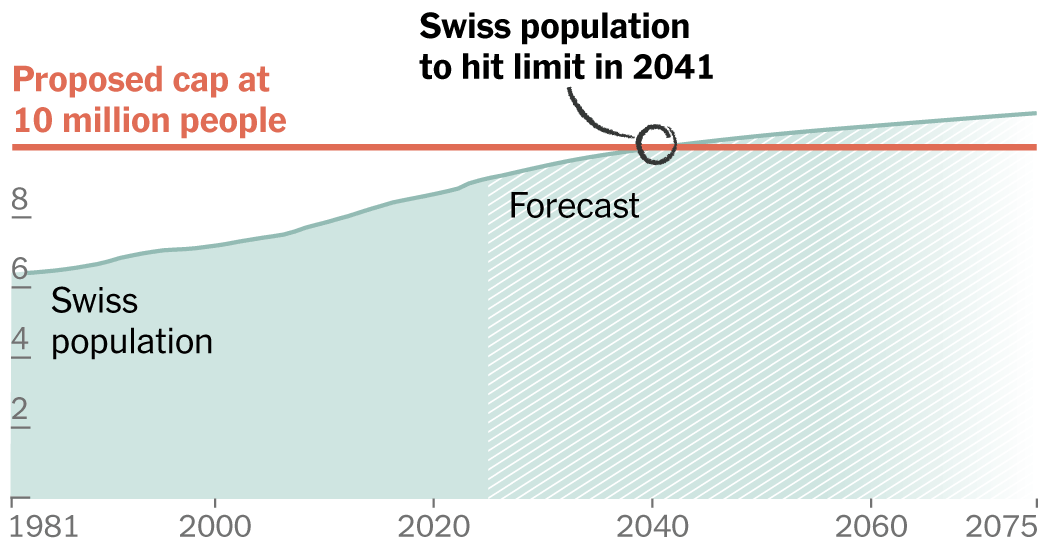
Nestled in the heart of Europe, Switzerland has long cultivated an international reputation as a serene, hyper-efficient enclave of stability, but beneath its pristine alpine exterior lies a brewing socio-political debate over the very definition of its national identity. On Sunday, the Swiss electorate will march to the polls to engage in one of the most consequential exercises of Swiss direct democracy in modern history: a national referendum on whether to constitutionally mandate a strict population cap of 10 million people. Currently home to approximately 9.1 million residents, the Alpine confederation is experiencing unprecedented demographic expansion driven not by birthrates, but by a steady influx of global talent attracted to its robust economy, high quality of life, and stable political landscape. For many Swiss citizens, immigration is no longer merely an abstract economic policy but an urgent, palpable reality that is visibly reshaping their daily lives, sparking fierce debates over the carrying capacity of their infrastructure and the long-term sustainability of their cherished social model. The coming vote represents a pivotal moment that transcends simple administrative planning; it is a profound existential referendum on how a small, landlocked nation balances its economic ambitions with its deep-seated desire to preserve its traditional landscape, cultural sovereignty, and historical isolationism.
The Populist Crusade: Preserving Helvetian Identity and Infrastructure
The driving force behind this dramatic public intervention is the right-wing Swiss People’s Party (SVP), the nation’s largest political faction, which frames the proposed Switzerland population cap as a necessary protective barrier against an unsustainable tide of rapid globalization. Proponents of the initiative argue passionately that unchecked immigration has placed an intolerable strain on the nation’s public services, resulting in congested highways, overcrowded rail networks, and a severely overheated real estate market that has priced young Swiss families out of homeownership. Beyond these practical grievances, the SVP’s campaign taps into deep-seated cultural anxieties, warning that the unique linguistic tapestry of the country is being eroded as traditional Swiss German dialects in historic town squares are increasingly supplanted by standard “high German” spoken by expatriate professionals. Party leaders also voice concerns that the arrival of newcomers from more distant, culturally distinct societies could weaken the traditional Western values and agrarian traditions that have historically defined local communities. While Switzerland’s seven-member federal governing council—which includes two representing the SVP—officially opposes the measure as a blunt instrument that could severely damage foreign relations, the party’s message has struck a powerful chord with conservative, suburban, and rural voters who fear that their affluent, quiet country is rapidly turning into an overcrowded, sprawling European metropolis.
Dismantling the European Pipeline: The Threat to International Treaties
To evaluate the potential consequences of such a dramatic policy shift, the Swiss government commissioned an exhaustive demographic study from the independent consulting firm Demografik, which painted a stark picture of the diplomatic and logistical hurdles that would accompany a hard population ceiling. The study’s findings reveal that because Switzerland’s population growth is driven almost entirely by immigration rather than natural birthrates, implementing a population cap would require the government to enact immediate, highly restrictive border controls that would block an estimated 1.2 million prospective residents from entering the country by 2075. Crucially, the data shows that the vast majority of those barred under a cap would not be asylum seekers from distant, conflict-torn regions—a common focal point of populist rhetoric—but rather highly skilled professionals from neighboring European Union countries like Germany, Italy, and France, who currently cross Swiss borders seamlessly under reciprocal treaties. This reveals a critical diplomatic vulnerability: Switzerland is bound to the European Union by a delicate web of bilateral agreements, central to which is the European Union free movement agreement. If Swiss authorities are forced to unilaterally restrict EU arrivals to maintain the 10-million ceiling, the EU’s “guillotine clause” could be triggered, instantly dismantling other vital economic and security pacts, isolating the Swiss economy, and severely damaging its standing as a cooperative partner on the European stage.
The Graying Alpine Crisis: A Demographic Time Bomb Without Foreign Youth
Beyond the immediate political friction with Brussels, the implementation of a strict population limit would dramatically accelerate a quiet demographic crisis that has been developing across the Swiss plateau for decades: the rapid aging of its native populace. Historically, the continuous arrival of working-age migrants has acted as a vital demographic relief valve, keeping Switzerland younger on average than many of its European neighbors, where birthrates have plunged well below the replacement level of 2.1 children per woman. Last year marked a historic and deeply concerning milestone for the country, as the number of Swiss residents aged 65 or older officially surpassed those under the age of 20 for the very first time. By closing the door to young, ambitious foreign professionals who migrate during their peak working years, the demographic study warns that a population cap would leave Switzerland with a severely top-heavy demographic pyramid, characterized by a massive pool of retirees and a dwindling base of active taxpayers. This dramatic imbalance would inevitably threaten the solvency of Switzerland’s highly praised social welfare and state pension systems, forcing the government to make painful choices such as raising the retirement age, drastically cutting benefits, or aggressively raising domestic taxes on a shrinking labor force, ultimately threatening to inflate the cost of living for everyone.
Strategic Brain Drain: The Crippling Impact on Key Industries and Healthcare
The economic ramifications of such a policy would be felt most acutely in Switzerland’s highly specialized, export-oriented industries, which have long relied on a steady pipeline of global talent to maintain their competitive edge on the world stage. From the cutting-edge pharmaceutical clusters in Basel to the burgeoning information technology and financial services hubs in Zürich, business leaders have sounded the alarm, warning that a sudden labor shortage could cripple innovation and force multinational corporations to relocate their headquarters to friendlier jurisdictions. The domestic services sector is equally vulnerable; crucial industries like hospitality, tourism, and agriculture depend heavily on seasonal foreign workers to fill physically demanding roles that are increasingly difficult to automate. Nowhere is this reliance more critical, however, than in the healthcare sector, where Swiss hospitals and elderly care facilities are already grappling with chronic personnel shortages that would be exacerbated by a ban on foreign medical professionals. As Stefanie Bailer, a prominent political scientist at the University of Basel, succinctly noted, the nation faces a massive structural problem if it locks out the very people who keep its social infrastructure functioning, pointing out that a lack of German doctors and foreign nurses would immediately compromise the high quality of care that aging Swiss citizens expect.
The Existential Choice: Balancing Cultural Preservation Against Economic Survival
As Swiss voters stand on the threshold of this monumental decisions, they find themselves caught between two fundamentally different visions of their country’s future: one of defensive self-preservation and another of global economic integration. Opponents of the initiative emphasize that the looming workforce shortages will arrive at the worst possible moment, over the next fifteen years, as nearly half of the current Swiss workforce approaches retirement age with far too few native replacements in queue to succeed them. Manuel Buchmann, the lead author of the Demografik study, warned that the policy would transform a situation that is already critical into an active crisis, leaving the country’s economic engine stalled and its public services stretched to a breaking point. Yet, for supporters of the cap, the potential economic cost is a price worth paying to halt the perceived erosion of the Swiss way of life and to guarantee that the country’s natural beauty and infrastructure are not permanently degraded by rapid growth. Ultimately, Sunday’s referendum on the Switzerland population cap is about much more than a number on a demographic chart; it is a test of whether one of the world’s most successful and open economies can afford to turn inward, and whether the unique, historically isolationist character of Swiss society can survive the demands of a deeply interconnected, rapidly changing world.