


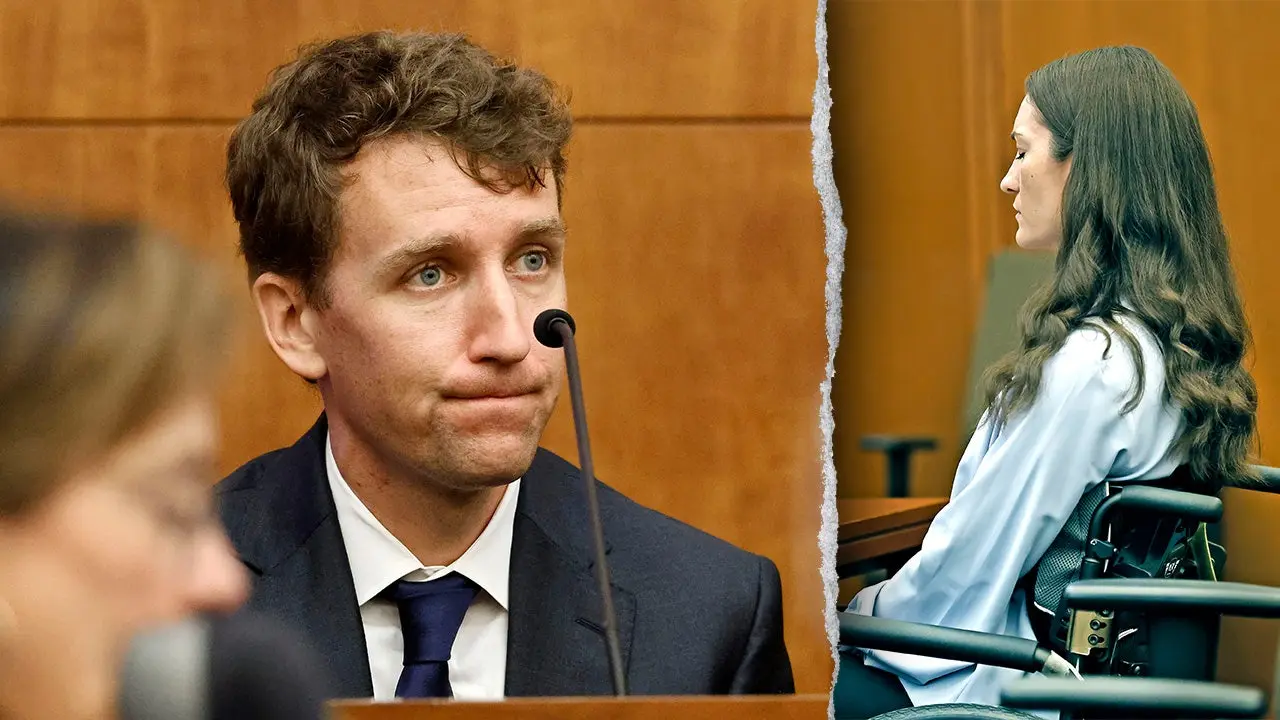
The solemn stillness of the Plymouth County courtroom was shattered on Monday as Patrick Clancy, a father forced to carry an unspeakable weight of grief, took the stand as the state’s first witness in the trial of his ex-wife, Lindsay Clancy. For those in attendance, watching Patrick sit in the witness box was a devastating exercise in witnessing the raw, quiet aftermath of domestic tragedy. He was there to reconstruct the final, agonizing months of a life that once belonged to a happy family of five in Duxbury, Massachusetts, before it was permanently dismantled on January 24, 2023. Lindsay Clancy currently faces multiple charges of murder and strangulation in the deaths of their three young children: five-year-old Cora, three-year-old Dawson, and eight-month-old Callan. For observers like Margaret McLean, a former criminal prosecutor and law professor, Patrick’s clinical and measured delivery did little to mask the profound suffering etched across his face. He sat before the jury, carefully compartmentalizing his shattered world, answering questions with a heartbreaking precision because he simply had to survive the ordeal of recounting the destruction of his entire universe.
With painful clarity, Patrick guided the jury through the terrifying trajectory of his wife’s mental decline, a period he described as a devastating “big spiral” that began shortly after she was prescribed the psychiatric medication Seroquel. He recalled watching her physical and emotional health erode almost overnight, witnessing a once-vibrant mother lose massive amounts of weight and succumb to a hollow, inescapable depression. Lindsay, a former labor and delivery nurse who had spent her career welcoming new life into the world, was suddenly drowning in her own mind, eventually admitting to Patrick that she was experiencing terrifying, intrusive thoughts of harming their children. Yet, the tragedy was masked by the cruel and deceptive nature of her illness; she expressed horror at these thoughts, denied having any desire or plan to act on them, and continued to go about her daily routine. In a painful paradox that many families struggling with severe mental illness will recognize, Patrick noted that moments after expressing these dark impulses, Lindsay would immediately pivot back to being a nurturing mother, preparing lunches, playing with the kids, and putting them to bed, leaving him with little reason to suspect the imminent danger that lay ahead.
The testimony quickly turned to the exhausting, frantic efforts Patrick made to save his wife and protect his family, shedding a harsh light on modern healthcare limitations. In the months leading up to the tragedy, Lindsay was prescribed a dizzying cocktail of 13 different psychiatric medications, a revolving door of pharmaceutical trials that Patrick watched with growing alarm. He testified to feeling deeply unsettled by the profound disconnect between the severity of her deteriorating condition and the brief, perfunctory telehealth sessions she received from her medical providers. Desperate for a higher standard of care, Patrick fought against the constraints of a flawed system, personally driving her to hospital emergency rooms and eventually securing her admission into McLean Hospital. He told the courtroom that he would have gladly paid any financial sum, regardless of insurance barriers, just to keep his wife hospitalized and safe. His testimony underscores the quiet desperation of a spouse trying to navigate a fragmented mental health infrastructure, struggling to find competent, in-person assistance for a loved one who was rapidly slipping away.
In stark contrast to Patrick’s agonizing recollections of a family in crisis, the prosecution presented a chillingly different interpretation of the events, framing Lindsay’s actions not as a involuntary psychotic break, but as a sequence of deliberate, cold-blooded murders. Assistant District Attorney Shanan Buckingham delivered a meticulous opening statement, arguing that Lindsay spent weeks planning the killings of her three young children. According to the state’s narrative, on the afternoon of January 24, 2023, Lindsay waited for her husband to leave the house, deliberately creating a window of opportunity by sending him on a carefully timed errand to pick up a prescription and fetch takeout food from a nearby restaurant. Once alone in the house, she allegedly used an exercise band to strangle Cora, Dawson, and baby Callan, before attempting to take her own life by jumping from a second-story window. As Margaret McLean pointed out, the prosecution’s deliberate emphasis on the physical mechanics and duration of strangulation is designed to convince the jury that these acts required a conscious, sustained choice to end each child’s life, dismantling the defense’s argument of a sudden, uncontrollable impulse.
The defense, led by veteran attorney Kevin Reddington, took a highly strategic and deeply humanizing approach by immediately conceding the physical facts of the crime, shifting the trial’s focus entirely to the fractured state of Lindsay’s mind. Reddington did not dispute that Lindsay killed her three children, but urged the jury to look beyond the horrific nature of the acts and consider the chemical storm that had hijacked her brain. He portrayed Lindsay as a deeply loving, non-violent mother who was utterly destroyed by severe postpartum psychosis, a condition that completely stripped her of her criminal responsibility. To counter the prosecution’s image of a calculating killer, the defense presented graphic photographs of Lindsay in the hospital, showing severe injuries to her neck and wrists, and noted that her suicide attempt had left her permanently paralyzed from the waist down. Reddington argued that her paralysis was not the consequence of a fleeing criminal, but rather the tragic, physical endpoint of a complete and devastating psychological collapse, urging the jury to see her as a victim of a biological horror rather than a monster.
As this emotionally charged trial progresses, the immense burden of deciding Lindsay Clancy’s fate rests squarely on the shoulders of the jury, who must navigate an agonizingly complex moral and legal landscape. Judge William Sullivan reminded the jurors that the Commonwealth bears the heavy burden of proving beyond a reasonable doubt that Lindsay was criminally responsible and legally sane at the precise moment her children’s lives were taken. This trial transcends a standard criminal proceeding, forcing twelve ordinary citizens to grapple with the deep, often-misunderstood realities of postpartum mental health and the rigid boundaries of the american justice system. There are no easy answers or victorious outcomes in this courtroom, only a landscape of profound, enduring grief—a father forced to relive his worst nightmare on a witness stand, a mother shattered both physically and mentally, and three innocent young lives cut tragically short. Ultimately, the jury’s verdict will define not only the fate of Lindsay Clancy, but also how our society measures compassion, accountability, and the devastating limits of a mind lost to illness.