


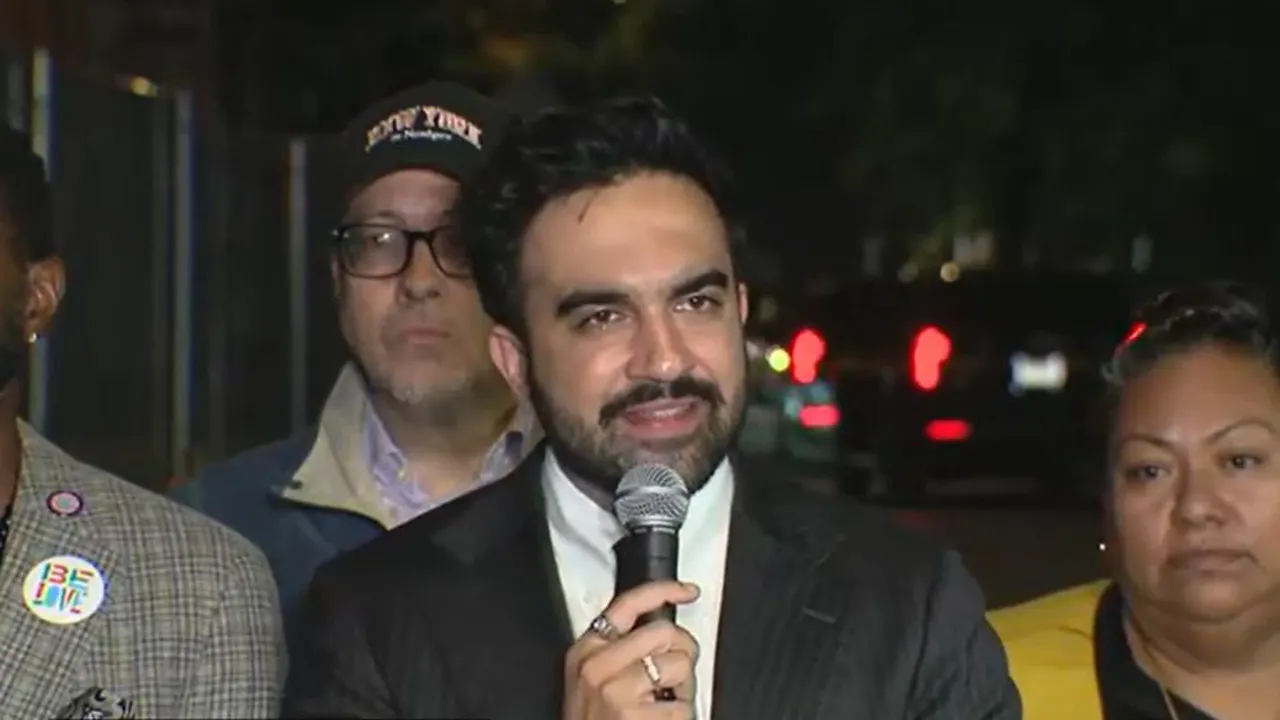
In the charged hours after a federal agent shot an illegal immigrant during a targeted operation in the Bronx, New York City’s political leadership plunged into confrontation with Washington, with Mayor Zohran Mamdani appearing before cameras late Thursday night to deliver a blistering condemnation of U.S. Immigration and Customs Enforcement. The mayor, visibly shaken by the day’s violence, demanded that President Donald Trump end all ICE enforcement within the state, insisting that the federal agency had become a source of terror rather than safety. According to Mamdani, he had just spent approximately two hours on the phone with President Trump, pleading for the wounded man’s release from custody—a request that ultimately went nowhere. This failure seemed to harden his resolve. “All they do is terrorize this city,” he said, his voice carrying the weight of a city still absorbing the shock. He accused ICE of acting “with impunity” and spreading”chaos and terror” across the country, and then went further, alleging that the agency has killed more people than it has ever saved. “Today’s shooting is only further devastating confirmation of what we have long known,” Mamdani added, his words echoing in the crowded news conference. “ICE is rotten to its core.” He confirmed that the man who had been shot had already been transported out of the hospital by ICE agents, a move that seemed to deepen the outrage. The mayor’s demand was not merely a policy position; it was an emotional ultimatum, grounded in years of frustration with federal immigration tactics that he and many fellow progressives believe have singled out immigrant communities for brutal, disproportionate enforcement.
Governor Kathy Hochul quickly joined the chorus of condemnation, though her tone was more measured and focused on transparency. In a statement posted to X, she revealed that she had spoken directly with President Trumpland Department of Homeland Security Secretary Markwayne Mullin about the shooting, which occurred in Marble Hill, a neighborhood that sits at the northern tip of Manhattan. “Tonight,’ I spoke with President Trump and DHS Secretary Mullin about the shooting in Marble Hill,'” she wrote. “I expressed outrage on behalf of New Yorkers and urged them to halt ICE enforcement operations in New York. I also asked that any body camera footage of the shooting be released to the public so we can establish the facts and get to the truth.'” Her call for video evidence reflected a broader demand from elected officials, activists, and ordinary residents who found it impossible to trust the official account without visual proof. The federal version of events, released by DHS, offered only a skeletal outline: ICE was attempting to arrest a wanted man from the Dominican Republic at around 4 p.m. on Thursday when an agent opened fire and wounded him. The agency declined to specify what exactly led to the shooting, but stressed that”ICE officers immediately rendered aid” and thatthe individual was alive and at a local hospital. “The FBI and HSI are on the scene. The incident remains under investigation. More information will be shared as it becomes available,” DHS said. But even these basic facts were soon complicated by new details from New York City Police Commissioner Jessica Tisch, who identified the wounded man as a 28-year-old and revealed a chilling detail: a 5-year-old boy, believed to be the man’s son, was inside the vehicle with him when the shots rang out.
The scene Tisch described was one of chaos and sudden, irreversible violence. Based on evidence collected at the scene, she said, at least one ICE agent discharged seven rounds, striking the driver in the neck below his left ear. The boy, miraculously, was not injured and had been placed in the care of a family member. That image—a child sitting inches away from his father as bullets tore through the car—became the emotional core of the ensuing protests. It was no longer an abstract debate about immigration policy; it was a visceral, horrifying tableau of what enforcement looks like when it goes wrong. For many New Yorkers, the presence of a five-year-old transformedthe shooting from a political controversy into a human tragedy. How could an operation involving a child be allowed to escalate so lethally? Why were agents firing into a vehicle where a child sat? These questions hung in the air, unanswered, as the city braced for what came next.
.
The man at the center of the storm was no innocent bystander, however, and federal officials were quick to emphasize his criminal history. DHS described him as an illegal immigrant with a prior grand larceny conviction and previous arrests involving assault, robbery, drug possession, and weapons possession. Perhaps most alarmingly, the agency alleged that he had ties to the Trinitarios gang, a violent Dominican street gang known for drug trafficking and brutal turf wars. This was not, in the federal government’s telling, a case of an ICE agent firing at an unarmed peaceful immigrant; it was a targeted operation to apprehend a wanted man with a serious violent background. The agency also noted that the man had been arrested by New York City police on Dec.? 7, 2023, but was released several days later. DHS blamed New York City’s sanctuary policies for his release, arguing that local laws protecting undocumented immigrants from federal cooperation had allowed a dangerous criminal to walk free and remain on the streets until Thursday’s confrontation. This created a deeply fraught political landscape: the mayor and governor were demanding an end to ICE operations in a state that had deliberately shielded immigrants from federal enforcement, while federal officials were pointing to that same shield as the reason a potentially dangerous man had been able to evade justice for so long. Sanctuary city policies, long a point of pride for progressive New York, suddenly seemed like aand double-edged sword—a moral commitment to protect vulnerable communities, but also, in the eyes of federal law enforcement, a dangerous obstruction that endangered agents and the public alike. The clash was not just about one shooting; it was about two fundamentally incompatible visions of how American cities should relate to federal immigration authority.
.
Outside NewYork-Presbyterian Allen Hospital, where the wounded man was initially treated before being transferred by ICE, hundredsof demonstrators gathered as word of the shooting spread. The hospital entrance became a stage for raw, collective grief and rage. Chants of”ICE off our streets” and”No justice, no peace” rose and fell like waves, echoing off the brick walls of the neighborhood. Some protesters carried signs linking the local outcry to broader global struggles, and at one point the crowd began chanting”From Palestine to Mexico, all these walls have got to go,” a slogan thattied Trump-era border policies to international movements against walls and exclusion. The atmosphere was electric, volatile, thick with anger and sorrow. When police began setting up barricades to control the crowd, tensions boiled over. Protesters and officers were seen shoving one another;; some demonstrators hurled water bottles at the line of helmeted officers, while police worked to push the crowd back from the hospital entrance. Arrests were made, though authorities did not immediately disclose how many people had been taken into custody. The confrontation outside the hospital was a microcosm of the larger battle engulfing the city: federal agents trying to do their jobs, local police caught in the middle, residents convinced that a brutal and racist system was targeting their communities with impunity. For those gathered in the cold night air, this was not an isolated incident but the latest chapter in a long history of state violence against immigrants and people of color. Their anger was aimed not only at ICE but perhaps also at local leaders who, despite their rhetoric, had not been able to protect their neighborhoods from the reach of federal enforcement.
.
The broader implications of the shooting reached far beyond the Bronx, touching a national nerve already frayed by years of heated debate over immigration. Calls for bodycam footage became a rallying cry, with Governor Hochul joining a growing chorus of Democrats demanding an independent investigation and full transparency. The FBI and Homeland Security Investigations had launched inquiries, but for many skeptics, federal agencies investigating themselves offered little reassurance. The incident seemed to crystallize every fearthat immigrant advocates had ever voiced about ICE: that agents operate with impunity, that they use excessive force, that their operations place innocent people—including children—at risk. Mayor Mamdani’s demand to “get ICE agents out” was not a solitary cry; it reflected a deep well of anger among New York’s large immigrant population, many of whom now live in fear that a routine encounter could turn deadly. Yet the federal government showed no sign of backing down. DHS remained defiant, emphasizing thean’s criminal history and gang ties, suggesting that the shooting was a justified response to a dangerous fugitive. President Trump’s silence after the mayor’s phone call spoke volumes; the administration was unlikely to bow to pressure from a city it had long portrayed as lawless and out of touch. The stage was set for a bitter legal and political war oversanctuary policies, federal funding, and the limits of local authority. In thee meantime, a 28-year-old man lay in a hospital bed, wounded and under federal custody, while his five-year-old son tried to understand why his father had been torn away from him. Behind the slogans and statistics, behind the dueling press releases and tweets, there was a family shattered, a child traumatized, and a city forced to confront the human cost of its deepest divisions.
.
As the night wore on and the last protesters dispersed, New York City remained a place of unresolved questions and raw emotion. The shooting in Marble Hill would be investigated, reports would be written, and no doubt politicians would continue to trade accusations. But the deeper wound—the wound inflicted on the relationship between federal law enforcement and the communities they are sworn to protect—would not heal so easily. Mayor Mamdani had made his position unmistakable, but his demand to end all ICE enforcement in the state was almost certainly beyond his legal authority, a reality thatwould fuel further frustration in the days ahead. Governor Hochul’s plea for bodycam video might bring some measure of accountability, but video alone could not undo the image of a child caught in the crossfire of an immigration raid. The incident had become a mirror held up to a nation struggling to define its own soul: a country that both relies on immigrants and fears them, that both demands security and recoils from its costs. In the coming weeks, the facts of what exactly happened inside that vehicle would be sifted, but the emotional truths were already clear—for immigrant communities, this was another warning of how precarious their lives remain; for law enforcement, another reminder of how quickly a routine operation can spiral into tragedy; and for the rest of the city, a wrenching example of the human stakes hidden inside every policy debate. The boy who lost his father to a hail of bullets would grow up with that memory seared into him, a living symbol of a clashthat no press release could resolve. And until America found a way to enforce its laws without losing its humanity, scenes like the onein the Bronx would keep repeating, each one carving another scar into the nation’s conscience.