


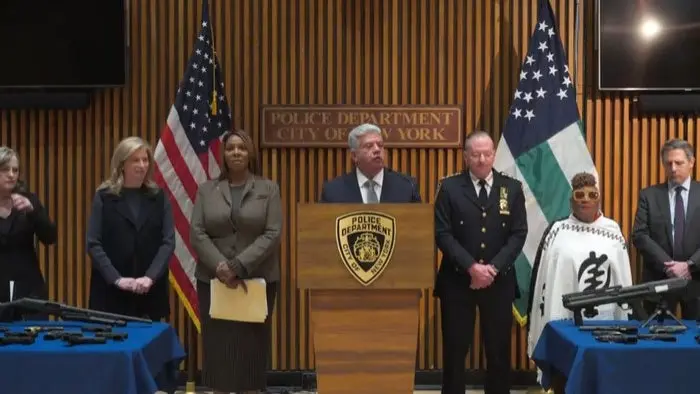
It was supposed to be a routine press conference in Manhattan—a chance for three of New York’s most powerful elected officials to stand shoulder to shoulder and discuss the issues of the day. But when a reporter stepped forward with a question about a scathing congressional report, the atmosphere shifted. The question was direct, uncomfortable, and aimed squarely at a controversy that had been simmering beneath the surface of New York politics for weeks. The report, released by the House Judiciary Committee, alleged that local prosecutors in the city had intentionally downgraded charges against noncitizens in order to protect them from deportation. The reporter wanted to know if Attorney General Letitia James, Queens District Attorney Melinda Katz, and Brooklyn District Attorney Eric Gonzalez had ever ordered their prosecutors to soften gun charges to keep undocumented immigrants in the country. The response was telling. Katz threw her hands up and shrugged, a gesture that spoke louder than words. James and Gonzalez stood silently, offering no immediate denial, no firm rebuttal, no indignant defense of their offices’ integrity. Instead, Katz muttered something that was almost inaudible: “Our answer couldn’t help it.” Then, before anyone could press further, a speaker redirected the room, asking for “any other on-topic questions” and briskly moving the news conference along. The moment was brief, but it captured something important: the discomfort of public officials confronted with an uncomfortable truth, or at least with an accusation they were not prepared to address head-on.
The report at the center of the controversy is a 22-page document released by the House Judiciary Committee, and it paints a troubling picture of how some of New York City’s most prominent prosecutors’ offices operate when it comes to defendants who are in the country illegally. According to the report, these offices have developed a series of practices designed to shield noncitizens from the immigration consequences of their criminal actions. The allegations are specific and detailed, and they suggest a coordinated effort to work around federal immigration law. For example, the report claims that Katz’s office in Queens employs an “Immigration Specialist” whose role is to help negotiate what are described as “immigration-safe” plea deals. These are plea agreements that are carefully crafted to avoid triggering deportation proceedings, even when the underlying conduct might clearly warrant removal. The report also alleges that prosecutors in Queens have worked to reduce past convictions, essentially rewriting history to make it easier for noncitizens to remain in the United States. This is not a small matter. When a person is convicted of certain crimes, particularly aggravated felonies or crimes involving moral turpitude, federal law requires that they be placed in removal proceedings. By downgrading charges or altering the record of what actually happened, prosecutors can effectively nullify those consequences, allowing individuals who have committed serious offenses to stay in the country without facing the legal repercussions that Congress intended.
The implications of these practices are staggering, and they go to the heart of the relationship between local law enforcement and federal immigration authorities. The House Judiciary Committee report does not just accuse individual prosecutors of being lenient; it accuses them of engaging in a deliberate, systematic strategy to undermine federal law. In one section, the report cites a 2022 memorandum from Manhattan District Attorney Alvin Bragg that allegedly instructed prosecutors to seek dispositions that would avoid deportation consequences for all misdemeanors and non-carceral felonies. That means that even when a defendant had committed a crime serious enough to warrant jail time, prosecutors were told to find ways to resolve the case that would not trigger immigration enforcement. The report also describes training programs in the Bronx, under District Attorney Darcel Clark, that teach prosecutors the art of “Immigration-Conscious Plea Bargaining.” This is not just about being aware of immigration consequences; it is about actively using that knowledge to shape outcomes. Prosecutors are trained to offer non-deportable offenses, to avoid aggravated felony charges, and even to use hypothetical or “legally impossible” charges—such as “attempted reckless assault”—which lack the legal intent requirements that would make them valid. In other words, they are creating fictional crimes in order to secure convictions that look good on paper but have no real legal substance, all in the name of protecting the defendant from deportation.
Perhaps even more disturbing are the allegations about how prosecutors handle the details of criminal cases. According to the report, prosecutors were instructed to omit critical information from official conviction records. This could mean leaving out the fact that a weapon was involved in a crime, that the victim was a domestic partner, or that the victim was a minor. These details are not incidental. They are often the very factors that elevate a crime from a minor offense to a serious one, and they are also the factors that federal immigration authorities rely on to determine whether someone should be removed from the country. By stripping these details from the record, prosecutors can make a violent crime look like a minor infraction, effectively hiding the true nature of the offense from immigration judges and federal officials. The report’s findings are so alarming that the Department of Justice has opened an investigation into a Soros-backed district attorney accused of shielding illegal immigrants from consequences. This is not a partisan talking point; it is a matter of federal law being circumvented by local officials who have taken it upon themselves to decide who should and should not face deportation.
After the press conference, a spokesperson for Katz’s office reached out to the New York Post to deny that leniency is ever shown in weapons cases. “We charge any defendant with an illegal firearm with the highest possible charge under the law,” the spokesperson said. But this denial rings hollow in light of the report’s detailed findings. If Katz’s office truly charges every illegal firearm possession with the highest possible charge, why would it need an Immigration Specialist to negotiate immigration-safe plea deals? Why would it work to reduce past convictions? Why would it engage in the kind of plea bargaining that the report describes? The contradiction between the spokesperson’s statement and the documented practices is glaring. It suggests that the denial is not a genuine rebuttal but rather an attempt to manage public perception, to reassure voters that the office is tough on crime while quietly continuing to operate in ways that undermine public safety and the rule of law. This is the kind of double-talk that erodes trust in public institutions. When elected officials say one thing in public and do another in private, it sends a message that the law is not a set of fixed principles but a flexible tool that can be bent to serve political agendas.
The broader context of these allegations is important to understand. New York City has long been a sanctuary city, meaning that local officials have chosen to limit their cooperation with federal immigration authorities. Supporters of sanctuary policies argue that they encourage undocumented immigrants to report crimes and interact with law enforcement without fear of deportation. They say that local police and prosecutors should not be forced to act as immigration agents, and that focusing on local public safety is more important than enforcing federal immigration law. These are legitimate arguments, and they have been debated in cities across the country. But what the House Judiciary Committee report describes goes far beyond non-cooperation. It describes active subversion. It describes prosecutors using their discretion not to protect public safety, but to protect individuals from the legal consequences of their actions. There is a difference between declining to ask someone about their immigration status and deliberately crafting fake charges to keep a violent offender in the country. There is a difference between refusing to honor a detainer request and omitting the fact that a gun was involved in a crime so that a convicted felon can avoid deportation. The former is a policy choice; the latter is an abuse of power. And it is that abuse of power that the report seeks to expose, and that the officials at the press conference seemed so reluctant to address.
What does this mean for the people of New York? It means that when they hear about a defendant being charged with a crime, they cannot be sure that the charge reflects the reality of what happened. It means that when a prosecutor announces a conviction, the public cannot trust that justice has been served. It means that victims of crimes, particularly victims of domestic violence and crimes against children, may see their abusers walk free or avoid serious consequences because prosecutors have decided that the abuser’s immigration status is more important than the victim’s right to justice. It also means that the federal government, which has a responsibility to enforce immigration laws, is being actively obstructed by local officials who have taken an oath to uphold the law. This is not a theoretical concern. The report cites real cases, real memoranda, and real training programs. It names specific offices and specific practices. And it comes at a time when the Department of Justice is already investigating similar allegations in other jurisdictions. The question is no longer whether these practices exist; the question is what will be done about them.
In the end, the moment at the Manhattan press conference was revealing not because of what was said, but because of what was not said. When confronted with a direct question about the report, the officials did not offer a spirited defense of their policies. They did not explain why they believed their actions were justified. They did not point to specific cases where they had protected public safety while also showing compassion for noncitizens. Instead, they shrugged. They looked uncomfortable. They tried to change the subject. That is not the behavior of people who believe they have done nothing wrong. It is the behavior of people who have been caught, or at least people who know that the questions being asked are questions they do not want to answer. The report from the House Judiciary Committee is just a document, but it has the power to force a conversation that many elected officials would prefer to avoid. It is a conversation about the rule of law, about the limits of prosecutorial discretion, and about the responsibilities of those who hold public office. It is a conversation that the people of New York, and indeed the people of the entire country, deserve to have. The officials at that press conference may have wanted to move on to other topics, but the questions raised by the report are not going away. They are only going to get louder, and the public will demand answers that are more honest than a shrug and a muttered phrase.