


It was supposed to be a completely normal, low-stakes evening of family bonding at the Lucky Strike bowling alley in St. Peters, Missouri. The air inside the venue was thick with the familiar, comforting symphony of crashing bowling pins, the retro synth-beeps of flashing arcade games, and the joyful chatter of local families enjoying a weekend escape. Among the crowd was Officer Brown, a dedicated veteran of the St. Charles County Police Department, who had happily shed his heavy tactical vest, badge, and duty weapon for the night to simply enjoy being a husband and father. Off-duty hours are precious commodities for law enforcement officers, serving as a rare sanctuary where they can decompress from the constant state of vigilance required by their high-stress careers. But as any seasoned public servant will tell you, the instinct to protect and serve is not a physical switch that can be easily turned off; it lingers quietly in the background of their minds, waiting to be triggered at a moment’s notice. On this particular evening, amidst the neon glow of the arcade section, Officer Brown’s sharp eyes caught sight of a bizarre situation that immediately put his paternal instincts and tactical training to an unexpected, pint-sized test. What began as a standard night of bowling rapidly transformed into an unforgettable community rescue mission, proving once again that a guardian’s watch never truly ends, even when surrounded by bowling shoes and arcade tokens.
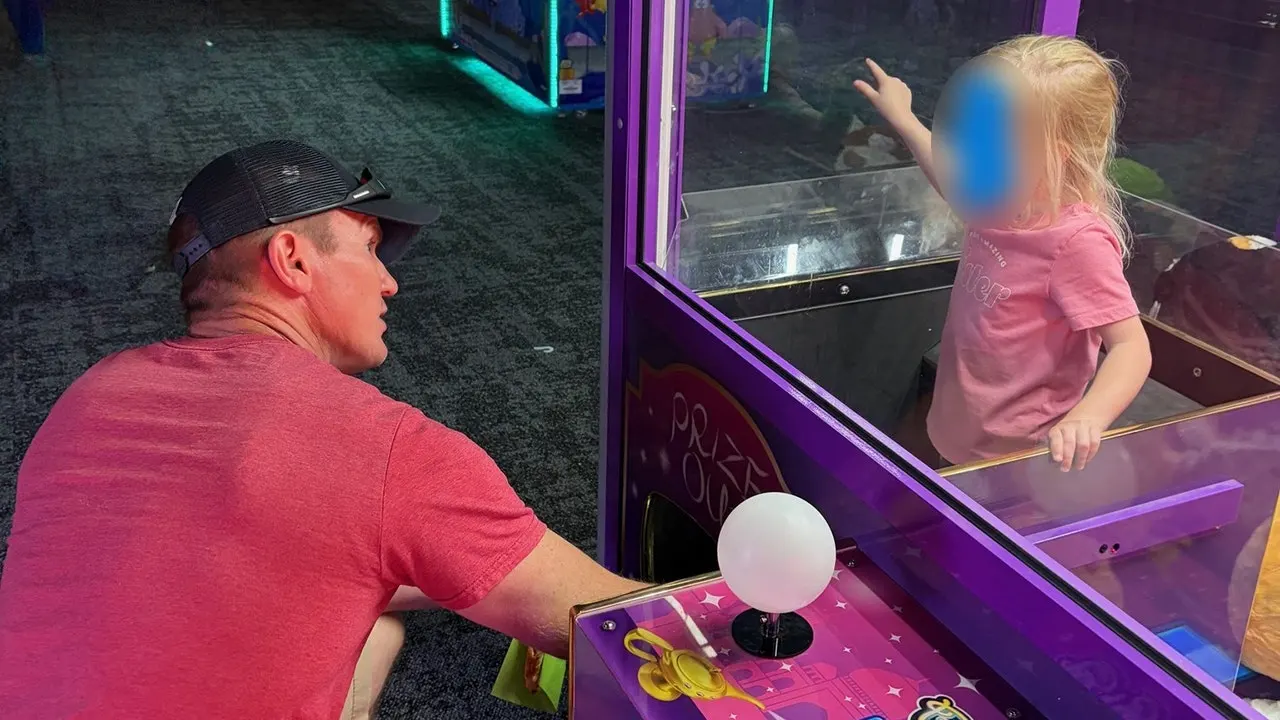
Peering through the crowd toward a flashing claw machine—a notoriously stubborn arcade staple beloved by children and lamented by parents—Officer Brown noticed something that was definitely not on the inventory list of plush prizes. Inside the glass box, huddled right in the prize-delivery chute, was a very young, very curious little girl who had somehow managed to defy the laws of physics and facility security to climb into the machine. Children possess an almost supernatural ability to slip into tight, seemingly inaccessible spaces when left to their own adventurous devices, and this toddler had clearly viewed the prize dispenser as a magical portal to a stuffed-animal wonderland. She was now trapped, staring out from behind the thick glass like a living plush doll, surrounded by bright lights and unreachable toy prizes. While the situation could have easily spiraled into a panic-inducing emergency for the child’s parents, the whimsy of the setting and the sheer absurdity of the predicament cast an air of lighthearted disbelief over the gathering crowd. Bystanders watched with wide eyes and hushed whispers, wondering how on earth they were going to extract the tiny explorer without breaking the glass, calling the fire department, or causing the child any distress. It was a bizarre, real-life puzzle that required immediate action, creative thinking, and a remarkably calm demeanor.
Recognizing that a delicate touch was required to resolve this unusual crisis without causing a scene or damaging the venue’s property, Officer Brown immediately stepped up to the plate. Armed with nothing more than a pocketful of quarters—totaling about four dollars—and a reservoir of patience, the veteran officer prepared to wage a playful yet determined battle of wits against the stubborn arcade machine. The St. Charles County Police Department would later playfully describe this high-stakes intervention on social media as an intense conflict of skill, nerve, and aggressive “button mashing” against a “nefarious arcade device.” Brown approached the console not with the stern authority of a police officer making an arrest, but with the warm, reassuring demeanor of a father who understood exactly how to keep a child calm in a scary moment. He spoke gentle words of reassurance through the glass and the prize slot, keeping her focused on his face rather than her confined surroundings. Meanwhile, he meticulously fed quarters into the slot, putting on a heroic display of claw-operating acrobatics in an attempt to manipulate the internal mechanisms, open the prize door fully, and find a safe, non-destructive way to physically access and extract her.
After a brief but incredibly tense sequence of mechanical maneuvering and gentle encouragement, the breakthrough finally arrived. Drawing upon his physical coordination and steady hands, Officer Brown managed to maneuver around the prize-deposit door, carefully reaching into the plastic chute where the little girl had squeezed herself. With a gentle but firm grip, he guided her tiny limbs back down through the narrow, swinging plastic flap, carefully coaxing her out of the machine’s belly and back into the open air of the bowling alley. When her feet finally touched the carpeted floor, safe and completely unharmed, a collective sigh of relief and warm laughter swept through the small crowd of onlookers who had gathered to witness the odd spectacle. The little girl, perhaps a bit dazed by her brief stint as an un-winnable arcade prize but largely unfazed by the drama, was instantly wrapped in the comforting, emotional embrace of her incredibly grateful family. It was a beautiful, human moment that highlighted how the smallest acts of kindness and quick thinking can instantly defuse a potentially terrifying situation, turning what could have been a traumatic memory into a charming family anecdote that will undoubtedly be retold at Thanksgiving dinners and family gatherings for decades to come.
Once the excitement had settled and the grateful family had been reunited to enjoy the rest of their evening, Officer Brown did what true community heroes do best: he quietly stepped out of the spotlight and went back to his life. Without waiting for a grand parade, demanding manager assistance, or seeking immediate accolades, he calmly returned to his own family’s bowling lane, picking up his ball as if he hadn’t just conducted a high-stakes, off-duty rescue operation. He went on to bowl a thoroughly respectable, if delightfully average, score of 96—a score that his department proudly shared as evidence of his effortlessly cool, unpretentious demeanor under pressure. This humble return to normalcy perfectly encapsulates the spirit of local law enforcement officers, where the line between being a cop and being a helpful neighbor is beautifully blurred. Brown didn’t see the rescue as an extraordinary feat of heroism, but rather as just another moment where someone in his community simply needed a helping hand, proving that a true guardian is always on duty, even when their only goal for the night was to get a strike on a Friday evening with their loved ones.
When the St. Charles County Police Department later shared the story on social media, complete with the playful title of “claw and order,” it quickly went viral, capturing the hearts of thousands who appreciated the lighthearted break from typical, heavy news cycles. The incident serves as a gentle, humanizing reminder of the people behind the badges—men and women who live, play, shop, and raise their own children in the very communities they are sworn to protect. It shows that police officers are deeply woven into the fabric of everyday American life, ready to tackle everything from serious neighborhood safety concerns to the whimsical rescue of a toddler who loved stuffed animals just a little too much. In a world that can often feel chaotic, divided, and overwhelmed by complex issues, the story of Officer Brown, his four dollars in quarters, and a trapped little girl at a bowling alley shines brightly as a heartwarming testament to the power of community, everyday heroism, and the enduring readiness of those who serve. It reminds us all that sometimes the greatest acts of public service don’t involve sirens, flashing lights, or dramatic chases, but rather a pocket full of change, a gentle smile, and a willingness to help.