





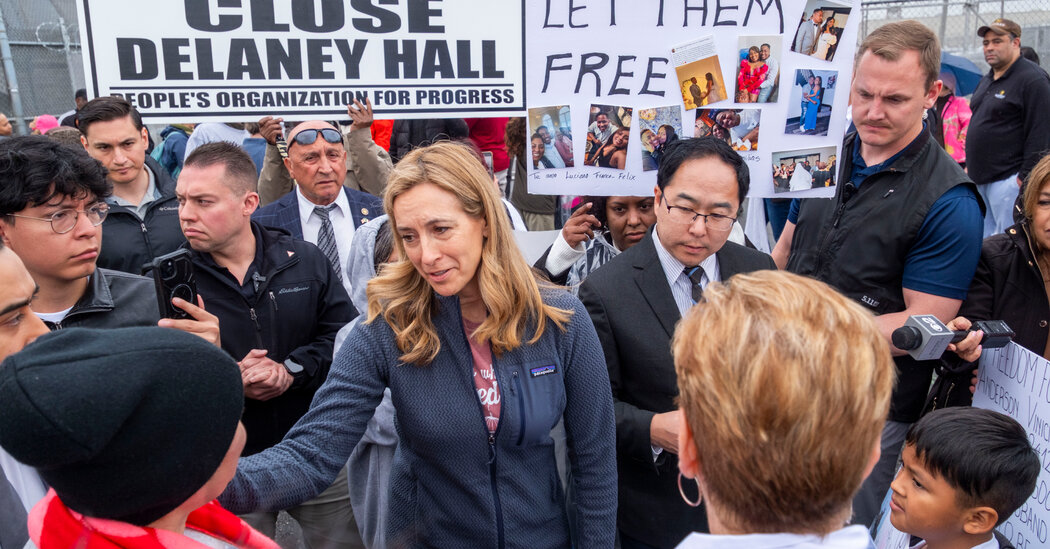
Under the scorching mid-afternoon sun of a tense and emotionally raw Memorial Day in Newark, the stark, gray cinder-block walls of Delaney Hall detention center loomed like a concrete fortress of silence, but outside, the heavy summer air vibrated with a visceral, unmistakable human agony. This drab outpost of concrete, security cameras, and razor wire became the stage for a desperate stand as family members, community advocates, and prominent political figures gathered in solidarity with the hundreds of invisible, suffering souls inside who had embarked on a perilous hunger strike. Among the swelling crowd was New Jersey Governor Mikie Sherrill, a Democrat whose tenure has been increasingly defined by a fierce, public friction with the Trump administration’s draconian immigration enforcement policies. Dressed in basic, understated clothes—a faded T-shirt, blue jeans, and a simple blue-gray jacket—Sherrill stood not merely as an elected official representing her state, but as a direct, deeply affected witness to the profound heartbreak of her constituents. The scene surrounding her was a chaotic sensory barrage: the relentless, rhythmic thrumming of protest drums, the ocean of hand-painted cardboard signs pleading for mercy, and the visceral, throat-raw chants of “Free Them All!” echoing violently against the impenetrable gray facility. As she moved through the packed ranks of the demonstration, she was immediately confronted by weeping mothers, anxious siblings, and terrified children whose family units had been completely fractured by the sudden, aggressive detention of their loved ones. At one poignant moment, the political theater stripped away completely, revealing the basic, tender human core of the crisis as Governor Sherrill paused to rest a comforting, steady hand on the trembling shoulder of a sobbing relative, before gently smoothing the hair of an visibly shaken child. Confronted by their raw grief, she shared her own deep frustration with the crowd, revealing that she had formally requested entry into the detention center to inspect the conditions herself, but had been flatly denied by federal authorities. “No matter what your immigration status is, you shouldn’t be treated with anything less than dignity in this country,” she told the gathering storm of protesters, her voice carrying a mixture of resolve and grim acknowledgment of the towering legal and physical barriers separating the street from the cells inside.
The roots of this desperate confrontation lay in a collective, silent rebellion that had begun days earlier on Friday, when detainees inside the facility launched a coordinated hunger and labor strike to protest their rapidly deteriorating living conditions, choosing to starve themselves as a final, desperate cry for help. Their demands were fundamental to basic human survival and dignity: a thorough, independent federal investigation into the facility’s operations, a face-to-face meeting with Governor Sherrill to secure formal protections from Immigration and Customs Enforcement (ICE), and an immediate end to systemic neglect that had turned their daily lives into a struggle for survival. Behind the walls, according to advocates, the conditions had deteriorated into a stomach-churning reality of rancid, molded food, lack of running water, and near-total medical abandonment that left many to suffer in silence. While Governor Sherrill faced heavy criticism and angry, frustrated shouts from some protesters who berated her for not showing up earlier in the weekend, other leaders had already embedded themselves deeply in the struggle. United States Representative Rob Menendez of New Jersey had arrived at the heavy gates at eight o’clock on Sunday evening, keeping a grueling, all-night vigil on the cold asphalt until he was finally granted entry into the facility on Monday morning. Upon emerging, Menendez painted a devastating picture of the misery festering inside Delaney Hall, detailing conversations with detainees that laid bare the sheer, grinding inhumanity of their confinement. He spoke of a young, terrified woman whose only dream was to be released in time to walk across the stage at her high school graduation; a pregnant woman frantically seeking basic obstetric care for her unborn child; and a man who showed him a carton of sour, spoiled milk that had gone rancid in the summer heat. “I heard just desperation from so many people in there,” Menendez recounted afterward, his voice heavy with the burden of what he had witnessed, highlighting a system where even the absolute bare minimum of nutritional and medical sustenance is routinely withheld from those awaiting legal processing.
Of all the agonizing pleas representing the human cost of the standoff, few were as sharp and terrifying as the story of Bolivar Bueno, a sixty-five-year-old grandfather battling severe diabetes inside the locked complex, whose medical vulnerability stood as a chilling example of the facility’s systemic apathy. His cousin, Angela Martinez, stood before Governor Sherrill at the protest, her face lined with the deep exhaustion of sleepless nights and relentless worry. Angela pleaded with the governor, explaining that because of the administrative blackout imposed by the facility, she had been completely cut off from communicating with her cousin, leaving her in an agonizing state of ignorance regarding his health. With the strike in full swing and food being refused, the danger for a senior citizen dependent on regular insulin doses and consistent nutrition is immediate, turning a hunger strike into a ticking clock of survival. “We don’t know what’s going on,” Angela told Sherrill in a voice trembling with fear, desperately searching for some sliver of reassurance that her cousin was not slipping into a diabetic coma behind those mute gray walls. The silence of the detention center felt like a deliberate weapon, designed to break the spirits of the families waiting on the outside just as effectively as the physical confinement broke those on the inside. Afterward, as the governor’s security detail began clearing a path for her departure, Angela watched the black SUV slowly pull away, her eyes still searching for a promise of action. “I want for her to help me out,” she whispered, crystallizing the quiet, heartbreaking hope of hundreds of families who find themselves entirely powerless in the face of a massive, unyielding federal bureaucracy that treats human beings as administrative numbers.
The tenuous peace of the morning fractured rapidly after Governor Sherrill’s departure around mid-morning, as a toxic mixture of anger and panic swept through the crowd of demonstrators. When some protesters attempted to block the governor’s vehicle, her security detail was forced to physically clear the path, signaling a sharp escalation in the day’s volatile energy and setting the stage for a much more confrontational afternoon. A few hours later, a frantic alarm rippled through the protest lines when a convoy of heavy, tinted ICE vehicles was spotted approaching the facility’s southern entrance. Fearing that immigration agents were preparing to secretly transfer the hunger-striking detainees to distant facilities to break their resolve and isolate them further from their families, dozens of protesters ran from the north gates, throwing their bodies onto the hot pavement directly in front of the oncoming vehicles. What followed was a raw, chaotic display of physical force: masked ICE agents, their faces obscured to maintain anonymity, moved in with aggressive pushes and shoves, dragging protestors across the concrete. In one particularly jarring moment of violence, agents seized a young man by the traditional kaffiyeh wrapped around his neck, pulling him roughly across the asphalt. Refusing to yield to the intimidation, the protesters linked their arms tightly together, their voices rising in a defiant, collective chorus of “Trump Has To Go” as they stared directly into the eyes of the armed federal officers, creating a human wall that completely paralyzed the southern exit of the detention center.
The standoff quickly escalated from a local civil dispute into something resembling an active combat zone when a massive, military-style armored vehicle rolled toward the southern entrance, carrying a masked federal officer perched on top who pointed an assault weapon directly at the unarmed crowd. The sheer asymmetry of power on display—assault rifles and armor deployed against citizens demanding human rights—shocked onlookers and drew New Jersey Senator Andy Kim out of the building to intervene. Kim, a Democrat known for his calm, methodical approach to crisis, had been inside inspecting the conditions of Delaney Hall when the violence erupted; he immediately rushed into the fray, positioning his own body between the hostile federal forces and the terrified protesters in a desperate bid to broker a peace. For a brief, agonizing moment, his mediation seemed to work, as the military vehicle and the phalanx of ICE agents fell back slightly toward the interior of the detention compound, though the underlying tension remained at a breathless, hair-trigger high. “They provoked it, they brought that tank over,” an exasperated Senator Kim told reporters on the scene, his garments stained and his face reflecting the heavy toll of the escalating conflict. “It’s getting worse and worse here.” Tragically, his efforts to restore calm were brutally shattered when ICE agents suddenly unleashed a barrage of pepper balls and tear gas into the tightly packed crowd, sending a chemical cloud over the street that left protesters, advocates, and lawmakers like Kim himself gasping for air, their eyes burning and their skin blistering in the humid afternoon heat.
This violent confrontation outside Delaney Hall was not an isolated flashpoint, but rather the latest, bloodiest chapter in a long, troubled history of systemic abuse and community resistance surrounding the controversial Newark facility. Just under a year earlier, in June 2025, the detention center had been rocked by days of intensive internal unrest over wretched, sporadic meals and severe overcrowding that forced many detainees to sleep directly on the cold concrete floors, culminating in a daring escape of four desperate men who had smashed through reinforced windows, doors, and security cameras to claw their way to freedom. The facility had also become a political battleground for local leaders; Newark Mayor Ras J. Baraka, a fierce opponent of the federal government’s immigration dragnet, had famously been arrested outside these exact gates in May 2025 during his own physical confrontation with ICE agents over the treatment of his constituents. As the chemical smoke cleared on Monday evening, leaving a trail of discarded banners, tear gas canisters, and weeping families on the pavement, the fundamental crisis remained entirely unresolved inside the gray, silent fortress. The hunger strike continued behind the razor wire, a silent testament to the enduring human spirit that refuses to be broken by cages, while outside, raw and determined, the community vowed to keep fighting for the basic dignity of their loved ones, proving that the struggle for human rights cannot be silenced by pepper spray, steel gates, or federal indifference.