




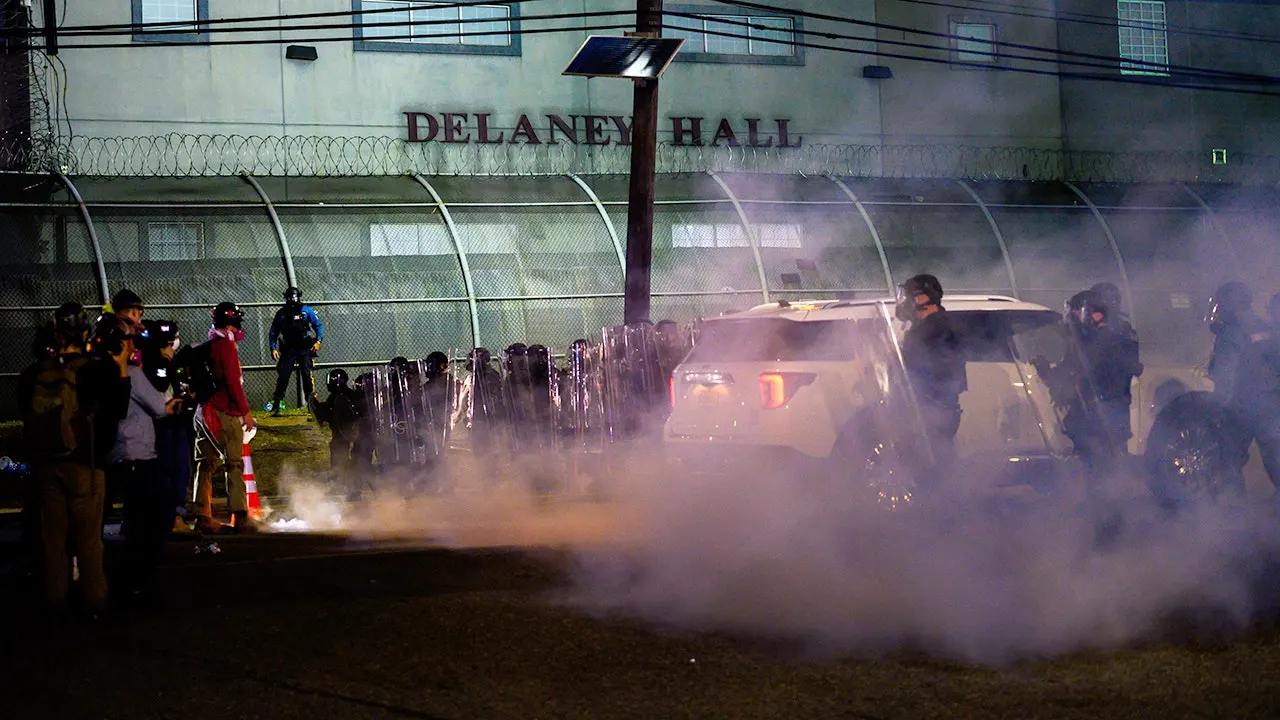
Newark, New Jersey, became the dramatic epicenter of a raw, deeply emotional clash of ideals on a tense Friday night, as the streets outside the Delaney Hall detention facility erupted into a chaotic, volatile battleground of human wills. Under the cold glare of flashing emergency lights, the boundary between peaceful democratic assembly and violent physical confrontation dissolved into a disorienting, toxic haze of smoke, tear gas, and raw, desperate human shouting. This explosive atmosphere had been building for seven long, exhausting days, fueled by a deeply personal and ideological crusade against federal immigration enforcement that brought the community’s underlying anxieties to a boiling point. On one side of this divide stood a highly organized, passionate group of demonstrators who saw themselves as a vital, compassionate human shield for vulnerable migrants held within the detention facility; on the other stood weary state law enforcement officers, caught in the middle of a systemic firestorm and tasked with maintaining a fragile peace under immense, unforgiving public pressure. The visceral human element of this standoff was palpable in the thick tension that hung in the air, felt in every shouted slogan, every nervous breath, and every defensive line formed by police officers holding heavy riot shields. When a State Police trooper’s voice crackled through a megaphone, instructing the assembly to relocate to a designated “First Amendment zone” for their own security, the command was not received as a protective gesture. Instead, to the ears of the frustrated, emotionally charged crowd, it sounded like an oppressive attempt to marginalize their voices and sweep their protest out of public sight. The crowd’s defiant response—”We will not, we will not, I’m expressing my First Amendment right here”—symbolized a profound, systemic breakdown in trust between the public and the authorities, setting the stage for an inevitable, destructive physical clash that would leave the community deeply scarred and the nation questioning where the boundaries of free speech truly lie.
As the hours wore on and the heavy darkness deepened, the stubborn refusal to yield escalated into a physical confrontation of terrifying proportions, highlighting the raw, physical toll of civil unrest on both sides of the skirmish line. State Police tactical units, including officers mounted on horseback whose commanding presence was meant to deter violence, were eventually ordered to deploy heavy riot control measures to disperse a crowd that had grown increasingly adversarial and unyielding. The silence of the Newark night was violently shattered by the deafening, disorienting blasts of noise bombs, accompanied by the blinding, choking irritation of tear gas grenades and pepper spray that saturated the humid air and sent waves of panicked, coughing protesters fleeing into the darkness. In the midst of this sensory nightmare, the very physical structures intended to keep the peace became improvised weapons of defense and division. Metal barriers that police had meticulously erected earlier in the afternoon to delineate the safe, designated demonstration zone were quickly commandeered by angry rioters, who dragged, tipped, and threw them to construct makeshift barricades and defend their positions against the slowly advancing wall of state troopers. For the individuals caught in the eye of this storm—whether they were passionate young activists suddenly gasping for clean air and dousing their eyes with milk, or police officers sweating behind heavy riot helmets, enduring a barrage of projectiles—the conflict was a grueling, terrifying test of basic physical and mental endurance. The scene quickly degenerated into a chaotic, terrifying blur of stampeding boots, thick chemical mist, and the frantic cries of those overwhelmed by the kinetic force of the dispersing tactics, vividly illustrating how quickly high-minded political disagreement can devolve into raw, survival-driven desperation on the hard, unyielding concrete of an American city.
The political fallout from this explosive night was swift, fierce, and deeply polarizing, centering on the figure of New Jersey Governor Mikie Sherrill, who found herself walking a highly precarious and intellectually dizzying political tightrope in the immediate aftermath. New Jersey, which operates under strict sanctuary state guidelines that severely limit cooperation between local law enforcement and federal immigration authorities, became a highly visible national theater for a larger conflict over sovereignty, human rights, and federal authority. Taking to the social media platform X on Saturday morning, Governor Sherrill addressed her anxious, divided constituency by framing the crisis through a lens that shocked many observers and law enforcement advocates. In her public statements, she chose a rhetorically provocative path, pointing the finger of blame for the violent eruption not at the rioters who had vandalized property and ignored police orders, but at the impending presence of federal Immigration and Customs Enforcement (ICE) agents. Sherrill argued passionately that an increased ICE surge in the area surrounding Delaney Hall constituted a visceral threat to public safety, writing that lives would have been put at unacceptable risk had federal forces been allowed to expand their footprint without local resistance. She defended the state police’s aggressive tactics as an absolute, tragic necessity to protect the community and proactively prevent any escalation or overreach from federal agents on state soil. This extraordinary, highly debated political stance illuminated the deeply agonizing human and systemic divisions inherent in modern American governance, wherein a state executive feels compelled to justify the deployment of tactical riot police against her own citizen-protesters as a defensive maneuver to ward off federal overreach, leaving local families and business owners to navigate the wreckage of a structural and constitutional tug-of-war.
Conversely, the perspective emerging from the federal government painted a radically different, highly alarming picture of the very same events, focusing intently on the immediate physical danger and psychological trauma faced by individual law enforcement officers on the front lines. Representatives from both ICE and the Department of Homeland Security (DHS) stepped forward to express profound, public gratitude toward the New Jersey State Police, praising their intervention as a vital, stabilizing partnership that successfully restored order in a moment of near-anarchy. According to federal accounts, ICE officers on the ground had been subjected to harrowing, dangerous acts of personal violence during the demonstrations, with reports arriving of agents being brutally bitten, receiving explicit death threats, and enduring relentless physical assaults from what they categorized as a highly dangerous, radicalized mob. This federal narrative sought to remind the public of the vulnerability of the individual men and women behind the badges, who are often viewed by angry crowds as faceless, unemotional symbols of state policy rather than human beings trying to survive a hazardous shift. Furthermore, DHS attempted to directly counter popular narratives surrounding the detainees secured inside Delaney Hall. While protesters shouted slogans condemning the facility as a site of cruelty and systemic abuse, federal spokespeople insisted that the inmates were treated humanely, well-fed, and even compensated fairly for work programs they participated in. DHS emphasized that most of these detainees were not merely undocumented immigrants, but individuals who had gone on to commit additional crimes in the communities they lived in, introducing a messy, challenging layer of moral and legal complexity to the protesters’ unified outcry of pure injustice. This stark contrast between federal security mandates and local sanctuary ideals highlights how easily the human lives caught in the middle—both the officers and the detainees—are translated into political talking points while their physical safety is hung in the balance of a fractured bureaucracy.
Beyond the grand political posturing and the fierce rhetorical warfare, the sheer logistical scale and human dedication of the anti-ICE protest network revealed a deeply entrenched, highly organized civil action that had been carefully sustained for over a week. This was far from a spontaneous gathering of casual, disorganized malcontents; rather, it was a highly sophisticated mobilization of resources designed to support a prolonged, difficult siege of public attention. Just outside the primary friction point, organizers had erected a fully stocked mutual-aid station, featuring large shelter tents overflowing with thousands of plastic water bottles, energy bars, basic medical kits, and gallons of milk used to neutralize the agonizing burn of pepper spray. The existence of this makeshift supply depot illuminated the profound sense of solidarity, empathy, and collective care that bound the demonstrators together, highlighting their willingness to endure cold nights, physical exhaustion, and the imminent threat of state violence in defense of those they believed were voiceless. Yet, this display of communal warmth and altruistic passion stood in stark, heartbreaking contrast to the destructive, raw violence that ultimately engulfed the Newark neighborhood. By the time the dust settled on Friday’s midnight clashes, the lofty ideals of humanitarian protection and mutual aid were visually overshadowed by the grim, violent reality left in their wake: shattered car windows, dented municipal vehicles, and asphalt heavily stained with chemical residues. This stark physical wreckage serves as a painful reminder of the tragic paradox of radical activism, where the desperate pursuit of human dignity for an unseen population can occasionally lead to the immediate terror, property destruction, and disruption of the lives of local, working-class residents who simply happen to live in the crossfire of someone else’s war, ultimately raising hard questions about the true cost of social change.
As Saturday morning finally dawned over the city of Newark, the tangible, smoky scars of the previous night’s dramatic conflict hung heavily in the cold air, presenting a somber, silent backdrop for a battered urban community trying to gather its bearings amid a fragile, deeply uneasy peace. Though the physical debris of broken glass and discarded barriers was slowly swept away, the psychological and social fractures within the neighborhood felt more pronounced and permanent than ever before. This division was immediately catalyzed on Saturday morning by the arrival of an even larger, more intimidating phalanx of state and local police officers, coupled with a powerful new human variable: the arrival of counter-protesters. Vocal groups of citizens carrying pro-ICE signs, American flags, and banners supporting law enforcement converged on the sidewalk directly opposite the remaining anti-ICE demonstrators, creating an electric atmosphere thick with visceral, face-to-face animosity. The human pain on display was no longer confined to the legal status of the detainees inside Delaney Hall, nor to the physical injuries of the night before; instead, it blossomed into a profound, heartbreaking realization of the unbridgeable chasm between ordinary citizens who hold entirely irreconcilable visions of national identity, security, and human empathy. To one half of the crowd, the federal agents and state troopers were heroic protectors keeping their families safe from dangerous elements; to the other half, they were the cold mechanism of a heartless system designed to separate families and suppress free speech. As these two passionate factions stared each other down across a heavily policed line of division, Newark became a vivid, sobering microcosm of the wider national struggle, proving that when complex human crises are reduced to binary battlegrounds, the casualties are often local peace, mutual understanding, and the shared fabric of a community.