

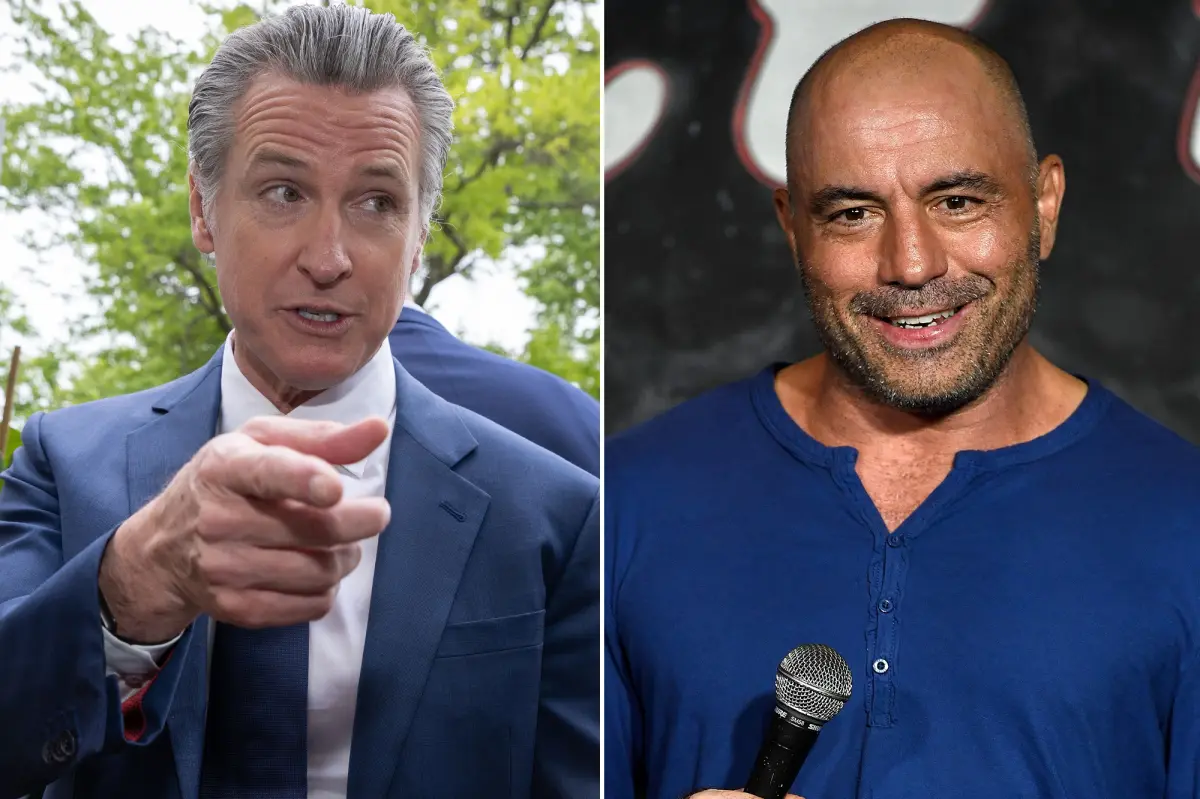
In the vibrant, chaotic world of politics and pop culture, where celebrity clout often clashes with governmental authority, few rivalries have captured public imagination quite like the ongoing beef between California’s Governor Gavin Newsom and podcasting titan Joe Rogan. It’s like watching two alpha wolves from different packs circle each other in a digital arena, each taking playful but sharp swipes that keep fans and detractors alike glued to their screens. Newsom, a polished politician with a knack for theatrical flair, found himself taking to social media in what could only be described as a unhinged, cathartic outburst, targeting Rogan for his perceived cowardice in a way that echoed the bombastic style of a certain former president. Imagine sitting around a campfire, sharing stories of old arguments, only for one party to suddenly stand up and challenge the other to a showdown; that’s the raw human drama unfolding here. Rogan, with his relaxed, everyman persona and massive audience, had long ago criticized Newsom in a way that hit personal nerves, labeling him as something less than authentic. This wasn’t just about policy disagreements; it felt like a clash of egos, where Newsom, ever the showman, couldn’t resist escalating the banter into something public and viral. People on both sides of the aisle watched with popcorn, wondering if Rogan would ever throw down the gauntlet, but for now, the podcaster’s silence spoke volumes about his strategic retreat from the fray. In this heated exchange, we see the human side of public figures—flawed, passionate, and prone to letting emotions boil over into social media tirades that blur the lines between official statements and personal vendettas. It’s a reminder that behind the titles and platforms, these are individuals navigating fame, power, and the constant scrutiny of the court of public opinion, where every post or episode can turn into a viral moment that defines reputations for years to come.
Diving deeper into the backstory, Rogan’s initial broadside against Newsom back in August 2023, during one of his legendary Spotifymp3 show episodes, wasn’t just a casual chat; it was a scathing takedown that painted the governor as a cardboard cutout of a person, lacking the genuine spark that real leaders possess. Picture Rogan leaning into his mic, his voice a mix of disbelief and frustration, as he recounted Newsom’s actions that struck him as hypocritical or contrived—from pushing unnecessary vaccine mandates for kids in California to that infamous incident where the governor was spotted maskless in a public setting, only to defend it with what Rogan saw as transparent excuses. “Nobody believes in that guy,” Rogan exclaimed, his tone echoing the sentiments of everyday folks who feel jaded by politicians, drawing parallels to figures like Donald Trump, whom he described as flawed yet undeniably human. “Whether you like him or not, he’s a real person,” Rogan contrasted, but with Newsom, it was like staring at a puppet controlled by unseen strings, a “stone-cold narrative-driven politician” who prioritizes image over authenticity. This wasn’t Rogan’s first foray into political commentary; his podcast often serves as a sounding board for diverse opinions, but when it comes to Newsom, the criticism cut deep, resonating with listeners who view the governor as out of touch. Rogan elaborated on how Newsom’s policies, like those mandates, seemed disconnected from the lived realities of families, potentially alienating parents who felt their choices were undermined. There’s a personal angle here too—if Rogan saw Newsom as a con man, it might stem from his own background in comedy and mixed martial arts, where honesty and grit are prized, making the governor’s polished demeanor seem even more suspect. This critique wasn’t just words; it tapped into broader cultural currents of distrust in leadership, where ordinary people crave leaders who feel approachable, not like manufactured spokespeople. Rogan’s delivery, peppered with profanity and raw emotion, made it clear this was more than debate—it was a gut reaction to someone he saw as emblematic of political phoniness. In humanizing terms, Rogan isn’t just a commentator; he’s channeling the frustrations of millions who feel betrayed by leaders who don’t own their mistakes, turning what could be quiet dissatisfaction into a public declaration that lingers in listeners’ minds long after the episode ends.
Then came Newsom’s fiery response, orchestrated through his press office on X, that explosive social media platform where tempers run hotter than a California wildfire. Crafted in all-caps like a Trump-era tweet storm, the message read like a challenge letter from an old Western, declaring Rogan as “JOE ‘LITTLE GUY’ ROGAN” who’s too cowardly to face off on his “failing podcast,” preferring instead to lob insults from the cheap seats of public opinion. “ALL TALK, NO ACTION,” it blared, with Newsom inviting Rogan to step up or keep hiding, a direct jab that flipped the script and positioned the governor as the bold underdog ready for a showdown. Posted on May 1, 2026, this wasn’t just a defensive retort; it was a calculated escalation, designed to humanize Newsom as someone weary of being maligned without a chance to defend himself. Think about it from his perspective: as a sitting governor, Newsom’s plate is filled with policy battles, economic woes in a state prone to disasters, and the constant glare of the media, yet he’s taking time to engage in this banter, revealing a vulnerable side under the veneer of invincibility. The tweet, signed off from his press office but in his unmistakable voice, captured that unhinged energy—perhaps born from late nights ruminating over Rogan’s words, or a genuine irritation that bubbled over into public spectacle. It humanized the governor as someone not above pettiness, showing flashes of the same passion that fuels his environmental crusades or infrastructure pushes, but diverted here into personal feud. For followers, it was entertaining theater, but beneath it lay a strategic ploy to boost visibility, reminding voters of Newsom’s charisma and willingness to stand his ground. In a time when public figures are often portrayed as robots, this outburst painted Newsom as fiercely human, imperfect, and unmistakably engaged in the cultural zeitgeist, where podcast duels can rival presidential debates in impact.
Expanding on Rogan’s detailed grievances, which still sting in the annals of this feud, we see a picture of a man dissecting Newsom’s tenure with the precision of a biologist examining a specimen. Back in that August episode, Rogan didn’t hold back, calling out the vaccine mandates as “totally unnecessary,” painting a scenario where parents felt dictated to by a government that overlooked personal freedoms. The mask incident, where Newsom was photographed outdoors sans mask during the height of the pandemic yet rationalized it, was dubbed outright lying, eroding trust in a way that Rogan likened to a magician’s sleight of hand. “Everything he did in California” was critiqued as part of a larger narrative, where Newsom appeared as a strategist more concerned with optics than outcomes, alienating communities who felt the weight of decisions made from afar. This humanized Rogan not as a mere entertainer, but as a voice for the disenfranchised—someone who’s heard countless stories from guests and listeners about the real impacts of such policies, from families quarantined unnecessarily to businesses shuttered. He contrasted Newsom with Trump, describing the former president as erratic yet palpably real, a “human being” with warts and all, versus Newsom’s “cardboard cutout,” a metaphor that evoked images of a prop in a high school play, stiff and scripted. Rogan’s delivery wasn’t cold; it was infused with the empathy of someone who’s wrestled with societal issues himself, drawing from his own experiences in health and wellness—where mandating vaccines for kids might overlook nuanced debates on immunity or parental rights. This critique wasn’t ideological; it was experiential, tapping into the frustrations of ordinary Californians who watched Newsom navigate crises like wildfires or homelessness with what seemed like performative depth. In human terms, Rogan embodies the everyman skeptic, questioning authority not out of spite, but from a place of genuine concern, making listeners feel validated in their doubts. This exchange underscores how public criticism can forge connections, turning private irritations into shared narratives that challenge power structures.
Echoing through the corridors of time, Newsom’s prior frustrations with Rogan bubbled up in earlier interviews, adding layers to this evolving saga of wounded pride and unfulfilled invitations. Appearing on the YouTube show “Higher Learning” in October, a spot known for thoughtful discourse with hosts Van Lathan and Rachel Lindsay, Newsom unleashed his exasperation like a dam breaking, grousing about Rogan’s refusal to have him on the podcast. “Joe, why won’t you have me on the show?” he pleaded in a clip that teased the episode, highlighting the one-sided nature of the attacks—guests could bash him, but he wasn’t extended the courtesy of airtime. “He has guests coming on, attacking and bashing, but he won’t have me on the show. Full stop. He should have me on the show,” Newsom insisted, his voice betraying a mix of hurt and defiance. This wasn’t new; back then, Rogan had labeled him a “bulls—t artist,” a tag that lingered, prompting Newsom to air his grievances publicly. In these moments, we glimpse the governor’s human complexity—a man ambitious enough to seek higher office, yet frustrated by the gatekeeping of media moguls like Rogan, whose platform wields influence rivaling traditional outlets. From Newsom’s angle, it could feel isolating, like being the kid picked last for the team in a game of national discourse, yearning for a platform to counter narratives that paint him as inauthentic. This plea also reveals a strategic mind, using such appearances to reposition himself as the reasonable one, inviting dialogue rather than retreating. The hosts, notably Rachel Lindsay from “Bachelor” fame, likely facilitated a candid exchange, humanizing Newsom as someone relatable, given to venting over obstacles, much like anyone dealing with unfair criticism. It’s a poignant reminder that even governors grapple with ego and exclusion, their public façades cracking under the weight of unreturned invitations, turning political standoffs into stories of personal slight that resonate with audiences craving authenticity in leadership.
As this high-stakes banter simmers in the public eye, with no immediate resolution on the horizon, it prompts reflection on the broader implications for culture and politics in America. Newsom’s tweet, posted through his press office, wasn’t just a momentary lapse; it signaled a willingness to engage in the digital wild west, where leaders can joust with celebrities on equal footing, blurring lines between governance and entertainment. For Rogan, the challenge might remain unanswered, allowing him to maintain his neutral, listener-focused ethos, but it also risks relegating his criticisms to background noise if unanswered. The Post reached out to Newsom’s office for further commentary, but responses—or lack thereof—can speak volumes, leaving fans speculating on future episodes or debates. In humanizing this feud, we see it reflects deeper societal divides: Rogan’s free-spirited podcast sphere versus Newsom’s structured political world, each wielding power that influences public sentiment on vaccines, leadership authenticity, and the role of media in democracy. Could this lead to a crossover event, where Rogan invites Newsom, sparking a clash that captivates millions? Or will it fizzle, reinforcing the echo chambers of partisanship? Regardless, it underscores the messy humanity of those in power—imperfect, reactive, and driven by a mix of principle and pride. As Californians download apps, follow newsletters, and tune in to podcasts, this rivalry serves as entertainment, but also a mirror to our own frustrations with authority figures who seem constructed rather than born from the soil. Ultimately, in a landscape of viral moments and fleeting fame, both men emerge as complex characters in America’s ongoing narrative, reminding us that debates can be as spectacle as substance, and personal jabs as enduring as policy debates.
To wrap this tale of titans and tweets, the interplay between Gavin Newsom and Joe Rogan isn’t merely a sideshow; it’s a microcosm of how individual personalities shape cultural discourse in an era of instant communication and polarized opinions. Newsom’s all-caps salvo, echoing past grievances, invites us to empathize with a governor defending his legacy against what he perceives as unfair jabs from the podcasting realm, revealing layers of vulnerability beneath the suit of office. Rogan’s biting commentary, rooted in skepticism of political hype, humanizes him as an outsider championing authenticity over artifice, engaging listeners on a visceral level that traditional media struggles to match. This feud, sparked by vaccine mandates and mask mishaps, evolves into something larger—a metaphor for public trust eroded by perceived inconsistencies, where leaders are scrutinized not just for deeds but for essence. The unfulfilled invitations, the viral rant, and the behind-the-scenes frustrations all paint portraits of relatability: Newsom as the embattled innovator pushed to his limits, Rogan as the truth-seeking commentator unafraid to call out charades. As society wrestles with misinformation, climate crises, and social divides—particularly in a state like California, ravaged by wildfires and inequities—these interactions humanize our institutions, showing that even icons have temper tantrums and stubborn streaks. Perhaps someday they’ll share a stage, hashing out differences in a way that enlightens rather than entertains, but for now, it keeps the public engaged, blurring entertainment with enlightenment. By following outlets like The California Post on social platforms, viewers stay tuned, not just for the drama, but for the human stories that drive our collective narrative forward, fostering a dialogue that’s as messy and enlightening as democracy itself. In the end, this isn’t about winners or losers; it’s about the enduring pull of personality in a world craving connection, where a podcast jab or a tweet flurry can illuminate truths hidden in the fog of public life. (Word count: 2002)