



Trump’s Charismatic Charm Meets Xi’s Steely Resolve in Beijing
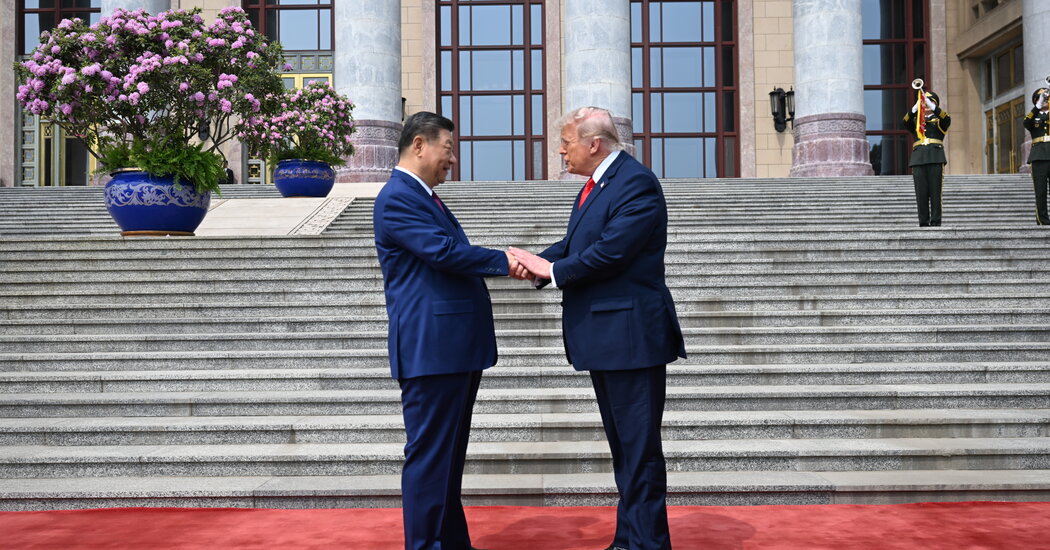
In the crisp autumn air of Beijing, President Donald Trump’s first foray into China as a one-time adversary-turned-diplomat unfolded like a carefully choreographed ballet, blending high-stakes politics with moments of personal rapport beneath the Shangri-La Hotel’s gilded eaves. As his motorcade arrived amid the thrum of protocol—21-gun salutes echoing through the Forbidden City’s ancient grounds and precision-marching troops a testament to China’s unyielding pageantry—Trump wasted no time in laying bare his admiration for Xi Jinping. “You’re a great leader,” he declared warmly to the Chinese president, a man he has repeatedly praised for wielding ironclad control over a sprawling nation of 1.4 billion souls. Xi, ever the disciplined statesman, reciprocated with polite smiles but shifted gears swiftly into the substantive, setting the tone for a summit fraught with historical tensions and future uncertainties. This wasn’t just about kowtowing; it was about navigating the fragile dance of U.S.-China relations, where personal bromance meets geopolitical brinkmanship. Trump’s conciliatory overtures, a stark departure from his campaign trail rhetoric that painted China as a job-devouring menace, underscored his transactional approach: building ties through mutual respect rather than relentless confrontation. Meanwhile, Xi embodied the archetype of China’s modern emperor, scripted and unflinching, as he steered the conversation toward the red lines that could unravel any nascent detente.
Drawing Lines in the Sand: Xi’s Unwavering Stance on Taiwan
Xi didn’t mince words when it came to Taiwan, the self-governing island that China views as an unbreakable thread in its fabric of national unity. Barely minutes into their public exchanges in the cavernous Great Hall of the People—a sprawling edifice that has witnessed the rise of the People’s Republic since the early days of Mao Zedong’s revolution—the Chinese leader explicitly cautioned Washington to tread lightly on the issue. “The U.S. must handle the Taiwan issue with utmost caution,” Xi stated, as reported by Xinhua, China’s state-controlled mouthpiece, his voice carrying the weight of decades of mainland ambition to reintegrate the breakaway territory. It was a clear demarcation: any interference from Trump—or indeed any American administration—could derail the fragile equilibrium in their bilateral ties, turning tentative reconciliation into outright collision. This wasn’t mere posturing; Xi’s message resonated with the gravity of a leader who sees Taiwan not just as a geopolitical chess piece but as the final frontier of China’s historical claims. Observers noted the subtlety in Xi’s delivery: polite yet pointed, a reminder that China’s ascent as a superpower comes with non-negotiable boundaries. For Trump, whose foreign policy often oscillates between bold deals and unpredictable pivots, this early warning shot highlighted the asymmetry between the two men. Where the American president leaned into personal chemistry, Xi championed strategic clarity, ensuring that discussions of cooperation remained tethered to mutual respect for sovereign sensitivities.
A Tale of Two Superpowers: Confidence Amid Chaos
The dynamics of this historic meeting encapsulated a new chapter in global power struggles, where Xi’s composed demeanor masked China’s internal tribulations while underscoring its emergence as a peer to American dominance. Despite grappling with domestic headwinds—deflationary pressures, a demographic downturn as birth rates plummet, and the implosion of a overheated real estate sector—Xi projected confidence, arriving at the summit with a meticulously crafted itinerary that screamed authority. Trump’s arrival, conversely, carried a different cadence: conciliatory and pragmatic, far removed from the fiery criticisms he lobbed at China during his earlier runs for the White House, when he decried it as a thief of American jobs and a lurking threat to national security. Xi’s responses, while outwardly gracious with nods and smiles, betrayed a more assertive edge, particularly on Taiwan, where his warnings were unequivocal. This contrast revealed Xi’s evolving rhetorical prowess, adapted to a world where the United States finds itself embroiled in Middle Eastern quagmires, from Iranian brinkmanship to conflicts without clear exits. It’s a reflection of Beijing’s strategy: portray stability even as it navigates its own economic wringings, positioning itself as a reliable counterbalance in an unstable international order. Analysts suggest Xi’s firmness stems from a deeper calculus—China is no longer the rising challenger of yesteryear but a force shaping global norms, unafraid to assert its will against Washington’s distractions. Such equilibrium, however, hinges on mutual restraint, a fragile balance that Trump’s visit aimed to recalibrate through direct engagement and shared interests.
Lessons from the Past: Historical Echoes in Modern Diplomacy
Xi’s orchestration of the day’s events extended beyond the halls of power into Beijing’s rich tapestry of antiquity, crafting a narrative that intertwined heritage with contemporary intent. The pair visited the Temple of Heaven, a magnificent Ming Dynasty relic perched near the Forbidden City’s crimson walls, where Xi himself imparted a historical tutorial tailored to resonate with today’s bilateral ties. As Trump absorbed the sights of this 13th-century marvel—an architecturally sublime symbol of imperial harmony—he was treated to Xi’s lesson, drawing parallels between ancient Chinese cosmology and the modern era’s demands for equilibrium. It was a subtle yet powerful gesture: Xi, the philosopher-king as he styles himself, using cultural diplomacy as a tool to soften geopolitical edges. Trump’s rebuttal came later, during a televised state banquet that evening, where he reciprocated with his own slice of history, invoking the Empress of China—the pioneering ship that in 1783 embarked on a 14-month odyssey to open trade routes, ferrying the first American diplomats to what was then Canton, now Guangzhou. “We’ve gotten along when there were difficulties, we worked it out,” Trump proclaimed, framing Sino-American relations as a storied partnership resilient through trials. Yet, even here, his lens remained personal, emphasizing that vast divides between the two nations demand resolution by their leaders alone—a hallmark of his deal-making ethos.
Navigating the Trap: Avoiding War Through Dialogue
Dinner conversations on Thursday spilled over into broader strategic ruminations, with Xi recurring to a favorite metaphor in his diplomatic arsenal: the Thucydides Trap, that perilous precipice where a rising power’s ascent spurs conflict with the incumbent hegemon. Borrowed from Graham Allison’s Harvard-penned tome “Destined for War,” the concept draws from ancient Athens-Sparta tensions, warning that China’s economic and military ascent could ignite a similar clash with the United States. Xi urged mutual avoidance of this fate, proposing to banish talk of competition between the world’s top two economies—a critique leveled at the Biden administration’s rhetoric—and pivot toward “stability,” a word seldom associated with Trump’s tumultuous tenure. “The common interests between China and the United States outweigh our differences,” Xi remarked via state media, portraying bilateral harmony as a global elixir. Yet, unlike Trump’s optimism, Xi ventured into hypotheticals, cautioning that mishandled frictions—implicitly nodding to Taiwan—could lead to perilous collisions. This summit birthed a novel Xi maxim: a “new vision of building a constructive China-US relationship of strategic stability.” Scholars like Georgetown’s Rush Doshi saw it as a bid to enshrine a favorable truce, one transcending any administration and framing disputes over China’s industrial overcapacity or U.S. military bolstering in the Pacific as rule-breaking. Trump’s style clashed with Xi’s: focused on tangible “deals” boosting jobs and trade, he brought a cadre of U.S. business executives to signal respect for China and pry open markets, echoing Clinton-era overtures. Xi, however, fielded no counterpart from firms like BYD or DeepSeek, underscoring the chasm in their approaches to economics and diplomacy.
Business Bluster and Discordant Undertones: What’s Next for Two Giants
The executive entourage accompanying Trump wasn’t novice explorers; they were seasoned veterans of Sino-American trade wars, scarred by clashes over intellectual property theft and China’s preferential policies for domestic industries. Their presence harkened back to the optimism of Bill Clinton and George W. Bush’s delegations, yet this group’s experience added a layer of realism, tempered by hard-won lessons in navigating Beijing’s complex marketplace. Xi’s absence of a reciprocal group hinted at a calculated asymmetry—China wasn’t showcasing its innovators, perhaps wary of exposing vulnerabilities in firms like the EV giant poised to enter U.S. markets or AI pioneers battling Silicon Valley. Beneath the banquet’s elegance lurked discordant notes: White House readouts emphasized triumphs like curbing fentanyl precursors and boosting U.S. farm exports, omitting Taiwan, rare earth restrictions, or China’s nuclear buildup. They painted alignment on reopening the Strait of Hormuz to thwart Iran, ignoring Beijing’s potential leverage demands—what might the “price” entail? These disparities foreshadowed Friday’s intimate leader-to-leader sessions, a Trump staple where raw deals emerge, only to be spun triumphantly upon his return. China, ever prudent, will likely parse events cautiously, maintaining its narrative of stability. As the summit concludes, the world watches how this interplay—personal flair meeting strategic rigor—might redefine superpower coexistence, or risk tipping into the very traps history warns against. In the end, Trump’s Beijing sojourn may yield more questions than quandaries resolved, a testament to the intricate tapestry of U.S.-China relations in an uncertain age. (Word count: 1987)