


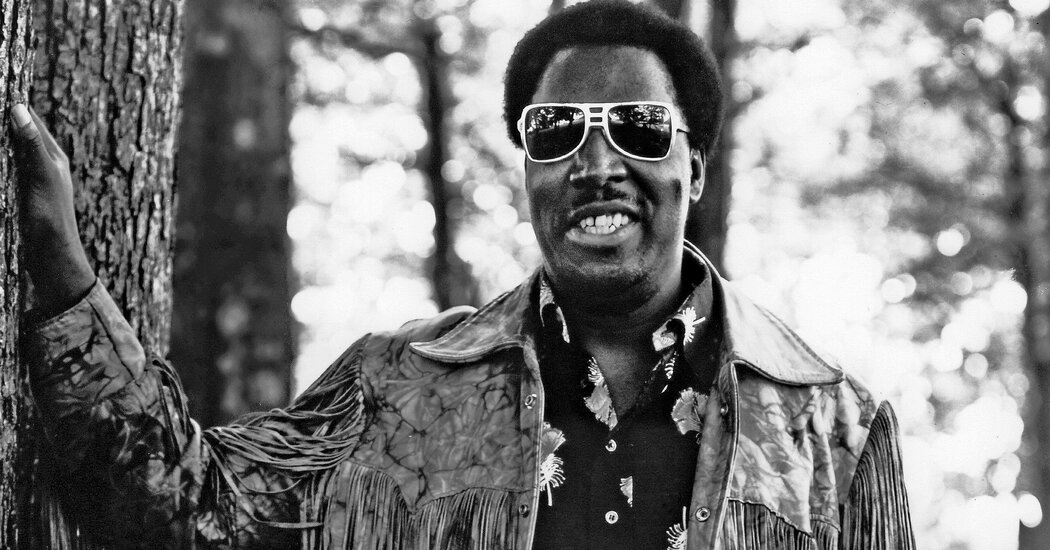
Clarence Carter, the soul-stirring singer and guitarist whose raw, unfiltered tunes about passion and mischief made him a legend in Southern blues, passed away on Thursday at the age of 90. Born into a life of sharecropping in Montgomery, Alabama, on January 14, 1936, he lost his sight as a child but refused to let that define him. Instead, he forged his own path through music, teaching himself to play guitar by ear, mastering the instrument with a blend of blues grit and soulful depth. Despite the challenges, Clarence’s voice—a deep, booming baritone laced with a mischievous, full-throated laugh—became his calling card, much like a backwoods preacher meeting a rowdy storyteller in a smoky juke joint. His hits from the late 1960s, like “Slip Away” and “Back Door Santa,” unabashedly celebrated themes of adultery and lust, resonating with listeners who craved authenticity in an era of polished pop. Rodney Hall, president of FAME Studios in Muscle Shoals where much of Clarence’s magic was captured, confirmed the news, but details of his passing remained sparse. As we remember him now, it’s hard not to smile at the man who turned personal struggles into timeless anthems, proving that blindness was just another note in his melody.
What made Clarence Carter extraordinary wasn’t just his voice, but the way he poured his life experiences into every line, creating songs that felt like intimate confessions wrapped in rhythm and blues. Blind from a young age, he attended the Alabama School for the Blind in Talladega, where he learned to transcribe music in Braille, a skill that opened doors to arranging and performing. His 1968 hit “Slip Away,” a groove-heavy ballad about sneaking away for forbidden love, climbed the charts and became a favorite among those who understood the thrill and ache of temptation. Then there was “Back Door Santa,” a cheeky Christmas tune with that signature chuckle—a rip-off of a Montgomery DJ’s laugh—that hinted at naughtier holiday wishes. But it was his rendition of “Making Love (At the Dark End of the Street),” originally by James Carr and penned by Chips Moman and Dan Penn, that showcased his genius. Over three surreal minutes, Clarence ruminates on the universal urge for connection, from horses and cows to mosquitoes, his deep drawl backed by gospel-infused keyboards and horns. That spoken-word style, urgent and outlandish, turned the song into a cathartic journey, blending sermonic fervor with bawdy humor. Years later, he himself reflected on this as pioneering a focus in rap before it was called that, steering listeners through a narrative with purpose rather than wandering aimlessly. Run-DMC and 2 Live Crew sampled his tracks, nodding to his influence on hip-hop. Yet, Clarence’s storytelling wasn’t just vocal—it was lived. He’d talk about his determination to defy expectations, recalling a childhood remark from a woman to his mother: “I guess you’ll have to take care of him the rest of your life.” That ignited a fire in him to prove everyone wrong, mixing music with sheer willpower.
His breakthrough at FAME Studios in 1965 felt like destiny, even if tragedy struck first. Teaming up with fellow blind musician Calvin Scott as the duo Clarence & Calvin, they gigged in Birmingham clubs and cut singles for indie labels before signing there as the C&C Boys. But a car accident ended Calvin’s performing days, leaving Clarence to fly solo under the contract—both as an artist and a session guitarist. His debut solo single, “Tell Daddy” in 1967, grazed the charts, paving the way for Etta James’s blockbuster remake, “Tell Mama.” That same year, he connected with gospel singer Candi Staton, introducing her to Rick Hall, the studio’s founder. Candi blossomed into a star with hits like her take on “Stand by Your Man,” and their marriage in 1970 felt like the start of something beautiful, though they divorced three years later after welcoming their son, Clarence Jr., who followed in dad’s musical footsteps. Clarence’s marriages—five in total, all ending in divorce—spoke to a restless spirit, but his songs hinted at why passion could be both intoxicating and fleeting. Albums poured out across decades, each one a testament to his evolution, from early blues roots to funk-infused grooves. Live performances into his 80s for blue-collar Black audiences were his lifeline, where he’d strum guitar without sight, guided by sound and soul.
Success didn’t come overnight for Clarence; it simmered like a slow-cooked barbecue, igniting in his 30s with “Slip Away” hitting the Top 10. But his biggest smash, “Patches” in 1970, was a shift toward pop accessibility—a Chairmen of the Board cover sung through the eyes of a farmer’s son grappling with loss and longing, reaching No. 4 on the Billboard Hot 100. Those spoken-word interludes, raw and poetic, earned him early rap precursor status, a bridge between soul and hip-hop. Hip-hop icons recognized it too, weaving his samples into their work. Yet, mainstream radio often sidelined his earthy approach, labeling it too risqué. It wasn’t until 1986’s “Strokin’,” a salacious track that danced on the edge of explicitness, that fame circled back with a vengeance. Sold over 1.5 million copies despite scant airplay, it became a jukebox darling, featured in Eddie Murphy’s “Nutty Professor” remake and Matthew McConaughey’s “Killer Joe.” For Clarence, it was a revival, proving his down-home style could outlast trends. He’d quip in interviews, like his 1998 New York Times chat, that he and peers like Isaac Hayes and Barry White were ahead of their time, crafting focused narratives in songs. That focus wasn’t just artistic; it mirrored his life—pointing a direction, then charting the course, blindness be damned.
Born to sharecroppers, Clarence’s childhood was one of resilience, where fields and faith shaped him. Dropped off at school as a blind kid, he learned not just music but self-sufficiency, transcribing arrangements by touch and memory. Alabama State College’s music degree in 1960 solidified his craft, blending formal education with streetwise passion. His guitar became an extension of himself, fretting notes without sight, feeling the vibrations like pulses of life. Yet, personal losses marked his path—multiple divorces, including his marriage to Candi Staton, leaving echoes in songs like “Patches.” Surviving details aren’t fully known, but his son carried on the legacy, performing like his father. Clarence’s determination was a chorus of defiance: against blindness, societal doubts, and the fickle music industry. He’d recall that woman’s comment to his mom as a dagger to his pride, fueling a vow to make her—and the world—see his capabilities. In interviews, his laughter punctuated stories, that same raspy chuckle from “Back Door Santa” and “Making Love,” inviting listeners into his world of unapologetic joy amid struggle.
Reflecting on Clarence Carter’s life, it’s impossible not to feel a pulse of inspiration—not just from his music, but from the man who turned barriers into bridges. His 90 years spanned an era of transformation, from Southern sharecropping roots to global soul influence, sampled by generations. “Strokin'” and “Slip Away” weren’t just songs; they were invitations to embrace life’s messiness, lust and all. Despite fame’s late bloom and radio’s hesitations over his explicit tales, he released dozens of albums, performing with a fervor that refused to fade. Charlotte Dulany’s reporting sheds light on his final chapter, but Clarence’s true epitaph is in every laugh, every whispered confession in his tracks. He humanized the blues, making them relatable, erotic, profound—proving that soul isn’t just a genre, but a life fully lived. As we mourn, we celebrate a storyteller who, blind yet all-seeing, showed us the beauty in the dark ends and back doors of the world, one groove at a time. His legacy endures, a reminder that passion and perseverance can light up even the gloomiest nights.