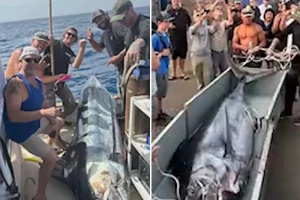





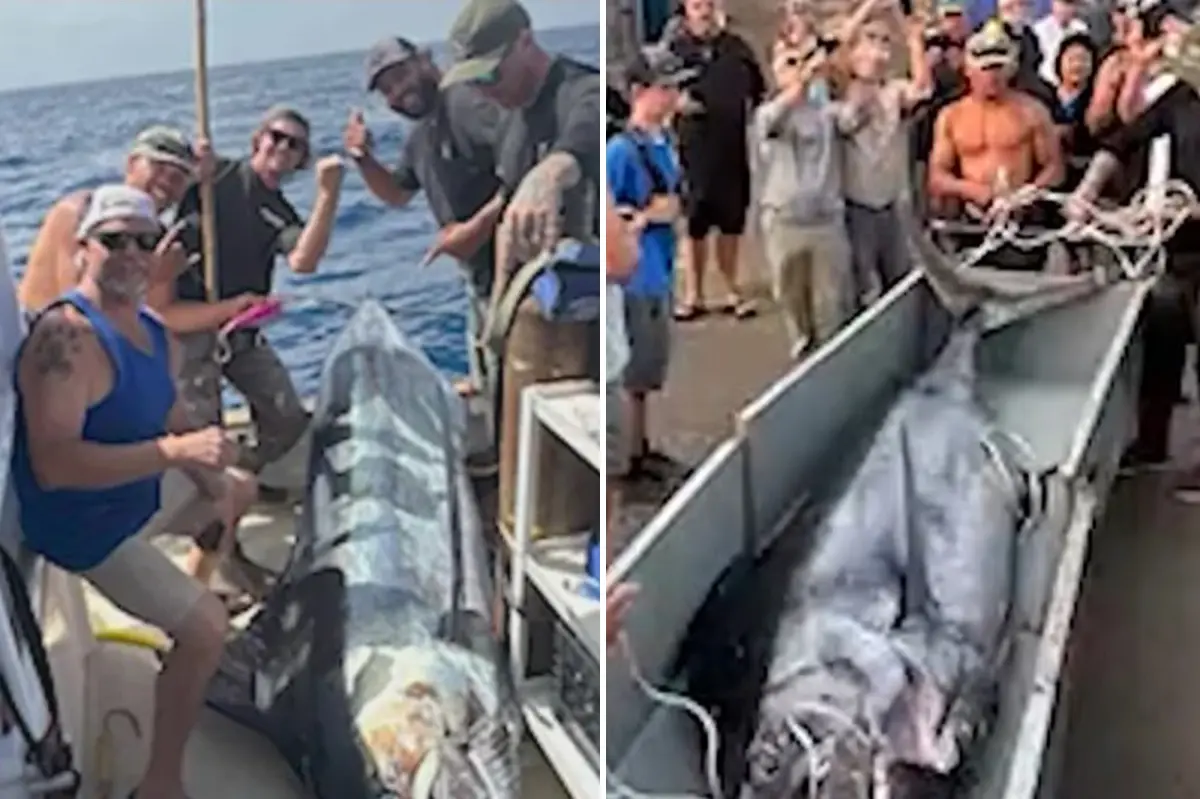
The day began like so many others on the Pacific, with a low sun burning off the morning haze and the steady rhythm of a sportfishing boat cutting through the swells. For Captain Alec Stockfelt, 32, and his crew, it was just another outing off the coast of San Diego—a chance to chase bluewater giants and give their anglers an experience they would never forget. But by the time the day was over, none of them would ever think of it as just another trip. After a tense, exhausting battle that tested both muscle and nerve, the crew pulled a blue marlin over the rail that was so enormous it seemed almost mythical. When the fish was finally hoisted onto the deck, the scale did not lie: 648 pounds. That is roughly the same weight as an adult male grizzly bear, a creature built for raw power and dominance. It was a fish that belonged in legend, yet there it was, lying before them in the cockpit of a 65-foot boat, a shimmering slab of silver and blue that had travelled thousands of miles across an ocean to meet them in the waters off Southern California.
The sheer physicality of the moment is hard to overstate. A blue marlin is not just heavy; it is a weapon of speed and endurance, with a spear-like bill and crescent tail that can turn the ocean into a battlefield. Stockfelt and his crew had been fishing 40 miles offshore, far enough from land that the coastline had dissolved into a distant memory, when the fish hit. The line screamed off the reel, and the fight was on. For a while, the marlin did what marlins do best: it ran deep, then exploded toward the surface, shaking its massive head and throwing sheets of water into the air. There was no room for pride or ego in that struggle, only teamwork. Every person on board had a role, and when the fish was finally brought alongside the boat, nearly everyone had to lend a hand to haul it aboard. It was a chaotic, adrenaline-filled few minutes, with shouts of encouragement, the strain of aching arms, and the shared relief of a prize that had nearly gotten away. In the end, nobody could do it alone, and that is exactly what makes such a catch so memorable: it becomes a story told for years, not because of the number on the scale, but because of the people who were there.
When the marlin was weighed at Fishermen’s Landing in San Diego, the number sent a ripple through the docks. Stockfelt estimated that the previous record for the location was around 598 pounds, meaning this fish had shattered the mark by roughly 50 pounds. For anyone who spends time around sportfishing, records like these are not just statistics; they are part of the oral history of the fleet, the kind of benchmarks that define a generation of anglers. Fishermen’s Landing has been a gathering place for decades, a hub where captains swap stories, mates sharpen gaffs, and tourists watch the day’s catch come in. To own a record there is to place one’s name in the local lore. The weigh-in drew a crowd, and as the scale settled, there was a collective gasp followed by applause. People took photos, asked questions, and marvelled at the sheer size of the fish. For Stockfelt and his crew, it was a moment of pride, but also one of humility. They had been handed a gift by the ocean, and they knew it. The marlin’s death was not taken lightly; in sportfishing, there is a deep respect for the quarry, and fish of this size are often treated with a solemn reverence that outsiders might find surprising. The crew posed with the catch, but their expressions said more than any words could: awe, gratitude, and a quiet awareness of how fortunate they were.
The timing of the catch added an extra layer of drama. Less than a week before, two San Diego fishermen had reeled in a massive 500-pound bluefin tuna, a fish that would have been a new state record in California. Yet because that catch was made under a commercial license, it was not eligible for the record books, which are reserved for sport-caught fish. It was a frustrating technicality for those anglers, who had done everything right and still come up short when it came to recognition. Rules are rules, and in the world of fishing records, they exist to ensure fairness—a way to compare like with like. But that does not make them any easier to accept when you have just fought a 500-pound animal to the boat. The bluefin tuna story had dominated local fishing news, with plenty of people lamenting the fact that a monumental catch would go unrecognized. Then came Stockfelt’s marlin, and suddenly the conversation shifted. Here was a fish that would have beat the bluefin by almost 150 pounds, and it had been caught legally, on sportfishing gear, under the watchful eye of an experienced captain and crew. The disappointment of the commercial tuna catch did not vanish, but it was overshadowed by the joy of a legitimate, record-breaking moment. It was as if the ocean had reached out to the sportfishing community and said: here is something to celebrate.
Scientists and local fishing experts believe this season could be one for the record books for reasons that reach far beyond any single boat. Tommy Gomes, the owner of Tunaville Market, told FOX5 that El Niño weather patterns are responsible for bringing in more exotic sea life than usual. Warmer ocean currents act like a conveyor belt, carrying species from tropical and subtropical waters to new places where they are rarely seen. Fish that normally roam the open Pacific near Mexico or Hawaii are showing up in Southern California waters, surprising anglers and delighting marine biologists. For fishermen, this means a season of strange and exciting possibilities—there is no telling what might show up next. The blue marlin, with its preference for warmer waters, may well have been a visitor from more tropical seas, drawn north by the shifting conditions. The same forces that can disrupt weather and alter marine ecosystems also create moments of wonder for those who spend their lives on the water. Gomes’s comments capture the hope that runs through the fishing community: this is a time of change, and with change comes opportunity. Yet there is also a note of caution in his words, a reminder that El Niño is not just about exotic fish. It is a reminder that the ocean is always in motion, always changing, and that the creatures we chase are not bound by the arbitrary lines we draw on maps. They follow the currents and the temperatures, and if we are lucky enough to cross their path, we had better be ready.
For Stockfelt and his crew, the giant marlin will remain one of those singular memories that define a life at sea. The fish will be remembered not only for its weight, or the record it set, but for the way it brought people together—the shared struggle, the adrenaline, the moment when the scale finally settled and everyone realized they had done something extraordinary. In the world of sportfishing, numbers matter, but they are not everything. What matters more is the story, and stories like this one are passed down from captain to mate, from parent to child, over cold drinks and warm evenings at the docks. The marlin was a prize, but it was also a lesson in humility and respect for the ocean. No matter how prepared a crew may be, the sea always has the final word. This time, the fisherman triumphed, but they knew full well that the ocean only lends its treasures rather than truly surrendering them. As the buzz grows around Fishermen’s Landing and the greater San Diego fishing community, one thing is certain: the memory of this great blue marlin will outlive the moment, carrying with it all the wonder, teamwork, and quiet gratitude that makes such a catch so much more than a number on a scale. It was a once-in-a-lifetime encounter, and for everyone on board, it was a perfect reminder of why they go to sea.