





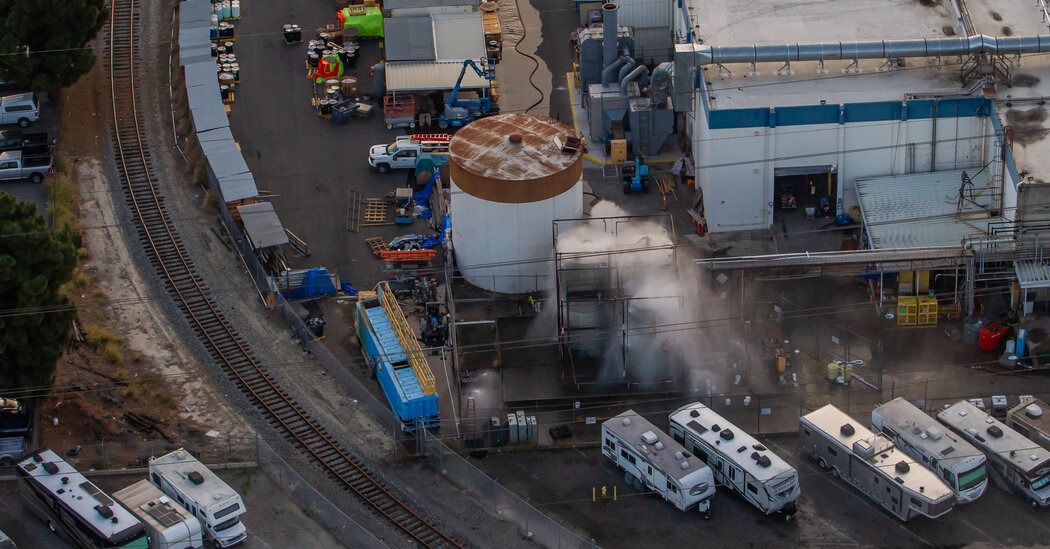
For the residents of Garden Grove, a quiet, sun-drenched suburban community in Orange County, California, mid-week life was supposed to hum with its usual predictable rhythm. Instead, a silent, terrifying countdown began ticking deep within the industrial heart of their neighborhood. Inside a manufacturing facility owned by GKN Aerospace—a prominent British aviation components manufacturer—a massive industrial tank holding approximately 7,000 gallons of highly volatile methyl methacrylate began to undergo a violent and unplanned chemical transformation. Methyl methacrylate is a compound vital to our modern world, serving as the raw foundation for high-strength acrylic plastics and shatterproof plexiglass, but in its raw, liquid state, it is a temperamental beast. On Thursday, an internal reaction began to trigger a rapid buildup of pressure and heat inside the colossal container, transforming the manufacturing plant into a potential bomb site. As the chemical mixture grew increasingly unstable, it began releasing toxic, highly flammable gases capable of producing a devastating, catastrophic explosion. The sheer scale of the threat was immediate and terrifying: a single spark or a structural failure could unleash a deadly shockwave and a toxic cloud over a densely populated region, instantly turning a standard workday into a historic municipal disaster.
In the face of this invisible, encroaching danger, the first responders of the Orange County Fire Authority and neighboring districts found themselves stepping directly into the path of an invisible gargoyle. Led in this frantic defensive action by Interim Fire Chief TJ McGovern, crews immediately initiated a desperate, high-stakes cooling operation, relentlessly dousing the swelling metal cylinder with thousands of gallons of water in an effort to absorb the escalating thermal energy. However, the crisis quickly escalated from a mechanical emergency to an administrative nightmare when GKN Aerospace’s engineers discovered that the critical safety valves on the tank had suffered multiple mechanical failures. This meant that the specialized chemical inhibitors and neutralizing agents—the industrial equivalent of a chemical fire extinguisher—could not be injected into the heart of the mixture to stop the runaway chain reaction. Chief McGovern, visibly worn by the gravity of the unfolding situation, described the crisis as entirely “unprecedented,” noting that no hazardous materials team had ever been forced to confront this specific chemical under such highly volatile, unmanageable conditions. For several agonizing days, the community held its breath as a small army of firefighters stood as a wet shield between a volatile chemical reaction and the homes of tens of thousands of sleeping families.
The tipping point of this quiet war occurred under the cover of darkness on Saturday night, during a daring recon mission that felt more like a scene from a blockbusting suspense film than a municipal safety check. At approximately 8:30 p.m., as the ambient temperature inside the tank climbed to a blistering 100 degrees Fahrenheit—the absolute maximum limit that the tank’s external monitoring gauges could physically register—a select group of courageous firefighters slipped deep into the exclusion zone. Armed with protective gear, infrared sensors, and a profound sense of duty, they braved the immediate blast zone to inspect the physical integrity of the swelling steel structure and adjust the water cannons. As they drew close to the vibrating, heat-radiating cylinder, they made a startling and highly significant discovery: a small, hairline crack had formed along the exterior shell of the tank. In a sudden twist of fate, the team noticed that no toxic liquid was seeping from the fissure. This tiny, structural fracture, which would normally signify imminent disaster, was quickly reinterpreted by disaster strategists as a miraculous safety valve. Rather than triggering a massive, uncontrolled rupture, the crack appeared to be slowly venting the built-up internal pressure, offering the emergency crews a sudden, unexpected path toward neutralizing the threat.
From a scientific standpoint, this mechanical fracture represents a delicate, high-stakes gamble between a traditional explosion and a controlled containment failure. Analytical chemists, including Assistant Professor Elias Picazo from the University of California, had spent the preceding hours warning of a catastrophic “thermal runaway”—an existential hazard where an increase in temperature changes the conditions of a reaction to cause a further increase in temperature, leading to a violent, unavoidable blast. However, the presence of the crack, combined with the extreme heat, suggested another fascinating possibility: the highly volatile methyl methacrylate might actually be solidifying, turning from a highly pressurized liquid gas into a solid, inert block of plastic. If the chemical inside is indeed undergoing polymerization and hardening within the tank, the threat of an explosive vapor cloud drops precipitously. Dr. Picazo explained that while this solidification process is notoriously unpredictable, it represents the absolute “ideal” outcome for the technicians on the ground, as a solid block of acrylic poses no explosive hazard and gives the emergency management teams the luxury of time to safely open, dismantle, and neutralize the remaining active compounds.
While scientists and firefighters calculated chemical equations and structural stresses in the dirt, the true human cost of the crisis was paid on the pavement of Garden Grove’s evacuated streets. Following a sweeping state of emergency declaration by California Governor Gavin Newsom, local authorities issued mandatory evacuation orders that abruptly displaced more than 40,000 residents, transforming bustling neighborhoods into eerie, desolate ghost towns. Among those cast into sudden exile was Erika Ocana, a local mother who lived just a brisk five-minute walk from the GKN Aerospace plant. When the sirens wailed on Friday, Ocana was forced to pack up her life in a matter of minutes, fleeing her home with her four children, three family dogs, and a cat packed into their vehicle. In the stressful days that followed, her thoughts remained anchored to the streets she left behind, plagued by the agonizing uncertainty of whether her house, her neighborhood, and the lives of her closest neighbors would still exist when the evacuation orders were finally lifted. As the days dragged on, the psychological toll on these displaced families grew heavy, sparking concerns among officials that desperation might drive some evacuated citizens to bypass barricades and return home prematurely to rescue forgotten belongings.
Despite the thick canopy of anxiety hanging over the Orange County basin, a robust and reassuring network of environmental safety nets has worked tirelessly to protect the health of the public. Operating in close partnership with the federal Environmental Protection Agency (EPA), regional air safety experts like Dr. Jason Low of the South Coast Air Quality Management District deployed an invisible shield of 24 sophisticated mobile monitoring stations around the perimeter of the evacuation zone. To the immense relief of city administrators and anxious families alike, these advanced sensors have consistently reported completely normal air quality levels, confirming that no toxic gases or dangerous volatile organic compounds have escaped into the surrounding atmosphere. Harry Allen, an on-scene coordinator for the EPA, offered a soothing voice of scientific certainty to a rattled community, promising that these round-the-clock sniffing stations would remain active and vigilant until the site is declared permanently secure. Supported by a unified task force of elite hazardous materials teams from Los Angeles, San Bernardino, Orange County, and Long Beach, the collective effort has successfully kept a terrifying industrial crisis contained, transforming a potential tragedy into a profound testament to California’s resilience, scientific precision, and frontline bravery.