




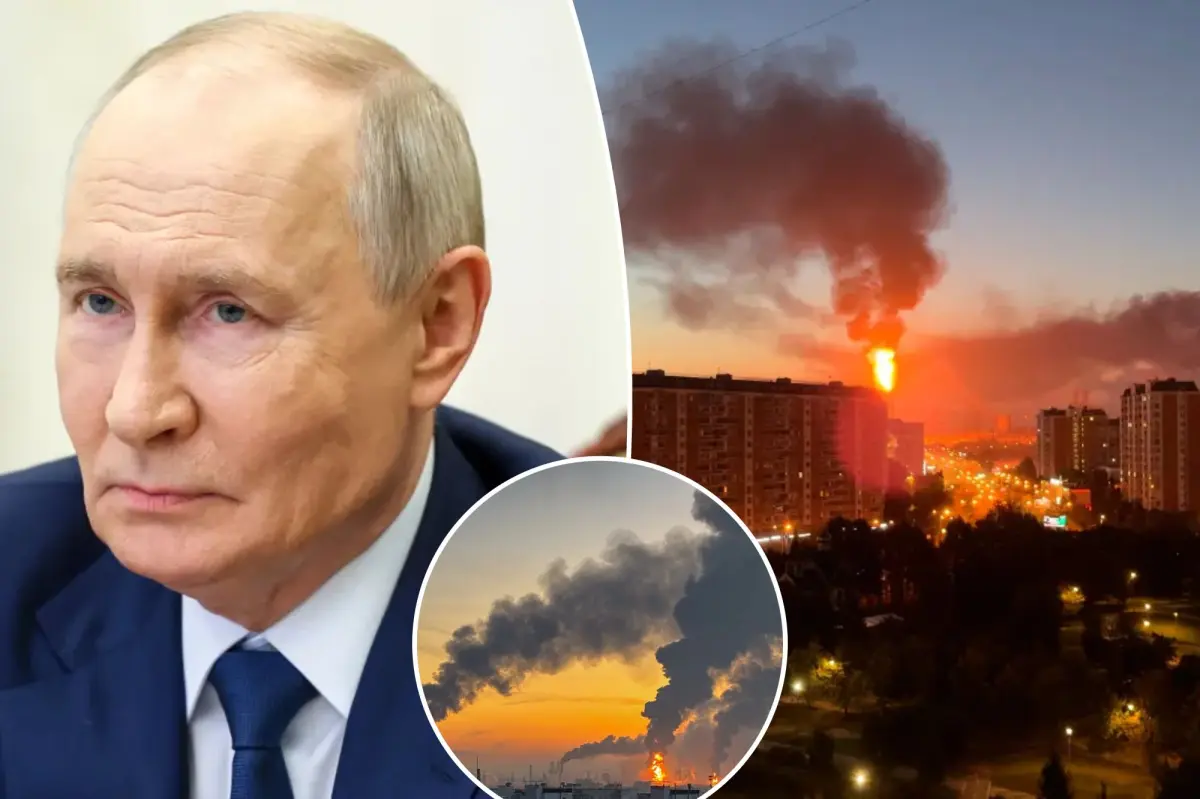
The cold is already beginning to settle over Ukraine, and with it comes a fear that has become all too familiar. After nearly five years of war, after countless nights spent in basements and subway stations, after the endless grief of funerals for soldiers and civilians alike, the people of Ukraine are bracing for what may be the harshest winter yet. According to a report from The Post, Russian President Vladimir Putin has privately told American officials that he intends to escalate his attacks on Ukraine, and the warning comes on the heels of a stunning Ukrainian drone campaign that has struck nearly all of Russia’s major oil refineries. Putin’s message, as described by a US official, was simple and chilling: “Now it’s our turn, and we’re going at them.” For Ukrainians, those words are not abstract geopolitics. They are a promise of blackouts, frozen pipes, and the terrifying hum of incoming missiles. The United States, under President Trump, has urged Ukraine to stop hitting Russian energy infrastructure, worried about soaring diesel prices and the risk of a broader conflict. But Ukraine, exhausted and defiant, has not listened. In fact, Ukrainian forces just launched their largest-ever drone attack on Moscow, striking the city’s main oil refinery and sending plumes of smoke into the sky over the Russian capital. The message from Kyiv is clear: if Russia is going to make winter unbearable, Ukraine will make sure Russia feels pain too.
The drone campaign is not a random act of aggression. It is a desperate, calculated strategy to cut off the money that fuels Russia’s war machine. Ukrainian strikes have hit all of Russia’s main oil refineries this year, along with many mid-sized facilities, in an effort to bleed the Russian economy and force the Kremlin to reconsider its war aims. The damage has been staggering: 27 of Russia’s 32 largest refineries have reportedly been hit, causing an estimated $20 billion in damage and helping push global diesel prices to nearly double what they were before the offensive began. For the hawks inside Ukraine’s military and political establishment, these attacks are one of the few levers Ukraine has to shift the course of a war that has ground into a brutal stalemate. The US official who spoke to The Post said that these hawks have “carried the day” in pursuing ambitious targets deep inside Russia, and that Putin’s response is now inevitable. “And now he is going to fire back, and that can’t be stopped,” the official said. There is a human cost to this strategy, and it is not only felt in Russia. Across Ukraine, families are preparing for another winter of uncertainty, knowing that their leaders have chosen a path of escalation in the hopes of ending the war sooner. The logic is cold: make the war so expensive for Russia that Moscow has no choice but to negotiate. But the reality is that every drone launch is also a gamble with the lives of millions of people who just want to turn on the lights, heat their homes, and sleep through the night without fear.
Beneath the surface of missiles and drones, there are signs that the conflict may be closer to some kind of resolution than many people realize. The same US official who warned of Putin’s impending retaliation also said that Putin and Ukrainian President Volodymyr Zelensky are “closer than people think” to ending the conflict. The problem, as ever, is land. Putin, a former KGB agent who has spent decades fixated on restoring Russian power, still dreams of completing the conquest of the Donetsk province. Its northern towns are heavily fortified by Ukraine, and the fighting there has been some of the bloodiest of the war. “The territory is the primary point of resistance for Putin,” the official said. “That’s really the issue.” It is an issue that carries enormous human weight. Every square kilometer of land is measured in the lives of soldiers who have been ordered to take or defend it, and in the families who have been forced to flee their homes, unsure if they will ever return. Zelensky, for his part, shows no signs of surrender. At the United Nations General Assembly, he told world leaders that Ukrainians know the coming winter could be harsh, but that they will not give up. “In response, we will have no choice but to make it painful for Russia too,” he said. This is the grim arithmetic of a war where both sides have learned to inflict suffering, and where peace seems to require someone to give up something they believe they cannot live without.
Diplomacy, meanwhile, continues in the corridors of power, even as the bombs fall. Trump met with Zelensky in New York this week and agreed to extend a lifeline by allowing Ukraine the license to use Patriot missile defense systems. But these new capabilities will take time to manufacture and deploy, and time is something that winter does not provide. Behind the scenes, special envoy Steve Witkoff has been shuttling between Ukrainian officials and Kremlin representatives, sharing dinner with some and meeting in quiet rooms with others. Trump’s son-in-law, Jared Kushner, has also been involved, along with Kremlin envoy Kirill Dmitriev. Secretary of State Marco Rubio met with Russian Foreign Minister Sergey Lavrov, and afterward suggested that both Russia and Ukraine have expressed interest in a limited ceasefire involving grain and energy targets. “Obviously, that won’t be easy either,” Rubio admitted. There is a strange intimacy to these negotiations, a sense of men who have spent years locked in a deadly struggle but who can still sit in the same room and talk about the rules of war. Trump has repeatedly blamed the impasse on the “hatred” between Putin and Zelensky, alternately pressuring both men to make a deal. At the United Nations, he delivered a simple appeal: “It’s time to stop the killing.” But the killing does not stop, and the hatred does not fade, because the war has become woven into the identities of both nations. For Ukraine, giving up land means giving up meaning. For Russia, giving up conquest means admitting that the sacrifices were for nothing.
As the temperatures drop, the human toll of this conflict is about to become even more visible. Ukrainian Energy Minister Denys Shmyhal has said that Russia is planning to knock out Kyiv’s energy systems during the winter, a strategy that has been used before and will be used again. On the sidelines of the UN General Assembly, Ukrainian officials and their allies told The Post that the war is about to get much worse as freezing temperatures approach. This is not just a matter of political strategy; it is a matter of survival for ordinary people. Across Ukraine, there are mothers who will have to choose between feeding their children and finding wood for the stove. There are elderly people who have already survived one winter without heat, without water, without medicine. There are soldiers who will come home from the front to find their homes dark and cold, and then go back to fight another day. The winter is not just a season in this war. It is a weapon. Russia has used it before, targeting electrical infrastructure to break the will of the Ukrainian people. And now, with Putin vowing to escalate, the fear is that this winter will be the cruelest yet. Zelensky’s promise to make Russia suffer in return is not a call for revenge; it is a reflection of the terrible choice his country faces. If Ukraine shows weakness, Russia will press forward. If Ukraine fights back, Russia will respond with even greater violence. There is no safe path, only a path forward through the darkness.
There is a cost to this war that goes beyond the physical destruction, and it is felt most deeply in the faces of the people who remain. Ukraine, already one of the poorest countries in Europe, has lost a significant part of its population to emigration and war deaths. The young have left, the old have stayed, and the dead cannot be replaced. Even if the casualties inflicted on invading Russian forces are believed to be higher, Ukraine is bleeding its future. The US official who spoke to The Post put it bluntly: “They’re valiant and courageous, but the demographics are not on their side.” These are words that carry the weight of a country’s tragedy. For every Russian soldier killed, there is a Ukrainian soldier who will never come home. For every missile destroyed, there is a child who will never know the sound of silence. The war has already become one of the longest and bloodiest conflicts in Europe since World War II, and there is no end in sight. Yet even in the midst of this despair, there is something remarkable about the resilience of the Ukrainian people. They have lost homes, livelihoods, and loved ones, but they have not lost their sense of who they are. They still gather in underground shelters to sing songs. They still plant gardens in the spring, even if the fields are full of mines. They still hope, because hope is the only thing that cannot be destroyed. The path to peace remains uncertain, and the road ahead is lined with the graves of the brave. But in the words of one American official, Putin and Zelensky are closer than people think. Perhaps, after all the years of suffering, the end of this war will come not with a thunderclap, but with a quiet recognition that neither side can win and that the dead have already paid the price. Until then, the world watches, the winter approaches, and the people of Ukraine hold on.